Taxing public servants (nationally and internationally)
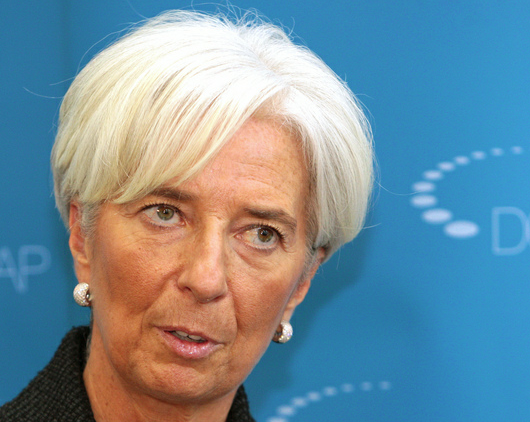
Scandal! Christine Lagarde, managing director of the IMF, pays no tax! How can this be when she’s lecturing more Greeks to pay tax!?! Story from The Guardian here.
Sony Kapoor, so often the voice of reason throughout the Eurozone crisis on Twitter, stated “IMF staff don’t, period!” prompting all kinds of follow up on Twitter, bringing EU officials into the mix too.
For me there are two issues here: the first, and frivolous one, concerns Lagarde herself. IMF (and indeed UN) rules mean officials there do not pay tax in the country in which they are resident, and so be it. Looks odd, but those are the rules. She is not paying tax because she does not have to. The second issue is to why is this the case and – importantly – what should be done about it.
Let’s start first of all at the national level.
If you’re a national civil servant, working in a regular ministry in France or the UK or anywhere else you pay tax like anyone else. You are an employee of the state, but you pay tax like anyone else. So when I worked for the Department of Trade and Industry (DTI) in the UK (as was, now it’s BIS) I earned in the region of £28000 a year, and took home a net salary of about £21400 or £1780/month. This leads to two issues: practical and ethical. Essentially the state was paying DTI cash, a portion of which was then returned to HM Revenue and Customs. At an administrative, practical level is this sensible? Would it not be simpler to just pay me £21400? I don’t know. But at an ethical level it is surely better I see the gross and net payments. As a taxpayer I can have some grip on how much I am contributing to the collective endeavours of the state, and I have something I can compare with friends working outside the public administration. So – on balance – civil servants paying national taxation, rather than just getting a net salary, seems to make sense.
Then try to apply this internationally. I’m going to try to do this on the basis of the principles of taxation, not Article 34 of the Vienna convention.
Where should Lagarde actually pay tax? She is resident in Washington D.C., as most of the IMF’s staff are. So it would make sense that taxation relating to her residence there – local tax for maintenance of the streets, refuse collection etc. should be paid. Taxation relating to her residence there, in so far as this impacts her everyday life, should also be levied – for hospitals, schools and police for example.
But then it gets a bit more murky. What about social security? As a posted official she would not be entitled to unemployment assistance in the USA in the event of the termination of her contract. Likewise she would not be likely to reside in the USA after retirement, so it could be argued that pensions contributions – in so far as these are managed by a state – are superfluous.
Add onto that the language complexities of international posting, most notable in for the children of EU officials in Brussels, who can send their children to Commission-run European schools rather than to local state funded Belgian ones. Should these officials then contribute to the education budget of the Belgian state? (in reality these schools are paid for from the Commission’s community tax – see bottom of this page). In Brussels there is the additional complexity that institutions do not pay local tax on office space, a matter that caused controversy when the Commission moved into the Madou Tower, located in one of the poorest communes in Belgium. Undoubtedly there will be similar complexities in Washington D.C., Geneva and anywhere else with major international institutions.
There is also the additional complexity of the amount of time a person working for an international organisation is posted there. Within the EU a worker in the private sector can be ‘posted’ for up to two years before having to sign in fully with the country where they are temporarily resident. Should there be an equivalent for officials posted to international organisations, where the length of service determines where taxation should be levied?
Right then, so what is the answer? I’m afraid I do not think there is a simple one. It is clear that Lagarde and people in the same situation as her (including US Embassy officials in London!) should pay taxes where they are resident because they call on the services of that place, and it is important that all citizens contribute. But exactly how much and for what purposes is a much harder issue to determine for the multitude of reasons I have explained above.
That’s of course all a lot more complex than having a quick rant at Lagarde!
All public workers should pay tax, as it ensure a transparent and level playing field with the private sector. You should note that tax avoidance is especially beneficial for those on high salaries where the tax burden is the greatest. There seems to a pervasive and rather pathetic justification made by high earners that they somehow work harder than everyone else and that their salaries are entirely justified. Of course this is not true and the highest earners primarily achieve their above average incomes through enhanced opportunity, commonly handed down to them through a privileged up bringing. Employees of the IMF, World Bank, OECD and Council of Europe are all tax exempt and this totally undermines their authority and makes society hate the political classes. Tax avoidance for senior ranking civil servant bureaucrats is nothing other than corruption of the highest level. Please don’t confuse it with anything else.
Jon, for me the most interesting reference in this post is the Posted Workers Directive.
This Directive is a total disaster and every Member State interpretes it in their own way. I know dozens of people in Belgium who have been ‘posted workers’ for more than five years, yet are not part of the Belgian tax or social security system (normally because of the impact on their net income!).
Indeed, my own situation is bizarre in that the Belgian authorities recognise me as a UK civil servant for the purpose of tax etc, whereas the UK government only consider me a local government officer. I think we all know many people in Brussels in strange tax situations.
Thanks for this very balance piece, Jon. As you say, its not an easy one to answer. It seems to me that there are all the other ways that posted officials contribute to the local economy that nobody in the media wants to take into account – the cost of living here in Brussels is certainly higher than in the UK, I contribute every day of my life to the Belgian economy by buying goods and services here etc. It also ignores the fact that the Belgian national system is FULL of all sort of incentives for nationals – Belgium might have 50% tax for all, but very very few actually pay it, and many workers get perks of all sort, from company cars to luncheon vouchers…Yes it is complicated, and that is why it is so much easier to point the finger instead. Having said all of that, I plan to spend the rest of my career here, if I can, and it wouldn’t bother me in the slightest to pay some additional forms of local tax – why shouldn’t I, indeed.
John, thanks for this nice overview!
EU-officials do pay income tax to the EU itself, not in the country where they happen to be posted. We therefore contribute directly into the EU budget as a whole (some say we pay tax in all Member States in that way!).
The fact that we do this makes sense so all EU officials receive equal payment independent of the place where they work. Similar to national officials (whether they work in Glasgow or Liverpool, Amsterdam or Rotterdam, etc.).
We have no diplomatic status (apart from the very top brass) and do pay all other taxes and VAT. Some host countries offer something extra on their own initiative. Belgium allows for a first 12 months after entry into service (and one time only and one piece only) to buy goods for your household without tax. Luxembourg allows this apparently for cars every now and then.
We have no other immunity, we pay fines for louzy parking and speeding as everybody else, if we commit a crime we go to jail, etc.