@WilliamJHague on Twitter – governmental and party political, and in contravention of the Ministerial Code
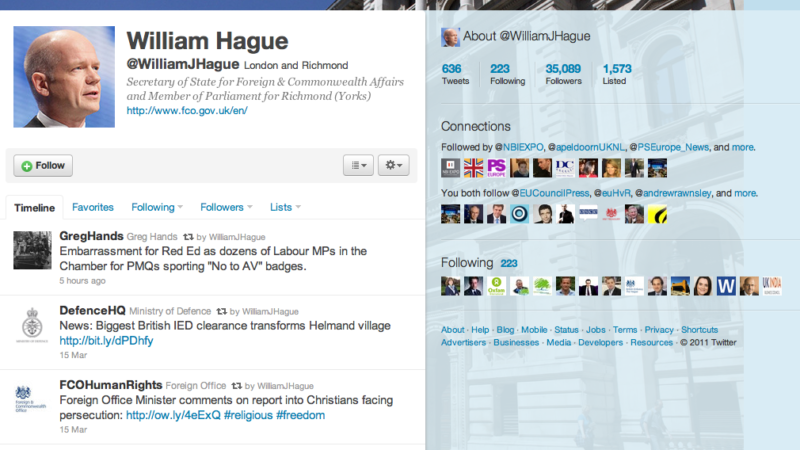
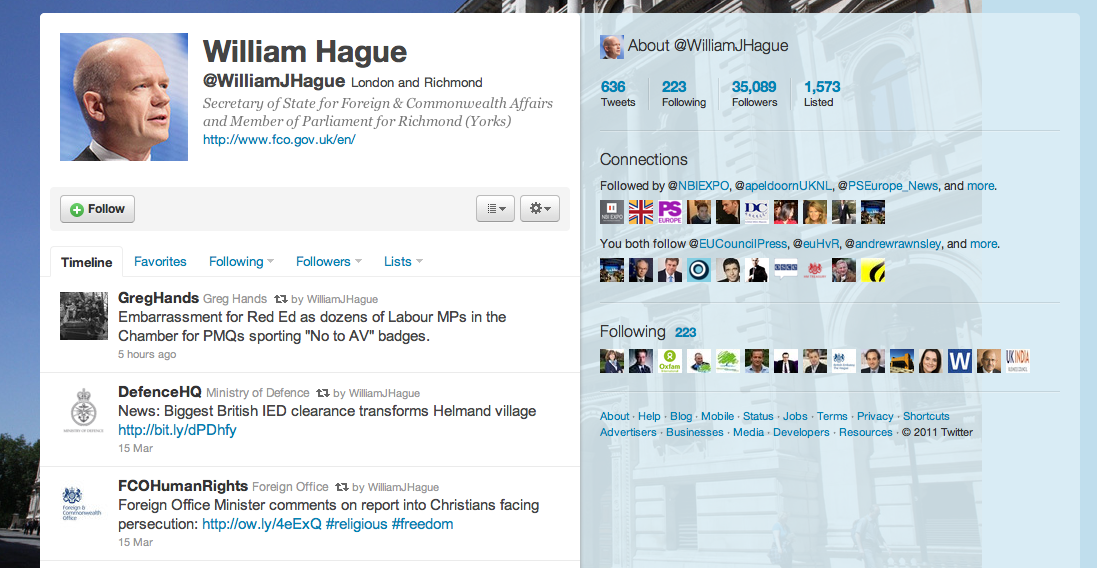
The screenshot above was taken at 1719 today, showing William Hague’s Twitter account, @WilliamJHague. It’s worth noting the three tweets present at the top, shown in more detail here:
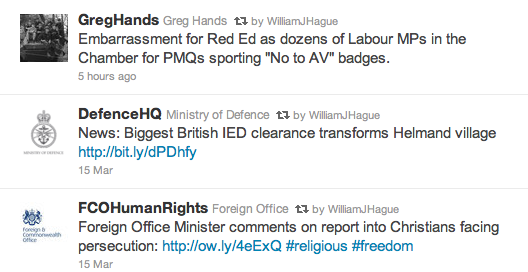
The first tweet is explicitly party political, while the second and third are retweets of governmental business.
The Hague account states first and foremost that he is Foreign Secretary, the background image is the main FCO building on King Charles Street, and most of the content is for explicitly FCO purposes. The Q&A sessions about foreign policy that are done using the account are mentioned – officially – on the FCO website. See this report from 10th February for example.
So is this account governmental, or party political? Today’s screenshot proves that it is both.
There is no doubt that Hague’s influence on Twitter – his number of followers – is in part due to the Q&A sessions, and as these are linked from the FCO site this means FCO staff time has been involved in running and publicising them. FCO staff resources have been used. Hague then uses this extended reach to make party political points…
This is clearly in contravention of point 6.1 and point 6.3 of the Ministerial Code (PDF here, p.12):
6.1 Facilities provided to Ministers at Government expense to enable them to carry out their official duties should not be used for Party or constituency work
6.3 Official facilities and resources [my emphasis] may not be used for the dissemination of material which is essentially party political
So what is the solution? Either Hague must make his account explicitly governmental (no party political points) or he must cease to use any FCO resources to assist with any of his work on Twitter, and all links and references to the account should be removed from the FCO website.
Additional FCO resources are not being used.
@Guido – I don’t agree with you. Clearly FCO staffing resources are being used here.
But the main point is that the rules governing this are far from clear – party, governmental and, while we’re at it, comms allowances for MPs. I’ll write a follow up blog entry about that when I get a moment.
Politicians, of all sides, often say one thing in opposition and do the other in government. It’s part of the game. Picking on Hague for potentially contravening the ministerial code for his use of social media will not resonate much with the broader public. There must be better targets than that. Take holding cabinet meetings outside London – the Tories attacked Labour for (re)introducing them at great expense to the taxpayer when in opposition. Now they are in government, they suddenly change their minds..! plus ca change.. mon ami 🙂
Does Hague have two phones on his desk, one of which is for party business, one of which is for foreign office calls? Does he have to be careful which pencil he uses when making notes?
It strikes me you’re confusing the medium and the message–Hague’s party political tweets are not prepared by FCO officials.
As far as the code goes you are grasping at straws:
Twitter is not a “Facilit(y) provided to Ministers at Government expense” or an “official…resource”. It’s a free service from the private sector.
That leaves you taking the rather bizarre line that Hague’s “influence on Twitter” is in some sense an “official resource” because it rests in part on work done by officials, and that it his “reach”, rather than Twitter itself, which should be seen as the vehicle of dissemination.
But Hague’s influence or reach in any medium depends in great part on the fact that he is foreign secretary, so you might as well argue that he can’t make any party political statements while in office except on a face-to-face basis.
Just because it is linked to from the FCO website doesn’t make it official, any more than if they gave out his personal phone number would it become his work number.
I’ve looked at these things before – when taxpayers pay their mobile phone bills should they be allowed to Tweet from them etc.
It *was* his personal account, before the election. But it has now been officialised, is linked from the FCO website, and promoted there, and used for FCO Q&As on foreign policy matters.
The official @foreignoffice account is in addition to the Hague one.
Isn’t it his personal Twitter a/c? It predates him becoming ForSec.
There is an offical @foreignoffice Twitter a/c.
Oh, to an extent I agree, and one of the things that caused Huhne to plummet in my opinion was the way he went on about the costs of Milliband’s blog using incredibly dodgy accounting and inflating the numbers horribly. For some, I’d have said simply “idiot doesn’t get it” but Huhne did–he deliberately played politics with startup vs running costs and similar and it really annoyed me.
And I called him on it, publicly.
I really don’t like it when anyone starts to point score on politicians using communication methods effectively, especially when it’s people I normally agree with.
Tories are arseholes. Hague, who I’ve met, is an arsehole. Stick to attacking him for being an arsehole, or even for being a hypocrite, I’m good. But this? Nah, he’s talking to people, and actually doing it quite effectively.
Or the ministerial code needs clarification and rewriting, I find the idea of splitting ‘work’ and ‘personal’ accounts up one that works for some, but not others, Hague was using his personal account clearly during the campaign, and now uses it in his job, I’m fine witht hat.
Whether it’s an actual or in spirit breach of the rules is debatable (and I think you’re probably worth, but others won’t), in which case the solution is to work out if the rules are right, and if not what should be done to them.
I like that senior politicians, of all parties, are engaging well online, but it will mean we, and some of the rules, will need to adapt.
And sometimes they’ll get it wrong, and we’ll decide the rules are correct, or need to be clarified and tightened. So be it. In this case, I don’t think it’s an in spirit breach, even if it is an actual breach, Twitter costs nothing, and links cost virtually nothing.
I would agree with both of you if the Tories hadn’t been such pains about this sort of thing to Labour. They were whining and griping the moment there was any grey area, only for people like Hague to then create big grey areas of their own.
I’ve often argued here that the party-administration balance is not right in the UK, but the rules are – for now – the rules and part of opposition is to point out when Tories, defenders of the parliamentary status quo, break them.
He may well have broken the code, but the code is an ass.
I’m sorry John, but I reckon there’s something almost anti-political about chasing down minor ways that public resources are used for political benefit (and I’m not really sure if Hague or the Tories get much benefit from indulging in minor bits of political snook-cocking on Twitter anyway). And this is a VERY minor infraction indeed.
I reckon that if you win an election, you should be given as many government resources as you want to say what you want. You’re elected as a politician and it’s ludicrous that you’re not allowed to behave like one.
Given the opportunity to speak their minds, they’re as likely to weave their own nooses as they are to turbo-charge their careers anyway