So that was a Presidency Press Trip. I’m feeling rather empty.
At one level it has been a privilege to attend the Danish Presidency Press Trip for the past four days. I’m the first blogger ever to have been allowed to attend, and hopefully not the last. But the whole experience leaves me feeling a little empty, although not quite for the reasons that may be immediately obvious.
Let’s start with what works well. The trip – from my point of view – was impeccably organised. Wifi in all venues, buses to get us everywhere, staff on hand to answer any questions we had. I’m waiting for the Foreign Ministry people to confirm the budget for the trip to me, but it will not be excessive for the journalists trip alone – beyond flight and hotel costs there were not too many other direct expenses. There was some pleasant food, but beyond that most of the events were either provided free, or the press people attended things that were happening anyway. As Jakob Alvi from the Danish Permanent Representation pointed out to me, this is only one of dozens of press visits that the Danish government supports during the Presidency and, for trade or tourism purposes, at other times too.
This then is a critique of a system, not a critique of the specific event I attended.
A key problem lies with the cosy yet dysfunctional relationship between the press, and the administration and politicians. Over the course of the four days we received on the record briefings from 9 ministers in the Danish administration: Margrethe Vestager, Villy Søvndal, Bjarne Corydon, Morten Bødskov, Morten Østergaard, Ole Sohn, Mette Gjerskov, Martin Lidegaard and Nicolai Wammen, and had off-the-record discussions with a few more at a dinner. In addition we heard speeches from Helle Thorning-Schmidt, Donald Tusk, Jerzy Buzek and José Manuel Barroso, and attended a press conference with Thorning and Barroso. We also heard from more than a dozen leaders of businesses of various sorts, with Claus Meyer (founder of Noma) the only one to truly stand out.
That sort of access is unprecedented. However it also seems to be rather useless.
The on the record briefings from ministers were remarkable mostly for their complete absence of content. 8 of the 9 ministers (Agriculture Minister Mette Bjerskov being the only exception) gave little more than simple summaries of the Presidency priorities. The Q&A sessions with the ministers were little better. Søvndal at least showed a little more passion and determination for some issues than others, and was willing to say so when he didn’t know the answers, and Wammen coined the phrase that this was the tap water (i.e. discount) Presidency. But sat writing this blog entry now I cannot recall a single thing Corydon, Bødskov, Østergaard, Sohn or Lidegaard said.
Oddly I don’t actually know who is wasting whose time here. We used up more than 10 hours of ministerial time – could these people have been doing something more useful? Yet conversely 60+ journalists sat and listened to hours of this. Could they have been doing something more worthwhile?
“Why do you bother listening to all of this?” I asked a veteran of a number of these press trips. “In Brussels we wouldn’t,” he said, “but here we’re the guests of the country holding the Presidency.” Why then, I asked, bother to come at all? “To make contacts,” he said, going on to say that these were made in the margins. But surely there is a more efficient way to achieve the same result?
There is also undoubtedly some educational aspect to the event. One correspondent I spoke to had only been in Copenhagen once before – for the UN Climate Negotiations – and was happy to use this trip to heal the scars from his previous visit. Many others had little knowledge of Danish politics and society beyond Forbrydelsen, one even raising the idea of making a ‘Danish politics 101’ presentation at the start of the trip. My knowledge of Denmark and Danish politics, and an excellent Twitter network giving me the gossip on the politicians we were meeting, meant I knew more than the average. But I am a politics nerd I suppose.
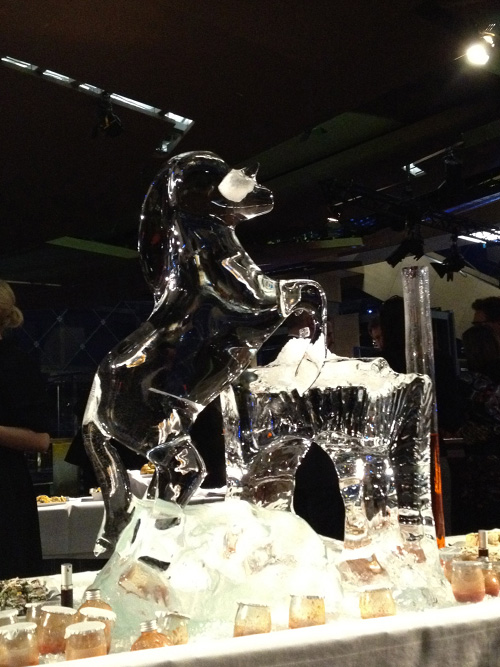
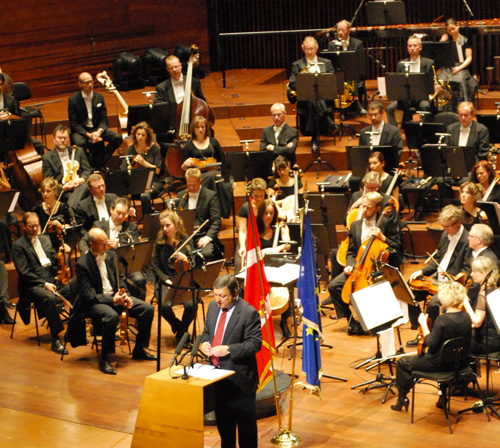 The press trip was timed to coincide with the joint meeting of the College of Commissioners and the Danish Government, and the opening ceremony of the Presidency. This was a gala concert at the DR Koncerthuset. The event was a mix of short speeches and classical music played by the DR orchestra, yet the audience was confined to the high and mighty of the Copenhagen political elite. The hall seats 1800 but it was only about a quarter were full. I’m not sure a classical music concert is something for mass public consumption, but here was an opportunity to show a slightly wider audience a little more of the spirit of the Presidency, and this was missed. Here Wammen’s notion of a discount Presidency was not much on show, with expensive canapés and ice sculptures.
 Over glasses of wine after the opening one of the most interesting scenes of the trip was played out. Olli Rehn, dour and grey Commissioner for Economic and Monetary Affairs, was surrounded by a crowd of journalists. How? Why? It cannot be because he has anything interesting to say, can it? I expressed my surprise to one of the journalists afterwards. Rehn didn’t say anything new or interesting was the reply, but he’s a nice guy. We (meaning the Brussels correspondents) talk about football and go for dinner with him, I was told. I countered that his communications were disastrous and towards the outside world he looks ineffective. This was met with a shrug and a further defence of Rehn as an individual. Are these journalists too close to Rehn to be objective? Or am I – as an outsider – just too cruel? Conversely, I am told that many Brussels correspondents are not altogether enamoured by the High Representative for the EU’s Foreign Policy, and on that one I am with them.
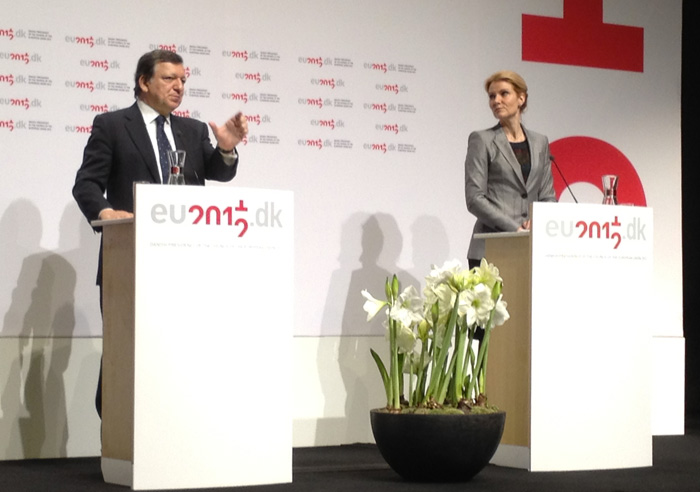
The icing on the cake was today’s Press Conference with PM Thorning and Commission President Barroso. It took place at Bella Center, a 1970s conference centre on the windswept edge of Amager. Throne like chairs – occupied by less than 100 press – sloped up the cavernous room from the impeccable stage with a flower arrangement that must have cost more than I’m paid in a day. The two politicians arrived late and gave us 30 minutes of their time – initial introductions that more or less word for word what they had said the night before followed by just half a dozen questions.
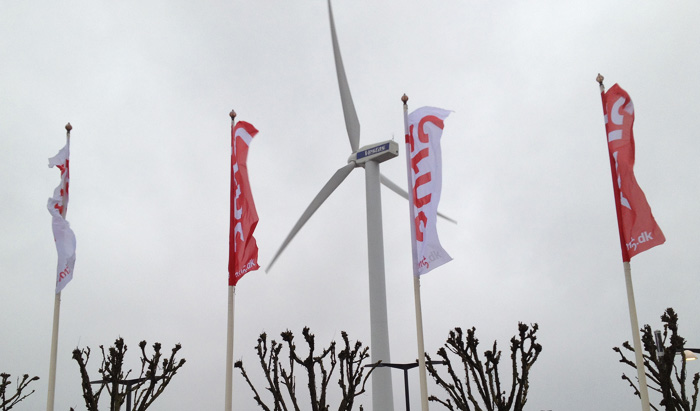
As the howling wind made the Vestas wind turbine spin at speed outside Bella Center, the Presidency flags billowing in the wind below it, it was with a grim face that Thorning discussed today’s announcement that the very same Danish wind turbine company is laying off 2300 workers. No words from the politicians could counteract this very concrete bad news.
The best question at the press conference came from the FT’s Peter Spiegel. Directing his question to Barroso, he neatly connected the Commission President’s campaigns against authoritarianism in Portugal as a young politician with the ongoing constitutional problems in Hungary. Did Barroso, Spiegel asked, think that Viktor Orban as a politician represented European values? Barroso’s answer was a classic, vague fudge. He didn’t mention his own view of Orban at all and instead kept referring to legal process needing to take its course. His words ended up being weaker and more vague than the Commission’s statement on the matter from the day before.
“What did we learn from all that?” I asked one of the journalists at the end. “It’s always like that” he said. So we all pottered off to the cavernous press room to file pieces about what we had just heard, crouching over our laptops and trying to muster up something worthy to say, with every practical need covered except anything noteworthy to actually write about.
So that folks, is a Presidency Press Trip.
UPDATE 16 Jan – @SpiegelPeter has just tweeted:
[blackbirdpie url=”https://twitter.com/#!/SpiegelPeter/status/158802093883396096″]
Which more or less proves my point I think…
Matches my experience – great promises of unique access… but what’s the good of all that if there’s nothing there to access?
These events are a farce supposed to give journalists the impression that they’ve done their job. The politicians involved are primed not to reveal anything, or answer any potentially controversial (and thus interesting) questions.
A few months back I met Barroso in Denmark. Journalists from all major Danish media were present, but we all had to submit our questions in advance. So the questions Barroso got were at the investigative level of “what are the three things you like best about Denmark?”
I did ask a question different from the one I submitted, and was promptly told that I mustn’t do that in the future if I want to be welcome on the premises again.
I think the point is that the rotating presidency is an enormous bluff…
Anyway, Jon perhaps you already know that, but at Stronger Europe they are going to start a campaign for a directly elected European President.
It remembered me your campaign of many years ago about “the telephone number for calling Europe”, how it was exactly, I can’t remember anymore the name in details, but I remember the initiative! I tried to dig out the website but I wasn’t able to do that!
Well, I think now the time is much more “ripened” than those days, maybe this time it could work! What do you think?
Well, Jon, your post made me remember the ending of the movie Burn after reading 🙂
See here: http://www.youtube.com/watch?v=NQQdSwFgSec&feature=youtube_gdata_player
Looky there, premier Barroso of the undemocratic Eurosoviet Union’s politburo was there. No doubt argueing that the wealth-destroying Euro is a great success (it has been for the rich and the bankers, not for anyone else though).
@Jon I often feel speaking to Rehn or the Commission in general on eurozone crisis is pointless. They don’t make the decisions. The EU’s leaders come together every six weeks, achieve some caffeine-fueled pseudo-compromise in the wee hours of the morn, then vanish. That leaves Barroso, Rehn & co to polish the turd for the markets and public opinion.
They are the wrong people to ask they are not decision-makers but facilitators. Really the people who SHOULD be giving answers to the public is Merkozy’s fictitious spokesperson and the ECB president.
@Hugh – I don’t doubt Rehn’s sincerity. I doubt his judgment and decision making ability!
@European Citizen – I don’t know how it could be done differently. These issues are ones about the very nature of representative democracy and the press. I suppose I could have asked some odd question at the Press Conference (about whether the Commission will investigate Google over its integration of Google+ into search results for example) – maybe that’s the way? Use the power of the unexpected?
Thanks, Jon, for a very insightful piece! But how could it have been done differently? Certainly, one can’t force Barroso or anybody else to be less bureaucratic in their language or to be bold, critical and imaginative.
It sounds as if everything has been elite-dominated but that’s often the case in Brussels and everywhere else. Can anything be done to change it when even most journalist are not outside the bubble?
In other words, it’s a ritual: the priests might have turned to face the congregation, but they’re still reciting rote lessons in Latin…
I think you are too cruel about Rehn: I don’t think I’m alone in considering his hesitant delivery a genuine indication of his sincerity.
Sounds dismal. Or perhaps it’s “grandeur and misery” as the French used to say..