I was a speaker yesterday at the Nordic-Baltic Youth Forum 2011 in Narva, Estonia. The slides from my presentation are here, but this post is about an issue that was on my mind all day – how Members of the European Parliament should organise their web presence. The 3 MEPs at the event in Narva – Emilie Turunen, Kristiina Ojuland and Radvilė Morkūnaitė-Mikulėnienė – all have personal websites and some presence on social media, but judging by their comments on the panels they struggle to make the most of the technology, and find it hard to work out what they should do and what their staff should do. So here’s a plan for them.
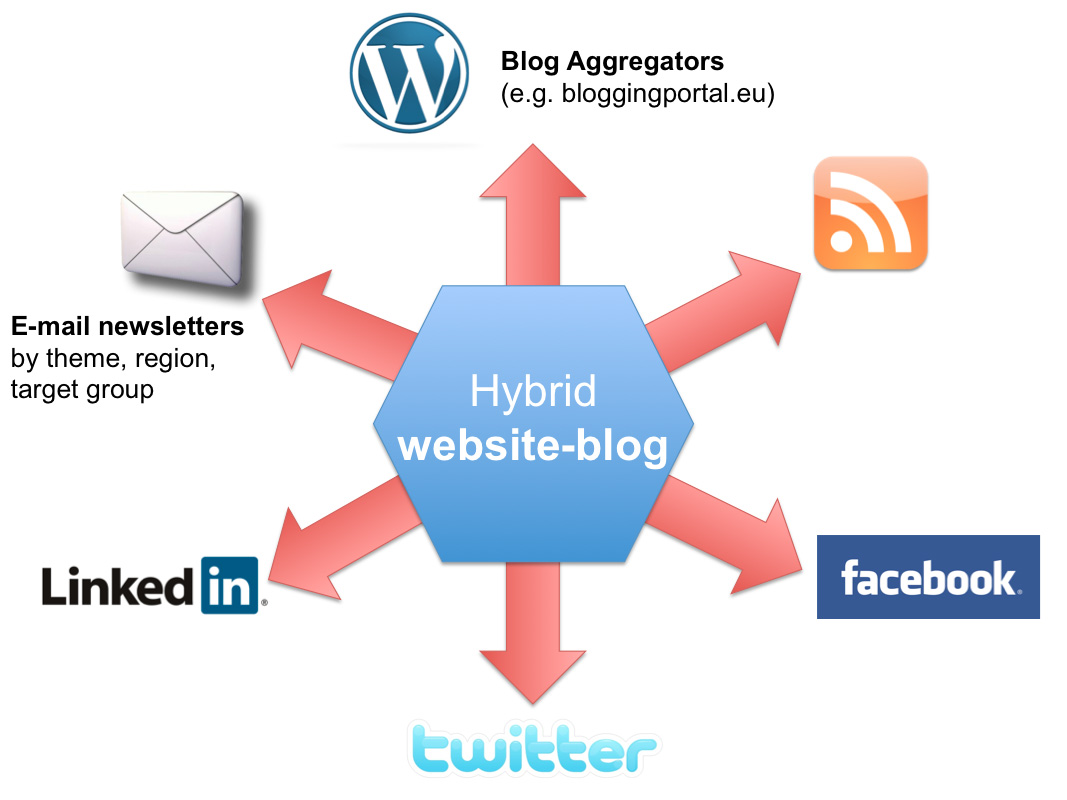
First of all, a hybrid blog-website should be at the heart of any politician’s web presence. All the information that is also to be used across all social media should be put there – the website remains the place to go for whatever information any citizen, lobbyist, journalist would possibly want about a MEP. The site should list all engagements a MEP is attending and contain details of all the person’s legislative activity in the Parliament. By default as much information as possible should go online – openness should be the point of departure.
I say it should be a hybrid blog-website because there is no legitimate expectation that the politician themselves does everything, and this can be distinguished on a site – with first person prose on a blog and third person elsewhere, similar in style to ex-MEP Caroline Lucas. Every MEP must determine their own level of engagement; no engagement from a MEP themselves is not acceptable these days in my mind. It’s not as if the tech is hard – I’ve taught people who didn’t know how to copy-paste how to blog! Further, MEPs should make it clear their researchers are part of the web team (as Simon Busuttil does).
For the tech of a politician’s web presence costs need to be kept low – there is nothing I’ve listed here that cannot be done with the excellent free and open source WordPress. I’m yet to see a genuinely interesting website of a politician who uses a central system provided by a national party HQ – these should be avoided.
Then on to the other points of the diagramme above.
First of all RSS feeds of all aspects of a MEP’s work should be provided – by theme keyword, and by type of work. If you don’t know what RSS is, or why it’s important, see this. If I want to know what Radvilė Morkūnaitė-Mikulėnienė is saying about Nord Stream only I can get this via RSS here (although this is not explicitly shown on her website). This allows visitors to keep track on one aspect of a MEP’s work and – secondly – allows content to be aggregated from a politician’s website into blog aggregators such as BloggingPortal.eu
Thirdly, the same targeted approach should be taken when it comes to e-mail communications. The standard monthly newsletters sent by most MEPs are no good – they are too long, too impenetrable, lacking in focus. E-mail bulletins should hence also be organised by theme, and also by target group – party activists, journalists etc. An open source solution such as phplist or a paid service like MailChimp would allow further accuracy of targeting. Also vital is that the communications should be web to e-mail, and not the other way around – news should be on the web first and then collected for e-mail communications. In the fast paced worlds of politics and social media there is no sense in holding back information for the sake of sending it out later by e-mail.
Fourth, a MEP needs to develop a presence on the relevant social networks in their national context. This basically means Facebook anywhere in Europe (and a Facebook page, not a profile), Twitter towards the Brussels environment (lobbyists and journalists) and possibly towards national audiences, and then other social networks (LinkedIn, XING, Hyves, Draugiem etc.) according to their use in the country a MEP represents. Selected information can automatically be fed onto these networks using RSS – blog entries make good content as Notes in Facebook, and it is worthwhile to tweet links to new blog entries. Standard press releases in the format “Kristiina Ojuland MEP said XYZ” should not be transmitted this way (should they even be written…?) as this style does not match the informal nature of social networks.
An individual politician needs to decide their own personal engagement in social networks, and under no circumstances should content be written on social networks by staff without a politician’s explicit approval. MEPs such as Marietje Schaake write all tweets and Facebook content themselves – that’s a best case scenario. MEPs sit in plenty of long and boring meetings – that’s the time for social networks, ideally off a smartphone.
It is a delicate issue but I would say that broadcasting alone (and no discussion) does not come close to making the most of the potential of social networks, but it is probably better than nothing. A politician’s staff can assist collating comments and feedback, and to determine which questions from citizens merit a reply. The use of Twitter lists can help make Twitter workload manageable.
Lastly, each MEP needs to determine their language preferences for their web presence – own language only eliminates the Brussels networking potential of the technology, so a combination of English (and French?) and national language needs to be used. This is easy enough to accomplish on a website with multi-language functions, and also onto a Facebook page, while on Twitter 2 separate accounts could be the best solution.
Right, that’s all for a quick overview! Would be good to hear comments from MEPs, politicians at other levels, and anyone who wants good web comms from their politicians!
@mathew / @dale – on e-mail… I am not sure myself on that point, as I have never seen it done! I do however know that the MEPs whose e-mail newsletters I do get are full of irrelevant crap I have no intention of reading. Filter by theme should be a way around this, and some MEPs are adequately specialised to make it worthwhile.
I am also aware that e-mail is vital for political comms, but it is weakening, and at least by using the same information sensibly across platforms there are ways to reach the relevant audience(s) where they want their info
@dale – come on, I am a founder of Blogging Portal, have to give it a plug! Plus what other aggregator is there to appeal to the Brussels bubble?
@Jon, cannot agree more with your list, except perhaps the blogging portal. .. I’d make a link to the parliament website and my voting record and my party website. ( well maybe not if I never showed up and voted)
@mathew, newsletter. Who cares who signs up,as long as you have an rss, you can create an rss to newsletter with mail chimp, and you are off to the races at no cost.
newsletter still the best. Rss, twitter, Facebook, weak in comparison if you are looking for support in the future.
I don’t have much to criticise in your menu, but I do wonder how many people will subscribe to an enewsletter from one MEP about, say, 2 particular themes? Does each MEP have so much to say – and the time to write it – that providing thematically-customisable enewsletters is actually necessary?
Perhaps this would probably be more useful for the meta-level than at the level of the individual MEP and his/her subscribers.
It could be interesting if BloggingPortal, for example, could provide provide a thematic interface and enewsletters to MEP posts by category – e.g., “here’s what the MEPs are saying about Issue X”. Similarly for other groups.
There’s probably no theoretical reason it couldn’t from a technical standpoint. But finding the resources to tag individual posts is not scalable, so getting the MEPs to classify their own posts would help.
@Ron – valid points, but hell, this blog entry was 800 words already!
First of all, I do web work for 3 MEPs, a 4th site is forthcoming, so I have made perhaps €3500 out of this business in over 5 years. It’s not as if it is a lucrative line of work for me.
This is much more important to me as a citizen.
There is no fundamental tension between being a good, communicative MEP, and being a good policy making MEP. OK, granted, some of the ‘big beasts’ of the EP don’t need to use the web at all because their reputation is secure in the Brussels circles, but whether the same individuals are trusted back home is a very different matter. Take Malcolm Harbour MEP for example – he’s chair of the IMCO committee in the EP, his reputation in Brussels is secure, but he is unknown at home.
Web communications can therefore help the legitimacy of individual MEPs. With the critique of the EP’s expenses system, the scandals with Thaler, Strasser etc., we cannot presume innocence of our elected representatives. Hence if they are not doing things online and in social media, I wonder why not?
Also as the work done by Marietje Schaake has shown, when MEPs use the web sensibly, this can help with citizen involvement in the EU policy process AND with the quality of legislation produced by the EP.
I am not sure social media or the web can really fully deal with the EP’s problem of legitimacy, but not being active online helps contribute to the reputation of the EP as being Brussels focused and inward looking.
@Ron.
New media is becoming a must if you want to mobilise supporters. It will be more and more felt by politicians that it is key to reach positions.
Your view on people reaching functions through canny manoeuvres inside party bodies is probably still part of some people’s carrier planning, but it will loose it’s power. On the other side the ability to successfully master social media – and reaching out to supporters, media and voters – will become more important. Societies are changing and so are the roads to success.
I would personally say that social media competence is not yet “a must” for a political career, but it’s already an asset. And it will be “a must” at some point in the future. It’s only hard to predict when this will be the case, maybe in just a few years.
What I still lack when I see you writing about all this is the “why”.
You say all this is a must, and since you earn some of your money convincing people doing this I understand that you are advocating for it. 😉
But is it a must because it’s a democratic necessity or a must because MEPs should try to dominate the public or is it a must because everyone does it? Is it a must because it increases transparency or is it a must because bad MEPs finally have the means to disguise even more that they are either doing close to nothing or that they are doing bad things? Is it a must because traditional means of politics don’t work anymore or is it a must because it helps to win the next elections? Is it a must to create an image or is it a must to prevent an image to be created of you? Should MEPs communicate with “Europe” or with their home country? And how do the different tools relate to all of that?
So far I have the impression that those MEPs with relevant influence in the European Parliament don’t have this influence because of social media and that one can only quote a handful where the use of social media has made much sense for themselves and for the public.
Isn’t that all this social media thing in the end is just overrated buzz, at least for those already in power, because they are already in power and that they will learn quick enough what tools to use if they are really helpful for themselves and/or their goals?
Personally, I prefer as little involvement of personal assistants as possible. I mean, for me it would be more acceptable if all the tweets or posts were written by a politician himself (even if it meant lower frequency of new posts), rather than written by someone else.
What is more, leaving all the social media management for assistants might lead to unwanted consequences. As you have probably heard, one of Kristiina Ojuland’s (MEP) assistants even started posting things without even consulting or informing her.
People appreciate sincerity and close relations with their MEPs and I think that direct engagement is something politicians should go for.