What precisely is this EU “red tape” that JCB speaks of?
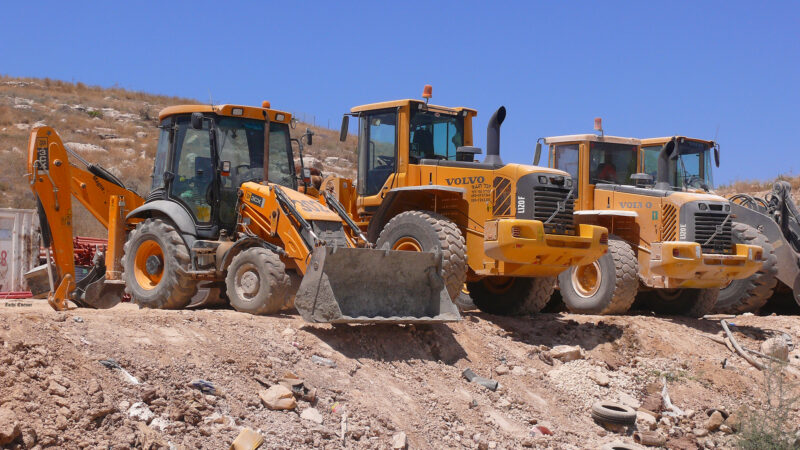
The construction vehicles pictured above are a JCB 3CX (on the left), manufactured in Rocester, UK, and two Volvo Construction Equipment machines (on the right), a , both manufactured in Arvika, Sweden.
My point of course – in light of comments yesterday by Chief Executive of JCB, Graeme MacDonald – is that in the future the Arvika Volvo plant might be still in the European Union, and JCB’s Rocester plant would not.
MacDonald confirmed that EU countries are an important export market for JCB, but said this:
What is needed is a lot less red tape and bureaucracy. Some of it is costly for us and quite frankly ridiculous. Whether that means renegotiating or exiting, I don’t think it can carry on as it is. It’s a burden on our business and it’s easier selling to North America than to Europe sometimes.
Now let’s think of the machines pictured above. Everything from the emissions standards from the engines, to the chemicals that are (or are not) allowed in the paint on the machines, through to the coolants permitted in the machines’ radiators is determined by EU law within the EU. If the UK were to leave the European Union that would make no difference whatsoever to any of these standards, and JCB – if it wanted to export to the European Union – would have to respect every single one of those standards anyway.
Yes, British construction workers might accept cheaper but less fuel efficient engines, paint containing harmful substances, and ozone-depleting coolants within the UK, but the rest of the EU sure will not – and they are not going to grant UK firms like JCB any special treatment. A Single Market means common rules that everyone respects – including competition law, even applied to companies headquartered outside the EU.
JCB could theoretically manufacture to one standard for the UK market, and one standard for the EU market, but manufacturing to two separate sets of rules would also come with at least some associated costs. If it’s anything like the mess when it comes to standards in the car business between the EU and the US then this is not to be underestimated.
So if the red tape that MacDonald has in mind can actually have nothing to do with the end product, what then, I wonder, does he actually mean? If the UK were not in the European Union then rules on working time, maternity and paternity leave, and workplace safety – the framework for which are currently set at EU level – could be set in the UK instead. The waste the JCB plant produces, and the energy it uses to manufacture its goods, would also possibly not be subject to EU norms. Accounting rules for large enterprises, and banking law and money laundering rules, could also probably be circumvented. However UK room for manoeuvre in these areas would still be restricted if the UK were to join the EEA upon leaving the EU.
So then, the next time some right-leaning captain of business (the Bamford family behind JCB donates to the Tories) in the UK complains about “red tape” in connection with the European Union, they need to be put on the spot and asked what law, precisely, they would actually want to get rid of, and what that would mean. Does freedom from the EU mean the freedom to exploit your workforce and pollute as much as you wish?
[UPDATE: 18.5.2015, 2135]
So it turns out that JCB was fined by the European Commission back in 2000 for unlawful distribution agreements. Red tape, eh?
Nearly forgot! Commission has just launched its Better Regulation Agenda exactly in response to the concerns raised by Graeme MacDonald of JCB.
See http://europa.eu/rapid/press-release_IP-15-4988_en.htm
Frans Timmermans just said in his press conference on this that eurosceptics don’t annoy him because they are wrong, they annoy him because they are sometimes right! He also said that this initiative is not about lowering standards, it is about making life easier for those who have to work with the standards.
There is a very strong narrative in the UK about “EU red tape”, so this kind of statement usually goes unchallenged and has become almost a mantra here. However, as far as (what is left of) manufacturing in the UK is concerned, what is never asked is how come German manufacturers somehow not only outperform UK competitors but also every other area in the world, despite “EU red tape”? Is this because German industry and manufacturers achieve a competitive advantage by flouting and ignoring rules and regulations? Or is it because they focus on quality and use the Single Market as a springboard for exporting to the rest of the world?
Nobody is disputing that bad and/or excessive regulation is a massive handicap, especially for SMEs, but this is true at national, regional and EU level. If the problem at EU level really is so bad that it could justify leaving the EU, why aren’t we hearing that from German industry?
Sorry, missed the update! Just saw it now.
I think this press release makes it quite clear just what JCB are talking about: http://europa.eu/rapid/press-release_IP-00-1526_en.htm?locale=en
Briefly, they were fined €39.6m for violating European antitrust law. Credit to @Paul_Haydon (as far as I know) who spotted this.
As the Guardian said the JCB boss donated to the Conservative party, if you look at what he is saying it is all about renegotiation “if Cameron cannot negotiate reductions to bureaucracy that weighs down UK businesses.”
There is debate within the real out campaign that we cannot wait until Cameron returns with his so called renegotiations, that no renegotiation will be acceptable because we will still be in the EU. Also to do so would mean giving to much power to the pro- EU side. Not only will they control the timing, but will have framed the debate to one about economics.
So from the perspective of the pro side the interjection of Graeme MacDonald is working for them, as it makes the economic case, makes the wait and see case and can be used later when he announces his complete satisfaction with the renegotiation package.
So in a sense both you and Graeme MacDonald are right leaving the EU will not make a blind bit of difference to trade with the EU. That is the important point because it is not membership of the EU that is important to trade but access to the single market.
Good point, made similar remarks on my blog ‘IdentitySpace’ Hope to see you there one day. Keep up the fight against this self harm called #brexit