The recipe for European Citizens’ Initiatives
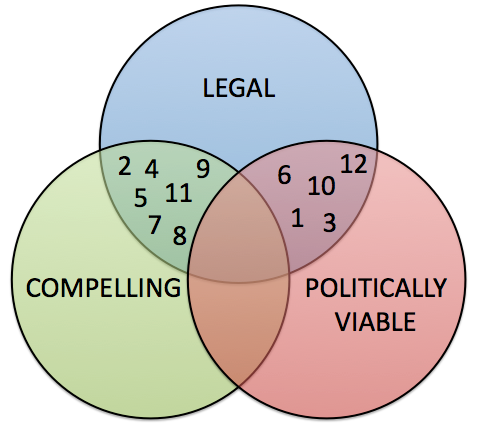
Over the years I’ve continually argued that the European Union needs to improve its representative democracy – it needs to develop federal institutions, and give citizens a genuine voice at elections. Yet while, in essence, I still believe in that, I nevertheless have to admit that representative democracy is struggling nationally from lower levels of trust and lower participation (see the stats here for example), and perhaps other models need to be looked at.
One such model might be greater participative democracy, and thanks to the Treaty of Lisbon, this is now a reality with European Citizens’ Initiatives, and – since the start of November – the first initiatives are available to sign. The list of initiatives that have been approved are below.
But first of all, what is the recipe for a successful ECI? This is summed up in the graphic above. First of all, any ECI has to be legal according to the EU treaties (see the ECI procedure). This effectively rules out ECIs about nuclear power or demanding one seat for the European Parliament in Strasbourg. Then any ECI already approved has to be both politically viable AND compelling in order to succeed. The problem is that – as I see it – none of the ECIs that have crossed the legal hurdle are both of these things.
These are the initiatives available to sign so far:
- European Initiative for Media Pluralism
- End Ecocide in Europe: A Citizens’ Initiative to give the Earth Rights
- Central public online collection platform for the European Citizen Initiative
- Suspension of the EU Climate & Energy Package.
- Pour une gestion responsable des déchets, contre les incinérateurs
- High Quality European Education for All
- Stop vivisection
- Let me vote
- One of us
- Water and sanitation are a human right! Water is a public good, not a commodity!
- Single Communication Tariff Act
- Fraternité 2020 – Mobility. Progress. Europe.
So, what can we learn from these? Numbers 6, 10 and 12 are extremely vague. Numbers 1 and 3 are more concrete, but are also not especially compelling. But all of these, if they ever could get 1 million signatures, might be politically possible. Among the others, 11 is concrete, but unachievable for market reasons. 9 – a ban on human embryo research, 8 – right to vote in other EU countries, 7 – stop vivisection and 2 – environmental standards are all too politically hot for the Commission to want to act. 4 and 5 are mutually contradictory, and highlight the complexity of the politics of ECIs. But my rather disappointing conclusion is no ECI hits the bullseye in the middle of the diagram above.
Anyone trying to change ECI legislation (as for instance someone on Twitter who made the brilliant proposal to take over the flexible US 25k petition system) would still have to contend with the basic requirements.
Article 11(4) TEU puts most possibilities into deep freeze: “Not less than one million citizens who are nationals of a significant number of Member States…for the purpose of implementing the Treaties.”
For the EC to put the effort into pre-screening these, possibly to avoid the problems mentioned earlier, shows that they’re taking it seriously, as it must represent a considerable additional load. So that’s one trap navigated, but at a cost in terms of their human resources.
I guess the outcome of these first dozen or so ECIs will determine its future. If all of them get a result, the EC will be able to demonstrate that they’re not remote or aloof … and can thus expect this resource burden to grow considerably as everybody hops aboard!
Even then, it would probably be more cost-effective than some EC comms budgets, as discussions around an ECI can only help illuminate to people outside the Brussels a) the limits to the EU’s power; and b) the logic of subsidiarity and EU added value.
If all of them get their signatures but result in nothing, of course, the PR effect will be disastrous.
@Ralf, of course, ECIs cannot possibly affect that. Like it or not, any shortcomings in EU democracy created by the treaties were arrived at by democratically elected HoSG.
However …
@Jon: if the ECI mechanisms represent a hurdle, would it be possible to launch an ECI aimed at lowering the barrier, or would that once again be ‘out of bounds’?
An ECI to amend the ECI legislation would surely be allowed. But would 1 million sign that?
You bump into the detailed and cumbersome EU treaties almost as soon as you think in political terms. Therefore we have the fundamental problem that almost all issues interesting enough for citizens in general are “high politics” out of bounds for the EU Commission.
Only real democracy can cure that, but the national and institutional actors seem to be more comfortable with the EUshambles we have.
One further ECI has been registered since I wrote this blog entry – this about movement of citizens between Switzerland and the EU. It’s not an especially politically optimistic ECI, yet it complied with the criteria, so it gets approved. So it would seem to me that the Commission is trying to be as much of an honest broker here as possible.
I hence reckon that how civil society organisations play this will make or break the ECI system – only such organisations have the know how and resources to make an ECI work, yet conversely the criteria are so onerous that many will shy away from the system altogether.
Many moons back I mentioned the risk that “people would be set up to be disappointed by organisers of badly conceived ECIs, who would blame the EU as their unrealistic and unrealisable proposals get canned, leaving the EU with an ever-more-reinforced reputation for being aloof and out of touch.” Basically an own goal.
That was back in early 2010, however. Since then, the EC now says they’ll pre-vet each proposal’s validity at the registration stage: “The Commission will register the proposed initiative within 2 months of the request provided that … the proposed initiative does not manifestly fall outside the framework of the Commission’s powers … is not manifestly abusive, frivolous or vexatious, and … not manifestly contrary to the EU values”
http://ec.europa.eu/citizens-initiative/public/how-it-works/registration
The question is, is this enough? Or is it too much? They have to be neutral, which is always a bich of a balancing act: too vigorous pre-screening will leave them open to charges of censorship, while letting too many pre-doomed ECIs through will waste everyone’s time and make things worse.
What do you think, based on your analysis of the ones they’ve registered so far? And do you think there’s a role for civil society organisations to provide useful advice?