Not why but how: reading Euroblogs
A few lines from a typical conversation when I’m asked what I do in Brussels: “I work as a website designer and write a blog about EU politics.” Response from whoever I’m talking to: “Oh, I don’t read blogs.” Rather than the rather simple answer – well, yes you should – a more nuanced and technological solution is called for.
First of all: why read Euroblogs? Because excellent analysis and debate about EU matters is being produced every day on blogs – content that rivals and is a complement to the main online sources such as Euractiv and EUObserver. For links to good quality Euro-blogs, try Getting A Grip of the Euro-blogosphere.
Secondly: how do you best read Euroblogs? That’s where it gets a bit tricky. Aside from having a long list of RSS-feeds, something that few have time or the technical knowledge to accomplish, it’s not so easy. This blog post outlines the issues, and tries to come up with some sort of solution.
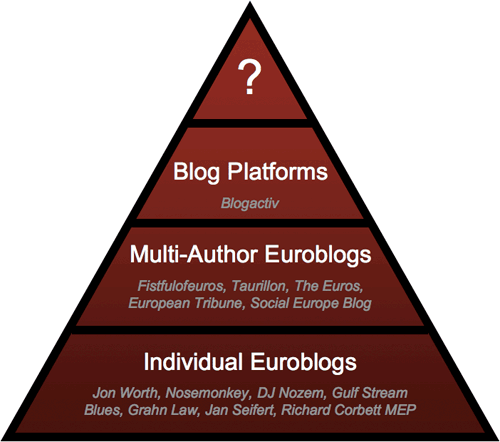
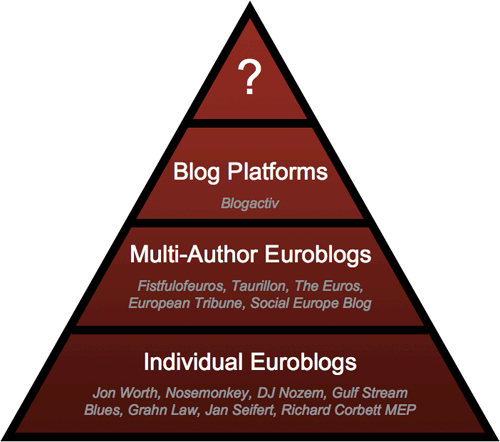
The diagram above shows the 4 levels of blogging about EU politics. At the bottom level are the mass of Individual Euroblogs written by single authors, and blogs dealing with one small part of EU politics. People read these if the blog appeals to their niche area of interest, or they happen to know the person writing the blog. These blogs can be a success in their own right, but they are unlikely to generate a mass readership.
In order to drive up readership and foster communities of people who read and write about the same things, Multi-Author Euroblogs offer a partial solution. Each takes a more generic brand name, and individual authors contribute content to the sites. Quality of the content can be higher than from an individual blog, but building a rapport with the authors can be hard.
EU news website Euractiv has made the only serious investment to date in a broader attempt to structure the Euro-blogosphere. Its Blogactiv Blog Platform system offers individuals the possibility to blog themselves and even to a certain extent brand their blogs, but collects all the content from these blogs in a central website. If a blogger writes decent content here he or she will get a guaranteed readership, but there’s little incentive for someone like me to join Blogactiv.
Overall that’s just too complicated. How can most people follow all of that? The great success of Iain Dale in the UK, Beppe Grillo in Italy or Loïc Le Meur in France is their blogs are widely known, they are among the first place people turn to for online comment about broadly political issues. Margot Wallström is the closest EU equivalent, but she’s a blogging Commissioner, not a political blogger as such.
So how do can the elusive ? part of the triangle above be filled? There are 3 sites that I reckon offer a decent model to show what could be achieved. PolitikPortal.eu is a free service giving daily EU news roundups in German by e-mail, with the website to accompany the e-mail services. Could an English-language blogging equivalent be established? The 5 best Euroblog articles, every Friday morning, by e-mail? The admin would be rather heavy and there would be the need for some decent marketing. Secondly, EuroBrussels shows what can be done over a couple of years if people want the information you have – jobs in their case, and hopefully there are enough people out there wanting EU politics blog content too? Lastly Bloggers4Labour shows how to bring together a few hundred people who write blogs supporting the Labour Party in the UK – it would be possible to do the same for Eurobloggers. Some combination of the models used by PolitikPortal, EuroBrussels and Bloggers4Labour might just do the trick.
So in typical Web 2.0, open source kind of a way, is there anyone out there who wants to give me a hand to turn any of that into reality?
Count me in, too. I think you’ll see a lot of the ideas mentioned above appearing online this year, in one form or another.
The problem is to get a critical mass of content to play with. Unfortunately, that can mean everyone having to agree on how the content should be used … easier to herd cats.
But how about this: a group sets up a delicious account and tags everything they find interesting to create a pooled RSS feed. But then different members use the feed in different ways, just to see which technology/editorial approach/etc. works best. A combination of cooperation and competition, then.
Interesting discussion. Lots of good ideas (also the code of conduct!). I also like the idea of a round-up and nosemonley did a great job last year, maybe we can organise a rotation. I think the eurovalley approach could be interesting as well but it really depends on how many people use it regularly…
Another idea is to create a “round-up website” that becomes sort of portal to the Euroblogosphere. I guess with a few volunteers it could work quite well. Let me know when you are planning to meet in Brussels, I would be interested in joining!
Nanne – thanks for your comment. The euractiv article about different blogs – or what I gleaned of it – was interesting, and the summary of blogs is exhaustive. However I didn’t think it was hugely different from the Loic le Meur wiki in content. I have already chosen blogs to look at from this site but I will mention blogactiv in methodology as well.
I find blogactiv interesting but at the same time it’s exclusive. If they had a way to feature or include blogs that don’t use the blogactiv domain that would be better – but it would possibly also defeat their intention, which seems to be to become a clearing house for eu/euro blogs.
I’d love to be able to make some contribution on how to find eu blogs or set up an aggregator but I always stumble upon blogs that I end up liking by accident, which isn’t very methodical…
Nanne / Ossi – there’s actually no contradiction here. There are some things you can do automatically with an aggregator, and others that require some editorial input. With a large enough group of volunteers the burden for the latter can be spread, and if the project starts to work well then any money raised can be ploughed into the editorial side… Anyway, that’s exactly what we’ll be discussing at the meeting.
Nanne,
I see your point, though I believe that at an automated or user-supported portal (e.g., the test Eurovalley site ) is preferable over for example linkblogs and the like. The Eurovalley platform allows summarising and commenting, which makes it perhaps more suitable for presenting analysis and debate.
To be honest, I am not optimistic that a completely manual system would work. People just can’t keep it going for very long.
Ossi,
I think these things are just depersonalised feed aggregators. They don’t add any new information, other than popularity ranking. I don’t think that’s a very useful way of presenting ‘excellent analysis and debate’ to an audience that doesn’t read blogs. You need to have a narrative, you need summarization, you need to repackage the information (all of which requires work, and time).
But perhaps it could be used to seed a weekly or biweekly roundup and e-mail newsletter. And maybe we could use a rotating curation model for that.
(Curating a round-up is so much better than having a carnival or circus visiting your blog)
Hi,
I did some research and found an interesting open source solution that might be of use, Pligg. You can give the beta of the Pligg-based Euroblog social bookmarking site here: http://www.eurovalley.net/cwe/. I encourage you to try it out and give comments. I think the platform has potential, but obviously requires critical mass before it becomes viable.
Nanne,
Why do you think an automated system would not work? What I had in mind was an automated feed based on blogs chosen by the editors. The idea would not be to be picky about which blogs to choose, but just to make sure they are not spammers. If the blogs are not interesting, the popularity algorithm would in the end make sure that their entries are not displayed that often.
Time is indeed the issue. I don’t know if a fully automated procedure could work. But maybe it would be possible to do much of the work via tagging, or having some submit feature. I don’t know if a fully automated service without editorial content would do much.
I’m up for a travelling euroblog roundup. As long as it’s not called carnival of the euroblogs.
Jen,
The loïc the meur wiki is a good idea, but it has not been updated in quite a while. Originally I put most of the list together, but my last revision of it was January 2007. The EurActiv piece is the most comprehensive up-to-date overview you’ll find.
I’m very interested in your research, hope you will be willig to share it when you finish.
Stefan,
I have a spec put together for a simple Euroblog tracker with a basic popularity tracking algorithm. If you are interested in helping with the technical side, I’d very much welcome it.
I have a leased dedicated server that can be used to run the site once developed.
On finding EU/Euroblogs: I like Loic LeMeur’s wiki on European blogs, http://www.eu.socialtext.net/loicwiki/index.cgi?the_european_blogosphere as I think the wiki aspect is quite good. However they have European Tribune as a pan-european blog and while it’s interesting it doesn’t quite fit into how i define a blog – it’s more of an e-community.
On a blog’s influence: there are a couple of peer-reviewed articles about the influence of blogs. One by Deva Woodly from this year says that their influence lies in who reads them: there is a high representation of journalists and politicians among blog readers.
Also I should note that I am writing an honours (4th year uni) dissertation about the EU’s communications and public opinion problems (which are numerous) and using blogs as a case study of possible/nascent/inconclusive contestation or debate. So I find this discussion very interesting.
Jen
Time to try and revive the Euroblog roundup I tried to start last year, perhaps? It was far too much effort for me to maintain on my own, hence only ever doing two of them, but having it as a travelling circus could work… And hopefully a good way of finding new Euroblogs worth adding to the RSS reader / blogroll to boot.
In response to RZ, especially:
So I am rather skeptical that Euroblogs can really play a big role in shaping the discussion about the EU. Not that I believe that there is another way to conduct this discussion. I simply feel that no Europe wide discussion about EU topics is happening.
I have no idea quite how much influence blogs can have in the end, but I am convinced there are more uses of blogging about EU matters than are currently being exploited.
On the language issue: yes, it is tricky, but it should not be seen as a reason for not developing blogs about EU politics… Every EU politics blogger has his or her national environment, and the EU level environment too.
In response to Christophe: thanks for the comment… It was a bit of a joke about the yellow!
Congratulations for the pyramid exhibit above, well thought through.
Thanks to all for the comments on EurActiv (and its autonomous sister Blogactiv). We welcome feed-back on both, publicly or privately.
I don’t claim to be a blogger myself, busy with publishing an ‘old media’ as some would say…
To complete your information, here are a few elements:
– the community manager of Blogactiv is considering ways of exchanging more links and content with others, including the above. Don’t ask me how, again, I’m not the expert myself!
– EurActiv does have a LinksDossier on other EU-type bloggers:
here is the French version for a change 🙂 :
http://www.euractiv.com/fr/affaires-publiques/blogs-combler-lacunes-ue-matiere-communication/article-164796
Not quite up to date? tell our journalist!
– We stand by our yellow appearance (at least you remember it!), but do expect some lay-out change very soon. And remember, Blogactiv is green, not yellow!
Congratulations again, and keep it up!
Christophe
Mhh, somehow my first post seems to have vanished.
So let me recap:
A major problem for Euroblogs is the multitude of languages. There might be a sufficient amount of people being able to read English, but only few willing to comment on English. It is significantly easier to understand a foreign language then to express yourself in it.
But Blogs need comments. Thats what makes them interesting.
So I am rather skeptical that Euroblogs can really play a big role in shaping the discussion about the EU. Not that I believe that there is another way to conduct this discussion. I simply feel that no Europe wide discussion about EU topics is happening.
I am sorry, I send my last post before I finished writing.
Now: Blogs need comments. Thats what makes them interesting.
So I am rather skeptical that Euroblogs can really play a big role in shaping the discussion about the EU. Not that I believe that there is another way to conduct this discussion. I simply feel that no Europe wide discussion about EU topics is happening.
Jon, good summary of the state of play! I would just add Cafebabel next to Blogactiv. Their approach is similar, but maybe less EU policy oriented.
Yes, memeorandum.com shows nicely what is possible in the US. For the moment, I think, such an automated tool wouldn’t work in Europe, where political blogging (especially on European affairs) is far from being popular.
I am definitely up to support such a project, though more on the technical and organisational side, than as a blogger. My experience with Politikportal.eu might also help.
Keep us posted, Jon!
I really regret that Corbett does not fully play the game. He regularly got trash by the Open Europe’ folks for this very reason:
http://openeuropeblog.blogspot.com/2007/02/more-email-banter-with-corbett.html
Another thought: quite a lot of Euroblogs don’t really follow any sort of good practice for political blogs. Some don’t take comments (Corbett) and plenty of others make no effort whatsoever to interact with other blogs / bloggers. Have a look at the bottom of this BBC page for a very concise guide to making a blog a success…
Jon, you’re right re-journalists/euractiv. The only guys who have a daily newsletter quoting random bloggers alongside hacks are the ones from Open Europe…
Sociologist – you might just find EU rants of a different sort here: hoping the EU does better! I won’t complain about its existence though.
Thomas – Euractiv will be happy to quote Quatremer because, together with Mark Mardell of the BBC, and the Economist and FT blogs, journalists blogging have plenty of credibility for an organisation like Euractiv. If and when they quote you or I then we will have managed something…! As for help with the newsletter: am putting together a plan and will try to organise a meeting in Brussels of a core team. We’ll get contributions from elsewhere via a Skype conference… Will post the details when I know more.
I might have been unfair to Euractiv though: I think I’ve seen a few times Quatremer’ blog being quoted. If Euractiv could stop the yellow addiction as well, that would be less painful for my eyes too.
Btw, if you still want a hand for the newsletter, I’m up for it.
Ah, at last I’ve found a blog that comments mainly on EU politics rather than ranting about them. There is certainly a niche in UK politics blogging for this kind of thing, so I’ve added you to my blogroll.
Thomas – I agree with your analysis of Blogactiv. I suppose they wanted to ‘conquer’ the EU blog market, but realised that grouping bloggers is like trying to herd cats… Plus the wish to brand everything bright yellow was just to strong.
As for whether blogs other than Blogactiv ones get covered on Euractiv: time will tell…
I was very sceptical at first about Blogactiv. I found it very pompous (“Europeans challenge Europe” c’mon, that’s cheap). However, the fact that euractiv is now putting some of the blogactiv post as news bites should widen the audience. But there are no reasons why Blogactiv should have the monopoly of blog coverage on Euractiv. Stanley Crossick’ blog is definitively worth a read (the only one?). It is definitively the “elites talk to the elites” but at least we know what they think. Ah, and the last post in French on the Blogactiv platform dates back from 23 December. I agree with you that there is a challenge in offering a wide picture of the euroblogs.
Hi Jon,
I have given a lot of thought to this as well. I am working, alone at this stage at least, on developing simple blog tracker software for Euroblogs. The inspiration for this comes from Memeorandum (http://www.memeorandum.com/), of which I am a big fan of.
Unfortunately I am not a programmer, but a lawyer, so the development is likely to take some time. I am working on the specs at the moment, and will decide in the end whether it is easier to code it myself or to outsource the coding to someone else.
If you have any ideas on the features you’d like to see, or would like to help in developing, feel free to get in touch.