Möjligheternas Land – how social democrats need a bit of Swedish optimism
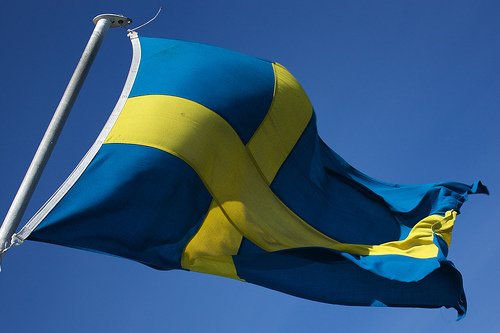
Swedish Flag – CC / Flickr
I’ve been at a conference in Brussels this morning organised by the Foundation for European Progressive Studies (FEPS) and I was asked to give a presentation about Social Democracy in the e-society era – you can find my slides here.
But that’s not the topic of this blog entry.
I want to instead reflect a little on a concept raised at the event by Eric Sundström – the term the Swedish Social Democrats are using called Möjligheternas Land or the Land of Possibilities in English. This is essentially a Lakoff-style political framing exercise performed by the Swedish Socialdemokraterna, nailing down in 1 A4 page the very core message for the election campaign between now and polling day on 19th September.
The idea, according to Eric (and as far as I can deduce from DN (translated)), is that the term encompasses the notion that the social democrats are in the political central ground, and that Swedish social democracy is about creating possibilities for people across the board – there are implications for business, education, families, middle classes etc. However the discourse is inherently optimistic.
So what happened in the event? The notion was decisively argued against by the more elderly social democrats in the room, most notably by one participant originating from Germany. We’re not, he said, about creating a world of opportunities! We’re about equality! That slogan would work better for liberals in Netherlands chimed in another participant.
Oh come on folks.
Look at what happened in the German elections last year. If one thing epitomized that election from a leftist perspective it was the difference in tone between the Grüne (chirpy, optimistic, light somehow) versus Die Linke (hold on to what you’ve got, workers man the barricades), with the SPD horribly stuck between those two. We all know that defending the past, Die Linke-style, is unworkable.
The exact translation of Möjligheternas Land may not work in every context, but that approach to politics, clever and thoughtful framing of the debate, was a very neat match for the excellent stats presented at the same event by Catherine de Vries from the University of Amsterdam, her research looking at where parties fit into what she terms ‘Consideration Set’ and ‘Choice Set’ when it comes to working out which way to cast a vote, a decision taken with just 7 minutes of an individual’s time thinking about politics each week.
I was left thinking I was witnessing the political equivalent of Max Planck’s famous quote, and wanting to buy a copy of Lakoff’s book for all present.
Dear Jon,
let me first of all thank you once again for your presentation during the seminar of FEPS last week. i just saw your blog and I am a little bit concerned in blaming “OLD GERMAN SOCIAL DEMOCRATS” for defening trully social-democratic values. Solidarity and Equality are the basis of our policies since the beginning of the workers’ mouvement in the 19th century! So I think we should not blame somebody and even further we should all accept the message of our deliberations: “Deal together with the past and move consolidated to the future”.
Ernst
Thanks for the comment. I think the critique of German social democrats came across rather more strongly than I had intended! Having said that my impressions on how different parts of the social democratic family approach the future have been formed over a number of years and last week was only the most recent manifestation of that.
@Sarah – I’ll add both to the very long list of things I need to read!
Buy a copy of Lakoff’s latest book instead (The Political Mind) which talks about mobilizing emotions through values and framing – arguably the most important factor in those 7 minutes. On the same line, Drew Westen’s The Political Brain created the same kind of buzz that Lakoff’s Elefant did when it was first published.
it’s new territory but I am convinced we need to go there. I mentioned Lakoff and framing at the last meeting and didn’t get far. There is a need to flesh this out in more detail and push for it…
Richard Wilkinson will be in the book too 😉
Yes, I agree that equality is also important, and I am a big fan of using a combination of stats from Spirit Level and discourse from Lakoff to do just that… but that sort of approach is a long way off how the replies to Eric were framed!
pitty I couldn’t come. I can imagine the debate. We need optimism but the equality argument (depending on the definition) is not wrong either. I am putting together a book on the future of European social democracy together with Jonathan Rutherford and a Lakoff chapter will be in it. It is the combination between values, policies and framing that is important.