Mandelson cannot resign a life peerage (even if Prentis and Dizzy want him to)
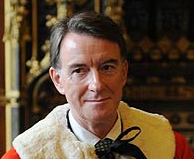
A post at Dizzy Thinks caught my eye. Gordon Prentice MP, never one to beat about the bush – has said stated this in a Commons motion:
That this House believes that individuals who are given peerages to enable them to serve as Ministers in the House of Lords should relinquish the peerage on leaving the Government.
Sorry Dizzy and Gordon but while your point could perhaps be correct from an ethical point of view, it’s not right from a legal point of view, for it’s only possible to resign a hereditary peerage – as pioneered by Tony Benn.
Baroness Sarah Ludford, a Lib Dem life peer, is also a member of the European Parliament. From 2009 onwards the EP has a rule that its members cannot also sit simulataneously in national parliaments. So Ludford wanted to leave the House of Lords, but could not resign a life peerage. Hence the The European Parliament (House of Lords Disqualification) Regulations 2008 to withdraw the peerage. Now I’m not sure that’s quite what Prentice was advocating… This issue was also highlighted when I raised the issue of whether Baroness Ashton’s peerage was compatible with the job as a member of the European Commission.
Anyway, what’s the main issue behind all of these technicalities? Essentially Prime Ministers need the opportunity to bring people into government from outside the House of Commons. The way to do this has been to make them life peers in the House of Lords. Wouldn’t it just be easier to appoint people to government, and allow them to be questioned by either house, but not have to make them Parliamentarians? Most other European countries organise their government that way – I would be happy to see that happen, and hence Prentice’s question would cease to be an issue.
Maybe Lord Meddlesum will somehow strongarm Pa Broone, and wangle a new law to allow Life Peers to resign peerages if they want. If Mr Mendacious does want to take over as the Secret Blokleiter of ZaNU-Lab, then he would have to go through this exercise, then stand in an election and be elected as an ordinary MP. Once he has suceeded in that, he could then mount a leadeship challenge against Gordo McRuin for the tenancy of Number Ten..
Whatever Mr Mendacious does, he will still keep his pension when an MP previously, then there is his massive pension as a Kommie Kommizzars au Bruxxelles. So, win or loose, Lord Meddlesome is rolling in the clover – ‘Money For Old Rope!’
That would generalize the question: is an unelected minister democratically legitimate ? In Italy, I believe that to be an issue as governments tend to be short-lived and we get a lot of these “technical” ministers (for example, a prominent doctor as minister of health ) with no input from the electorate. I am not really sure that’s compatible with the parliamentary form of government, mo
I think having a Cabinet that was separate from the legislature would require a fairly significant move down the route of a formal separation of powers. I don’t think that’s necessarily a bad thing, though with GB limited on consitutional reform and the Tories dead against, I suspect it will be a long time coming.
The one issue it raises is that of competing career paths – I rather like the US approach where long-serving academics can be appointed Treasury Secretary without ever having served as an MP, but it does make civil service/academia a much more attractive (and secure) route to political power than having to tramp the streets of Hemel Hempstead or Liverpool (Riverside) every four years?