Why it’s pointless to describe oneself as a pro-European
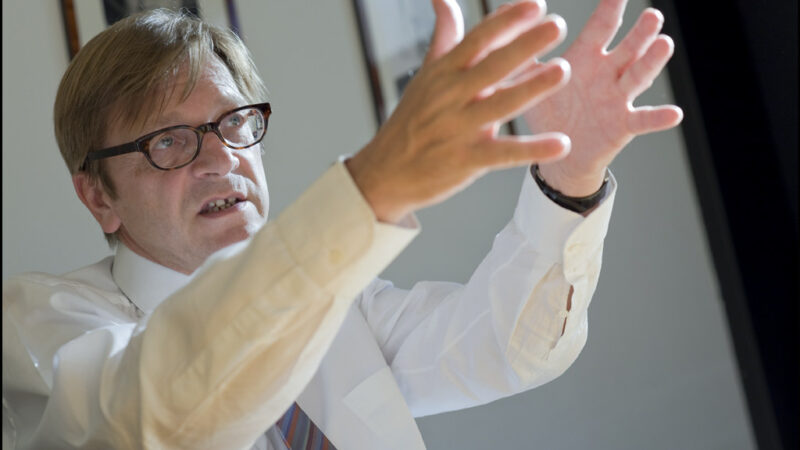
In response to Barroso’s State of the Union address today, leader of the ALDE Group in the European Parliament Guy Verhofstadt resorted to his tired old line. The pro-European forces should unite against Euroscepticism, he said, and this will define 2014 European Parliament election campaign. Verhofstadt has been saying this sort of thing since 2009 at least. It was wrong then, and it’s wrong now.
That is why the blog entry has the title it does – it’s pointless to describe oneself as a pro-European.
For a start how can you be pro a continent? That might be stretching it a bit, as I suppose it is OK to conclude that pro-European actually means pro-EU. But even then what does that actually mean? Am I pro-Westminster? Or pro-Landtag Mecklenburg-Vorpommern?
I use that to explain the problem in framing terms. Verhofstadt is setting out the fundamental dividing line as being about the European Union itself, not what he (or indeed his political opponents) want the European Union to be.
To put it another way, to argue using the pro-European / Eurosceptic frame sets you on a path to arguing about more or less EU, or in or out of the EU. It also leads to a way of explaining the EU that sounds like the EU we have is the only sort of EU we could have, and that to be a pro-European is to hence be a defender of the status quo.
So in a sense I am a pro-European, in that I want the EU to exist. Just as in the same way as I am pro-Westminster and pro-Landtag Mecklenburg-Vorpommern. But I am not going to ever make speeches on that basis, nor am I going to put that at the centre of my beliefs.
I am instead a social democrat, a social liberal, and an environmentalist, and a federalist, and I try to put those principles into practice as far as I can, including at EU level, and I would advocate that people like Verhofstadt try to do the same (if they do indeed have any ideology any more).
To illustrate the point, I have had interesting debates with Declan Ganley on Twitter about tax harmonisation versus tax competition within the European Union. Ganley is a free market liberal, and believes that within the European Union states should be allowed to set their own tax rates, and if this gives a state a tax advantage over another one – on corporation tax for example – so be it. I believe tax competition is a bad thing, and forces a race to the bottom when companies can easily choose their location. For me, as a social democrat, tax harmonisation has to be the solution. This debate between Ganley and I is a matter of ideology, a matter of values, and being pro-European or Eurosceptic has no bearing on it at all. Yet for Verhofstadt people like Ganley and I should be on the same side in the European Parliament elections – that is clearly absurd. The European Parliament elections should be fought exactly on these sorts of issues, giving the European Union concrete meaning but drawing on ideology, rather than slipping into the easy but limited frames politicians have used for decades about the EU.
I recently stumbled upon this interesting blog, whilst trying to research what pro EU types are out there and found you!
I never called myself pro EU before last year because like you say, how can one be pro a status quo, or pro a standard governing organisation? Seems faintly absurd.
But in the light of the ever growing tide of Scepticism I found myself having to stand up and be labeled as what is in effect , an anti Euro Sceptic.
I find myself mixing in circles of ardent EU fundamentalists who often turn me off as much as sceptics and really I am just like many – a level headed, proponent of Britain being in the EU and taking an active role.
I believe the EU is a force for good and Britain needs to take more interest and be involved more to really maximise the benefits.
Left, Right, centre, ….these are all such outmoded terms anyway but when it comes to the EU it is a matter which transcends political allegiances and therefore is something that does need some kind of label.
But we do as pro EU types need to stand up and voice our beliefs because unfortunately it is going to take a much louder voice to silence out the negative sceptic propaganda.
A very late response to Martin. I agree whole-heartedly with what you say. It may surprise you to hear that a certain Margaret Thatcher (dare I say that name here?) would be in agreement also. You only have to read her (1988) Bruges speech in evidence. In it she declared herself”a European” and the UK as a willing member of the EC (as it was then); but called for the EC to be given only those powers which would be better driven from the centre (ie she supported subsidiarity).
So, like her, I believe in the EU and will stand up for it – but will also press for changes in both what it does and how.
My comments already expressed here: https://www.facebook.com/PartitoFederalistaEuropeo/posts/518268631597091?comment_id=3115007&offset=0&total_comments=3¬if_t=share_reply
After reading comments by Neil and Martin I see I am not alone! 🙂
A bit late in the discussion, but I find myself not entirely agreeing with Jon – for a relatively simple reason: It has become the tried but tired tactic of politicians in various countries of the EU, no matter if they are officially in favour of further integration or against, to gladly take responsibility for every successful bit of policy, swashbuckling how they rode the charge against the “bureaucrats in Brussels”, no matter if it was actually the “bureaucrats” who came up with that idea to begin with and the local politicians opposed it. And conversely, the EU gets blamed for every evil of the world, regardless of whether it has anything to do with the respective legislation or not (best illustrated by the Tory railing against the Human Rights Convention).
So being pro-European (or pro-EU) to me means also defending the EU against undue criticism, while at the same time accepting just as much that mistakes get made at the EU level just as they get made at the national level.
But if we want the EU to move forward in ANY direction, we have to stop using it as a convenient scapegoat. And my chief issue with Verhofstadt here is if he’s honestly willing to “lobby” for his fellow politicians stopping to do that. I can’t take seriously people declaring themselves “pro-European” because it allows them to chicken out of their responsibilities.
I already expressed my disagreement with Jon’s criticism of Verhofstadt last week on Twitter, but 140 characters is somewhat constraining. I don’t believe, fundamentally that we disagree. Only that you are being a bit disingenous to suggest that this is Verhofstadt’s sole ideology. Sure he considers himself a convinced pro-European – even federalist. Though he comes at it from a Liberal perspective, whereas others may approach it from a different ideological direction. It doesn’t stop him taking positions on the need for Eurobonds or a form of debt mutualisation at European level to stop the rot of the financial crisis, or to attack the indecision and prevarication of EU Member States over Syria or the outrage at private citizens’ data being secretly sequestered by the NSA. Yet many of the big challenges we face together such as tackling climate change, terrorism, globalisation etc require the Member States pooling more sovereignty and centralsing more competences on the institutions of the EU (Europe).
Some, like Nigel Farage and Tory eurosceptics, remain implacably opposed to any further accumulation of powers at European level, as a matter of principle. In this sense, it is legitimate to boil the political debate down to a central question – do you want the EU to play a bigger or a smaller part in your lives ? Verhofstadt is the first to criticise the status quo – and even agrees with the sceptics that much of the EU is not working well and needs to change. But he still believes in it as the best way of tackling transnational issues. In the UK, sooner or later, there will be a referendum asking simply whether Britain should remain in or out of the EU. No nuance there. It will be time to decide if you are for or against the EU.
Picking it up from where I left it in my last post (I didn’t want to make it too long…) I think Paul above hits absolutely the right spot about the level of debate about the EU in Britain. And this is where the pointlessness of ‘defining itself as pro-European’ comes into life. Defining yourself as pro-European has zero meaning when the level of debate about what constitutes the merits or otherwise of the EU is on a par with Creationism mixed with the theory that the earth is after all flat.
Take Schengen for example. Only recently I was talking to some senior (at least more senior than me) English colleagues at work in lunchtime conversation. The topic was about Gibraltar (yeah right, a great one to be talking about with English people, lol) and I mentioned that if the UK had joined Schengen, or put it another way, if the UK had not been the ONE and ONLY EU or EEA member country to have a problem with Schengen, then the problems at the border between Gibraltar and its former mainland country wouldn’t exist. They looked at me and asked:
“Schengen? What’s that?” . One of them said: “I keep hearing this thing about Schengen visa but no idea what that is”.
And these are senior people working in the global department of a major British company, with degrees and MBAs and the lot. This just betrays the fact that (appart from widespread white and blue collar ignorance) there is censorship and brainwash on an epic scale.
Basically neither the government, nor the media are interested in the populace knowing anything about the real EU. Far better to let the EUSSR brigade run the show…
Everything you hear about the EU in the UK takes one of two forms:
– The first, by far more dominant, the vitriolic hatred spouted by the EUSSR propagandists and the more moderate version of the mainstream political equivalents
– The second, very tame and timid, the lame, pathetic excuses to ‘justify’ the EU of the terrified defenders of the same. Well at least they are brave, other than that…
Looking at the two fundamental pillars of the current EU, the euro and Schengen, all you can hear about them (the second one extremely rarely if ever gets a mention anyway) takes a negative form.
Nobody in the group think political bubble or the media bureaucrats asks the right questions:
OK, we have a single market consisting of 30 countries, can anybody imagine that single market working well – for the foreseeable future – with 30 different currencies? Because that is what you would have if the euro hadn’t been created.
Likewise for Schengen: This one only ever gets mentioned in politics because the Tourism bosses have their nickers in a twist because they have realised that Chinese tourists can get a Schengen visa which is valid for 26 or 27 countries, yet they need a separate and much more cumbersome one if they want to visit the UK. Unsurprisingly, no mass market organised European tours for Chinese tourists include the UK. So can anyone imagine the plight of the Chinese tourist or business person who wanted to visit several countries in the SINGLE MARKET of the EU and they had to apply for 3, 4, 5 or more different visas from each of those countries.
The problem with (the majority of) British politicians and media is that sadly they are unaware of their own stupidity. They proudly tell the Chinese that the UK is a proud member of the world largest single market, come and invest in the UK and use it as a launch pad for the S.M. and when the Chinese counterpart asks the right question, “…. errr sir, you told me the UK was in the SINGLE market, so why do I need a DOUBLE visa if I want to visit the UK plus, say, Germany and France, in the same trip?”
Response: “Ooooohhhh we are ‘proud islanders’ ”
http://www.panorama.gi/localnews/headlines.php?action=view_article&article=10702&offset=0
Not sure what to make of this post but I think a couple of things deserve a comment:
“I am instead a social democrat, a social liberal, and an environmentalist, and a federalist, and I try to put those principles into practice as far as I can”
Well, good to know that, I also consider myself a social democrat, although I’m not sure if I would venture into trying to explain what that means… likewise I’m also more inclined to see myself as a social liberal, enviro. – federalist. etc.
My point is that I am slightly perplexed that while you define yourself as such you are associated with Labour. Frankly, on past performance (I mean from 1997 onwards) I would suggest that Berlusconi looks more of a social democrat and social liberal (too liberal in fact) than Labour to me. The old adage ‘don’t judge a book by its cover’ fits this case perfectly. The Labour cover is social democrat and social liberal, the inside – judging by the post-1997 period – is most definitely not. Frankly when I hear that Balls and his wife Yvette Cooper speak, they scare the s**t out of me…. give me Berlusconi any day 🙂
This is simply because the idea that Labour is a centre-left party is complete rubbish. People, politicians, media in this country lamentably confuse the political centre with the centre of political gravity in middle England. They are absolutely not the same thing, because the centre of political gravity in middle England is straight right-wing, which is why right-wing pamphlets and papers are by far and away the most sold in the land.
So in England basically, Labour is centre-right, i.e. slightly to the right of the centre of gravity of middle England, and the Tories are somewhere in between straight right and hard right. Lib Dems might be closer to the political centre proper.
As far as the EU is concerned, which is the topic at hand, both Labour and Tories are much more right wing than Berlusconi or Rajoy, as the former oppose the euro and Schengen, the two most crucial and basic pillars of the EU, the ones that basically differentiate the EEC from the 1980s and what exists today. I would like anyone, JW for example, to point out, what is different between these two institutions (EU & EEC) if you strip away euro and Schengen. Ok yes, the method of voting has changed (more QMV, i.e. more internal democracy in the Council, and there are lots of new obscure technicalities in the workings of the EU so what…
I’ve had this conversation with you before, and I don’t entirely agree. I think it is important to talk about what the EU should or shouldn’t do; part of the benefit of it existing is that it allows for better vertical balance of powers. (The EU level and the Member State level should act as a check against each other, much as in Germany the Federal government and the states do.) Moreover, empirically the pro- and against-EU axis is easily the most useful variable other than left-right when it comes to predicting MEPs votes on things, meaning that it is something MEPs should talk about when they’re running for re-election.
Also, I’m not sure why it shouldn’t be meaningful to describe oneself as pro-EU. For example, much as I am pro-EU, I’m reasonably indifferent to the continued existence of the UK, my current host country. Scotland can become independent or not, I don’t care. I don’t see why it should be pointless to describe my politics in these terms.
Finally, just to point out: whether a race to the bottom actually happens is an empirical question, not an ideological one. The ideological question is whether a race to the bottom would be a bad thing. I suspect Ganley thinks it would be a good thing, hence the disagreement. (He just finds it retorically preferable to deny it happens.) That said, I discovered yesterday that in Germany there is a corporation tax set at the municipal level, and that doesn’t seem to cause too many problems, so maybe someone should dig through SSRN to find some research.
The pro-EU/EU pragmatists whether conservative/libertarian leaning or with more social democratic leanings fundamentally believe that keeping aspects of the status quo and evolving it in ways they see desirable (ironically a conservative/Burkian world view if there ever was). Whilst the vision they have for the union may be divergent, they share a common believe that the EU as a mechanism for achieving their political ends.
If you look at the anti-EU brigade also have divergent views on economics and how an independent UK should evolve. Again the only common “believe” is that the EU is a malevolent force in the world. When you try to uncover the systems they want to replace it with you find that there are several different streams of though that more often that not contradict one another (and often are internally contradictory).
However as well as being contradictory their views are also extreme. To really believe that bring down a system is the right course of action you have to believe the system is utterly indefensible. This is why UKIP supporters talk about “EUSSR” and “Cultural Marxism” etc. If see the EU as a club of nations with reduced internal trade barrier and some common bureaucratic functions the risk associated with leaving it or destroying it would seem reckless. If you believe that poses an existential threat to your liberty and undermines your identity… resistance is the only option.
The problem in the UK debate isn’t that such extreme views exists (extremists hold crazy views everywhere) but that these deluded views are actually being encouraged by the mainstream press and the right wing fringe of the Tory party… Therefore EU pragmatists regardless of their vision or economic politics should have a common agenda to debunk such views for the good of UK democracy.
Thank you Jon for this post – you are speaking my mind!
Paul, I think though that this artificial cohesion of pragmatic “pro-Europeans” against extremist “separatists” reinforces among skeptical observers the view that there is a political elite in Brussels conspired against Britain or whatever remains of it when Scotland leaves the UK.
And I think there is a “technocratic” neoliberal elite in Brussels and elsewhere which is benefiting from this “Burgfrieden” of a depoliticized European Parliament.
Instead of rallying behind an elusive pro European consensus, the parties on the left should, in their election campaign, attack Barroso full front, run with their own Presidential candidate, vow to not accept anyone but her if they win the election, and present to voters an alternative vision for Europe and the world.