Security paranoia on a journey from Brussels to London (Eurostar)
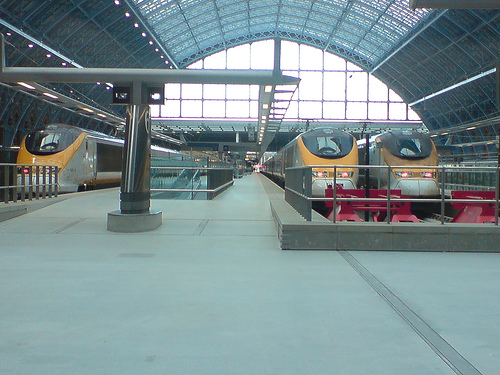
 I’ve just arrived home, having taken Eurostar 9133, the 1256 departure from Brussels Midi to London St Pancras. The security paranoia on the route is now so absurd it’s worth a blog entry.
The first check at Gare du Midi is a ticket check, where the QR code on a print-at-home ticket is checked and an automatic barrier opens. This verifies the validity of your ticket to travel. If your ticket can’t be used in the barrier it can be manually checked by a member of staff. In short, you can’t get into the terminal without a valid ticket.
Second, your passport is checked by a Belgian passport official, confirming you are leaving Schengen. Third, your passport is checked by a UK Borders official, confirming your are allowed to enter the UK, and your ticket receives a stamp. More about this later. (If you are travelling only as far as Lille you do not have to prove your identity, because Belgium and France are in Schengen – the so called Lille-loophole).
Next the metal detector at security is set at such an absurdly high level in Brussels that they oblige you to take off belts and watches. What am I conceivably going to do with a belt on a Eurostar train? Wrap it around the driver’s head and force him to take us all to Paris instead of London? OK, check my luggage and make sure I don’t have a bomb in it, but no more – that’s what they basically do in London as far as I can tell, so why so strict in Brussels?
Then today when the train called at Lille for more passengers to alight and board, we were told on the public address system in the train that there would be additional checks in the train between Lille and Calais. These checks were carried out by a team of 7 French rail police carrying guns and batons, but just checking tickets (and not passports). I asked the policeman who checked my ticket why he was doing so. “Parce-que c’est comme ça” (because that’s the way it is) he replied. I pushed him further, saying that of course I had to have a valid ticket, because how otherwise could I have actually got on the train? “C’est contre la fraude” (it’s against fraud) was the best I got out of him before he moved off.
Now if this really is against ticket fraud, then why these armed police, and not Eurostar staff? And if this is actually a border check rather than a fraud check, why are they checking tickets rather than passports? Or are they actually checking the stamps on the tickets from Brussels (see above), and are hence working with UK Borders in some way? Or is it all just bravado?
It is also most definitely inconvenience – not for the checks themselves, but because the train additionally had to call at Calais (not in the timetable) to let the police off, and due to the stop the train had missed its slot to pass through the channel tunnel, meaning a delay of 15 minutes. The train manager, when announcing the delay, did not say why the delay had happened.
Then upon arrival in St Pancras, not announced to passengers on the train, all passports and all tickets were being checked by UK Borders at the exit. Which – quite frankly – seems to render other checks superfluous. Why bother having a UK Border check in Brussels, and French police check in the train, if you’re then going to check in London too? Plus, due to the small terminal exit and a few hundred people streaming off a train, the checks are not swift in London – I was only through quickly as I always travel in the front carriages of a London-bound Eurostar.
Now I don’t know what the right answer to this is – in security terms. A passport check for all passengers in Brussels (including Lille-bound passengers) would probably be the simplest, but is not legally viable it seems. Passport checks (with auto passport gates?) at St Pancras would be the most secure if the risk is judged to be adequately high.
But two things are clear from today’s experience: the way the checks are currently done does not work at all efficiently, and the communication about why the checks are happening is deeply inadequate.
Fascinating perspective on the evolving security experience with Eurostar. Having taken this route pre- and post-Brexit, I’ve noticed subtle but significant changes in border procedures. Do you think the current checks strike the right balance between security and passenger convenience, or has the process become disproportionately rigorous compared to air travel? Also, with the new EU Entry/Exit System (EES) coming soon, how do you anticipate this will further impact the Brussels-London journey time?
This is exactly why I havent travelled in Eurostar from Amsterdam again (where I go regularly). The whole appeal is that you are checked prior to boarding, and can leave at St Pancreas with relative ease. Last time a spontaneous check at st Pancreas took 1.5 hours, at which point I realised I was both financially and in terms of time better off flying.
Hi Elliot,
The extra charges of a government on the purchasing of property in the form of general country tax can be eliminate easily with in a seven days according to the rules and regulations of a government,If you write an application with the authentic reasons for a elimination of property tax and also attached a legal documents of a property tax pairs after that submitted in the government office by the tax layers which is helpful for you to approved the claim of your property tax in the seven days without any allegations of a government on the application of your property tax ,Remember don’t write any irreverent reasons in the applications of property tax you want to submit in the office of government and also don’t attached any illegal or extra document of property which increase the chances to refuse or neglect your claim application ,So keep it in your mind all the instructions and requirements given to you by the tax layer after concerning this kind of matter according to the current policy of government .
Thanks
Here are some links on the Eurostar London-Amsterdam and London-Cologne plans:
http://www.therailengineer.com/2013/10/31/new-eurostar-under-test (these new Eurostar trains have been spotted circulating in Germany for test purposes according to German newspapers and blogs)
http://www.railwayage.com/index.php/passenger/high-performance/eurostar-netherlands-plan-london-amsterdam-service.html (unlike the one above, this doesn’t mention Cologne)
http://www.railwaygazette.com/news/passenger/single-view/view/eurostar-confirms-launch-of-london-amsterdam-services-in-december-2016.html (see also the related news at the bottom)
http://www.railjournal.com/index.php/high-speed/db-puts-london-–-frankfurt-high-speed-pla
ns-on-ice.html
They have indeed, and they will certainly run to Amsterdam, though I’ve heard no more about E* running to Cologne since 2012 (and I fairly sure this was a spoiler against DB – I’m not sure they ever had any concrete plans to run to Germany, as the e320 would need modifying (again) to run on the high speed tracks between Brussels and Cologne). My guess is that it could involve an isolated carriage or, as I said, disembarkation at Brussels (with luggage) and reboarding, unless there’s a major security rethink.
No good answer has been given, because there is none, other than the fact it would take a considerable amount of time to do so. When the Daily Heil Lille Loophole was at it’s most hysterical, they segregated the passengers and called them forward one by one, and it took around 30 minutes per train to disembark them. Which, if you’ve been via Luton or Heathrow recently, compares favourably to passing through immigration there, but then kind of loses the advantage of a city to city journey. My question is why not do it on the train like almost every other nation, and like it was when E* first started, and I know the answer to that – cost, pure and simple.
Deutsche Bahn may have given up, but Eurostar itself has ordered new trains from Siemens and has announced they would run past Brussels to Cologne and Amsterdam. So how will they handle security and immigration?
Regarding immigration, it has been discussed above, but no good answer has been given why border controls must happen on the continent for train passengers, while they are done after landing on UK soil for airplane passengers.
Yes, Guido, I think that’s about the size of it. On a trip to Lille recently, I was been checked for luggage at STP by a private firm – the poorly trained, no doubt minimum wage worker told me that I wasn’t allowed to take a shortwave radio on the train ! I told him this was rubbish and he said “Oh, OK”.
In respect of the long distance train issue, Deutsche Bahn has given up the ghost of a Brussels, Cologne/Amsterdam service, in part because of technical issues to do with approval (abetted, sadly, by a regulator in the pocket of the major shareholder of E*, but that’s for a different thread), but also in part because of the difficulties in sorting out the immigration issues. UK immigration wanted people to detrain at Brussels, and reboard via the same check-in as the Brussels – London passengers, surely abnegating the whole point of a through train. Similarly, the return Avignon service in the future will have to do the same via Lille. One assumes also the same applies to immigration that applies to security – that something against the (alleged) hordes of swan eating, asylum seeking migrants coming to take our jobs is seen to be done.
Why are Eurostar passengers checked against carrying bombs in their luggage, while Le Shuttle passengers are not checked for carrying even larger bombs in their cars/buses/lorries?
A colleague guessed that Eurostar security checks have only psychological reasons, i.e. they are made to reinsure passengers that they do not travel with terrorists. On Le Shuttle, this isn’t done simply because it would be impractical.
However, these security checks come at the price of making long-distance trains to/from London St Pancras impossible, besides being a loss of time. Eurostar announced through trains to Germany and the Southern France, so I hope they will think over security.
I guess there are European or international standards for security in railway tunnels, and since other tunnels, e.g. in the Alps or in the London underground, may be crossed without security controls, why not the Chunnel?
The only intelligent solution would be border controls only in London St Pancras both for leaving and arriving passengers, and no security checks.
They’re doing this, in the main either as a result of (cough) ‘intelligence received’ or, more probably, to give you the illusion that ‘something is being done’ about migration (legal and illegal). I’ve caught the train multiple times from Paris to London, with nary an additional check, but Brussels to London is a different kettle of fish.
Someone poses the point – why not check on the train ? – I can answer that, as I have used E* since 1994 – the answer is they USED to check on the train (and remove miscreants), but E* refuses to pay the additional money for an on train check. Similarly, there was a lengthy dispute between E* and Belgian Immigration in the early 2000s that led to us having to show our passports to both French immigration (at Waterloo, back when the E* terminal was there) and at Brussels. Someone else says “why, to enter the UK, there aren’t just passport controls at arrival in St. Pancras, like in any airport?” – in all probability because it would take forever to check 1600 people (2 E*’s worth) with the degree of scrutiny required, and to stop them making an asylum claim on British soil.
The metal detector (and indeed xray) is stupid, you don’t have it on other trains.
The 2 passport checks in Brussels is fair enough, it’s the EU that has the additional exit check which the UK (and US) don’t. We’re hardly going to trust Belgian police to do UK immigration.
The idea behind the check before getting on the train is you can simply walk off the train and get on with your day, no long queues. It also simplifies stopping people who aren’t allowed to enter the UK (although they will be trapped in a no-mans land if they can’t re-enter Schengen).
One easy solution for the Lille loophole is to only stop at lille to pick up, but eurostar don’t want to lose the money.
The easier solution would be for the UK and Ireland to join Schengen.
its not any different then a plane you get your passport checked a few times before boring then once at border control , just the same even if it didn’t stop at lille they would still do the same thing
The point is really why, to enter the UK, there aren’t just passport controls at arrival in St. Pancras, like in any airport?
I am totally with you. It is a bit contrived. I am not sure if someone already said it in the comments, but what the french police were looking for is a stamp that the UK border control in Brussels put on your ticket. If you use the Lille “passthrough” you won’t get the stamp. If they didn’t do it this way, one could buy a ticket to Lille and one to London on the same train without actually getting a border control.
@ Annonymous – I’ve been through almost the same story with a female UKBA agent when arriving in London and though I went through passport controlsat gare de midi in Brussels, the female agent asked me to have a seat and wait. She then asked me some very stupid questions and suspected everything I was carrying in my small back-pack. I was searched by custom officers who were very correct handling the situation and another experimented police officer. The female UKBA officer had african backgrounds and she was the most stupid and unexperienced border officer I’ve ever dealt with. I hold a german passport and I have myself a foreign background ( This is to avoid thinking that I’m racist )
The probllem is not being controlled but how we are controlled.
It’s all security theatre for no real benefit. Best to just sit back, relax and enjoy the show.
When I have asked one border agent in the UK (as. British citizen) why they did checks on arrival while the UK Border Agency also had staff performing the same checks on departure from both Paris and Brussels, I have always been told it is because of the stop in Lille. The fact that the departure checks are then completely unnecessary has apparently never occurred to anybody.
And (again as a British citizen) I frankly don’t get why the UK insist on multiple checks when they in really are not that strict. They Schengrn are have far stricter border controls, and if I came from outside the EU seeking asylum or social benefits, there are countries within the Schengrn are that are far more beneficial than the UK. Yes, if the trains were coming in from outside the EU and the Schengen area then I would agree that some border checks would be necessary, but that is not the case with the Eurostar.
And although the cause of the problem is mainly the border agencies in the respective countries, I also feel that Eurostar could be far more forthcoming in informing their passengers what to expect. I have also been a victim of discarding my ticket upon leaving the train (it’s a train for chrissake) only to be asked for it at the border check and been threatened to be escorted “home” (which would be to the UK, which they initially did not allow me to enter despite having a valid British passport). The border checks at the UK airports never ask for tickets, they are only interested in passports.
I have just booked another ticket to Brussels, but the carrier is not Eurostar this time. I’m flying instead, from the London City Airport, which is just as convenient as travelling from St Pancras. It gives me more peace of mind and I won’t have to suffer the abuse from the French, Belgian and UK border police in nearly the same way.
I had a very angry female customs staff check me on my way OUT of London. After the ticket barrier, after the security, after the police check, then customs. Not all customs are psychotic.
Notably the older more experienced male customs officials show signs of intelligence. But the female angry staff? if they are short, female and younger than 35 your in for a very rude confrontational exchange. They need more training, a few just need to be outright fired.
It’s amazing to recall, that in the 1980s it was possible to travel by train from Cologne via Berlin to Moscow without waiting in any queue at either end, without ever leaving the train, and with the train taking local passengers in each country.
Despite enjoying pleasant journeys with Eurostar in the past, I feel obliged to attest to Jon’s concerns following my own recent experience whilst travelling on their service. Returning from Brussels this weekend my family are I were rudely addressed by the French police (and Eurostar staff) for not carrying our tickets within the café coach.
Upon explaining to the staff that our tickets were in our seated coach, the crew became agitated, but refused to translate their concerns into English.
Due to the situation escalating, I asked for an English translation at which point, to my horror, I was accused of being racist and was told that I would be forcibly removed from the service if I continued to question their procedure.
Whilst it would be untrue to suggest that I would never use their service again, it has certainly left my bad taste in my mouth.
I guess there are a number of options to close the Lille Loophole, all of which require some element of co-operation from the French and Belgians.
1. Don’t sell Brussels – Lille tickets on Eurostar. If the French/Belgians complain, we can point out that we don’t allow domestic travellers between St Pancras and Ebbsfleet/Ashford [who could stay on the train and enter France/Belgium illegally].
2. If tickets are sold for Brussels/Lille passengers, make sure that they are in one or two dedicated carriages which are locked and not accessible to/from the rest of the train. Eurostar staff should then ensure that the passengers disembark in Lille.
The nuclear option would be to insist on full passport checks on the train before entering the UK, with a service stop at Lille or Calais for 30 – 45 minutes where all passports are checked by UKBA and French/British police, and any third country nationals without valid documentation escorted from the train.
They did this on the Eurostar from Brussels to London yesterday. Train stopped at Calais just as you said. French police weren’t happy with the mobile check-in application and wanted to see the paper ticket. Got my passport checked at both ends – and had to go scurrying for the UK entry stamp at the London end. As a foreigner that has to fill in a landing card each time I enter the UK I agree it is ridiculous to have to prove one’s identity multiple times. Better they have the landing at the UK end.
Mind you – it’s not the first trip where I found long queues to the entrance, security, and customs at the London end when going to Brussels, and almost non-existent queues at the Brussels end. Clearly the London side operators of Eurostar are caught by surprise on a regular basis how many customers want to use their service.
Had the same experience of multiple checks in Brussels yesterday resulting in 15min delay in departure and 30 min late arrival at St Pancras. I travel regularly to/from Brussels and have this experience all too often. I have never received any kind of explanation from UK Border Control staff who only appear to relish the power they have to delay impatient travellers. Certainly there is no feeling of improved security – only unnecessary bureaucracy.
How much did we spend to build the high-speed link from the Channel Tunnel to St Pancras? £5.8bn – to shorten the journey times by 15 minutes. A time saving now negated by Border Control checks.
@Mel – I don’t know the answer to that. The tickets are named for Eurostar’s purposes, not for security purposes. It’s in order to prevent a secondhand ticket market, where people sell the non-refundable tickets to each other. I don’t know what security would do if the names don’t match. Apologies!
Crap, I was thinking of using a friend’s Brussels-to-London ticket to see my family for Xmas. Sounds like I would be wasting my time… or worse? If I get on the train with someone else’s ticket, would I be arrested, or just kicked off?
I traveled last night 17/12/12 on the Eurostar service from Brussels to London and was surprised to have had 4 security checks on the journey…..Two passport and ticket checks in Brussels by Belgium and British Border control.One onboard the train checking tickets only by nervous looking security staff.An unscheduled stop in Calais had one person removed by these guys.Finally on arrival in London a final check of ticket and passport by Uk Border staff and alot of suited officials hanging around.
Amazingly have done Eurostar journeys with no checks at all……
An apparently unnecessary ‘double border check’ by the British Border Force occurred on our direct Paris to St Pancras journey on Sunday 26th August – firstly at Gare du Nord and a secondly on arrival at St Pancras. The arrival was also 15 mins late, so the combined delay made our Euston connection to Chester very rushed. No prior warning and no explanation that tickets would also be checked – many people had already discarded them. An irritation to our 40th wedding anniversary treat!
The resolution to the Lille Loophole (which is already mostly resolved) would be to establish full juxtaposed controls at Calais-Fréthun, as this is the last station before the trains cross the border into the UK. The French authorities are generally very co-operative with the the British authorities on Channel Tunnel matters. It would not be unachievable to juggle timetables to ensure that all trains stop at Fréthun with enough time to clear the controls. Then task the French Police to ensure all passengers disembark to clear the juxtaposed controls and customs. This would eliminate the need for any other controls in Europe or upon disembarkation in the UK — saving money and reducing hassle for passengers. It’s important that control from Belgium is rigorous because Belgium is a global hub for illegal migration and people trafficking. Equally, it is important for the UK to maintain the controls in Europe to prevent the worst of the world’s scum claiming asylum on UK soil.
On a somewhat different note… the UK border check in Brussels not only checks our passports but seems to verify the name in one’s passport against the name on the ticket. While it would be perfectly within the rights of Eurostar staff to do this, it is bloody inconvenient of the UK Border Agency to step in. It was very useful to be able to travel with ‘second hand’ tickets every now and then when the original passanger was forced to modify their travel plans.
My partner and I already hand over a significant portion of our income to Eurostar as it is given how frequently we travel and they do not have a decent monthly or yearly subscription to offer.
Seriously, man – stop whinging. If, as a Briton, the thought of the Lille loophole being freely exploited, and the UK government helpless in the face of a Schengen rule doesn’t make you wince, you’re selfish and a simpleton. Take 30 seconds to show the cops your damn passport and stop complaining. What are you, some godly colossus who should stride through life unhindered and unconfronted? Pull your head out of your ass!
I commute every month for a fortnights night work in the NHS travelling Lille/ London occasionally returning via Calais.Always Eurostar.What is the problem with border checks on the train?It seems to me the usual’ anglo saxon’ resentment of authority in any of its forms in particular dressed in french policegear.Oh get real its well known people were boarding trains in Brussels with its lax checks and alighting in london and claiming asylum.Sorry but its a fact and it needs to stop.Why do you think all those young men are massed at calais poised to take advantage of a better life in the free market utopia of grubby little britain.If border checks etc are such an inconvenience perhaps a life in Somalia would suit you?No travel checks no income tax no speed limits…..Stop moaning for gods sake!
I regularly use Eurostar and have no problems with extra checks- the more the merrier. It is still much quicker than airport queues- so what is the problem?? We can’t rely on French and Belgian police to eject/refuse passengers for the UK as they have a comletely different set of immigration rules. So its quite simple- don’t travel on Eurostar if you don’t like the checks and i pitty the poor Officer’s that have to deal with morons like you on a daily basis. PIPE DOWN
@Rob – as you don’t know how to use an apostrophe I’m not too sure who’s the moron here.
It’s not intended to be logical. It’s intended to annoy the hell out of people and if that doesn’t work, make them cower in fear.
Armed French police moved up and down the evening Brussels-London Eurostar on Tuesday 6th March, but weren’t checking papers.
Same crazy queues at St Pancras on arrival. I asked the Border Agency person checking my ticket and he said the extra checks were because of ‘illegals’ from Brussels.
BTW, British Transport Police now have armed police and I’ve asked them, if they board trains, to ensure passengers are told that they are on board and, if possible, why.
I’m worried about this. Closing the so-called Lille loophole would likely result in eurostar abandoning Lille just like it has abandoned Ashford. If cross-channel trains to/from Brussels cannot carry passengers between Lille and Brussels, then there would be no benefit from stopping at Lille: it would have to just pass straight through Lille without stopping, rather than have a lot of empty seats between Lille and Brussels. And it would likely undermine the economics of new cross-channel rail services: I think that the proposed DB service would need to be able to carry passengers between Brussels and Lille if it is to make sense economically.
I am going on my first trip to Brussels this Wednesday, and like Tom I hope all this keruffle doesn’t mean the end of Schengen. Schengen is not only of the pillars of the European Union, but one of the success stories of European integration making the idea of a border-less travel possible.
One can’t help but feel that we’re witnessing the end of Schengen what with headlines today of Sarkozy’s threats (http://www.bbc.co.uk/news/business-17332458) and Denmark last year (http://www.bbc.co.uk/news/world-europe-14188727). With all the World’s economic and growing environmental problems (water and climate) a move towards a dystopian ‘Children of Men’ type scenario, with stringent boarder controls feels possible, albeit not to that extreme (I hope)!
This too has happened to me, although not as yet on a Eurostar. Back in December travelling from Brussels to Strasbourg on the train (IR via Luxembourg City) I had my passport checked not once, but twice by armed French police. They didn’t provide any useful reasons either why, I recall. Since there shouldn’t be any borders on that trip, I almost didn’t pack my passport, but I’m glad I did. Regarding the ‘Lille Loophole’ the extra check in London must clearly be in response to that, but I’ve noticed recently it’s hard to find tickets from Brussels to Lille bookable on the Eurostar site – always “fully booked” – which is odd for such a journey a couple of months in advance. Unable to book this via Eurostar, I’m now making the journey first class via TGV instead. I do sincerely hope we are not witnessing the unravelling of Schengen before our eyes…
I’m genuinely not sure what the checks on arrival in London are for. I only showed my ticket; and my bf only showed his passport. Both of us were waved through.