Napolitano: with leaders like this, no wonder Europe has problems
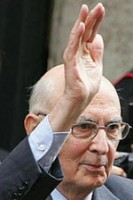
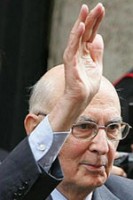 I spent an hour this evening at LSE listening to Italian President Giorgio Napolitano [Wikipedia] speak on the topic ‘Is there a future for European Integration?’, part of the LSE European lecture series [details].
The event got off to a bad start: a standing ovation for Napolitano in typical Italian style (there were plenty of Italians present), and a long period of applause. What for? For arriving? For just being President? I’m glad that this overly deferential approach no longer applies in UK politics.
Napoliano then started his speak – in decent English – but seemed to just have nothing interesting to say. I was hoping to be able to write something for Italian Economy Watch as a result, but Napolitano devoted all of 2 sentences to economic matters, in a speech that lacked any discernable direction or structure.
There were a few blithe statements about how Europe needs a better role in the world, how we need to feel secure in the face of a terrorist threat, how wonderful the Erasmus scheme is, bla, bla, but above all, he had absolutely no plans or ideas for the future. I’m sorry Napolitano, but you are now supposed to be a leader. You are supposed to be one of the people that has a position to inspire others, to give some ideas for the future. OK, I know the Italian President has little power, but surely some vision and statesmanship should be possible.
To cap it all, Professor Sarah Worthington, chairing the event, gave a sick-inducingly positive assessment of the speech, stating how welcome Napolitano’s vision was. Did she listen to the same speech as I listened to? Or was she just pandering to the deferential audience?
Or is it just that I have been to so many political speeches that I can’t ever get inspired any more? If we can’t look to our political leaders to help us find a way out of our current economic and political predicament, where can we look?
@Sicco : actually you are quite mistaking about the federalists. Federalists have been the most constant critics of the European Union and the way it is dealt with by our political leaders. The few things that work are actually those beaing dealt with through the federalist methods but mostly the EU remains a diplomatic organization that fails to obtain its goals. Because the EU is not federalist it does not work and it is bound to fail hence our criticism and our proposals for significant reforms.
Sicco – that’s part of the reason why I am so disappointed! I know Napolitano is decent at heart. So why so bland and dull and boring in his speech?
Jon, I think your expectations were too high: he is a Federalist after all and celebrating Europe without seeing actual or potential problems is precisely what Federalists are good at. Raise someone with the idea that the EU is a good thing no matter what … and you get speeches like these.
In reply to Walter: if he’s not supposed to say anything of any interest, why is he even trying to address the issue of whether there is a future for EU integration? Plus I recall that Ciampi actually had some decent ideas on EU integration.
Further, we should all ask ourselves this: just because a role has always been bland and dull, should it stay like that? Politics in most of Europe tends to move on from time to time, but Italian politics does seem stuck in an old fashioned time-warp.
The role of the Italian president is, basically to be a decent, non-insane guy that appears in ceremonies, uses his powers (veto) when laws are not compatible with the Constitution and tries help in putting a government together when it is required. Grand visions are not his province, and he would not have the instruments to implement them anyway.
More or less like the Queen.
So young, and yet so cynical. Anyway, what does Sarah Worthington know about the EU? I thought she was a company lawyer…
Well, what he said was like an academic lecture on the values of Europe. So there were some pleasant phrases about identity, and the values of universities. But not much!
As for Vanhanen, I think he’s dire. Probably worse than Napolitano actually. I heard him at the Sound of Europe conference earlier this year, and despite blogging about that a lot, I managed to not mention Vanhanen once… See the January Archive.
Alas, how right you are when you raise your eyebrows at such deferential treatment towards a very old representative of Italian politics. But Italians have never stopped swooning at their Princes…
Did he at least say something intelligent? My recent brush with political VIPs – Finland’s PM Matti Vanhanen lecturing us on The European Union and the Challenge of Globalisation left me badly bruised…
Surely, it could be worse. What do you think about Ségolène’s latest “ideas” about Europe?
http://www.taurillon.org/Carton-rouge-a-Mme-Segolene-Royal
http://www.desirsdavenir.org/index.php?c=interventions&id=191
Agh, hell. I suppose Royal might have at least said it in a moderaterely interesting way?