Muhammad cartoons situation getting really out of hand
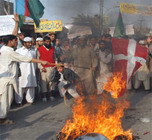
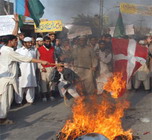 Things have gone from bad to worse with this row over the cartoons of Muhammad that first appeared in Jyllands-Posten last year. For an excellent and concise overview of what has been happening, see this blog entry from Robert Lindsay.
Right, so let’s put a few things straight. The cartoons were published, and great offence has been caused. No doubt about that. But – realistically – what can be done about it? Anders Fogh Rasmussen, the Danish Prime Minister, has done what he reasonably can: he has apologised for the offence caused, but has stated that in a country with a free press, he cannot and should not control what the press writes. I can understand why other European newspapers have responded by also printing the cartoons – it was an act of solidarity with Jyllands-Posten. More on that here.
All of this shows the scary power of the internet and world wide media – if such cartoons had been printed a half century ago, would we have seen the same reaction? Further, it seems to show that there are plenty of countries that seem unable to deal with the concept of free speech, and that one newspaper doing something is the same as the whole of a country doing something. Mix into this a lot of hard line religious dogma, and you have a horrid mess.
Just to give a kind of overview, let’s take the words of Samir Zaghir, from the Palestinian Ministry of Foreign Affairs who was quoted by the BBC as saying the cartoons are offensive to many Arabs and Muslims. “Have you ever see any Muslim write about Jesus in this way?” Well, no. But how many Muslim countries have a genuinely free press in which such a cartoon of Jesus could be published? And if something was written about other religions, I would doubt that the reaction of the people would be to start burning Iranian or Syrian flags in the street. Further, there are plenty of offensive things that have been said about the Christian religion – take Jerry Springer The Opera or something like that.
And worst of all, the reaction in Gaza and in Indonesia has been violent, just when Islam had been provoked by a cartoon showing the Prophet wearing a turban shaped as a bomb with a burning fuse! I wonder whether the irony of that has been understood?
Anyway, what should be done about all of this?
1. Leaders of all of Europe’s countries, and the European Commission, should write an open letter to plenty of arabic newspapers, and appear on arabic TV and radio saying that they are very sorry for the offence caused, but press freedom is a central value to European countries, just as Islam is a central value to arabic ones.
2. No more newspapers should publish the cartoons – the damage has already been done.
3. Efforts be made by leaders of countries where violence is taking place to calm things down – some calm language, and appeals for calm, would help for a start.
4. Once calm has been established, European countries need to reflect on what to do. The EU is for example one of the largest funders of the Palestinian Authority, but their offices were the ones attacked. If Saudi Arabia was one of the largest export markets for Arla foods, what should happen now? Should we still keep our trade as open with Saudi Arabia and others as we have so far? I am aware that 2 wrongs do not make a right. But, as some of the richest countries in the world, if European states cannot get their acts together to deal with this in the medium term it shows the depths to which our political leaders have sunk.
I would like to point out that I am an atheist, and nothing can manage to offend me sufficiently to carry out an act of violence. I want to make it clear that I am not writing this as some kind of Christian reactionary. It is the right of every person to have his or her religion, or none, and have that respected. Yet religion should have no special position in our societies that means it can be beyond criticism or caricature.
““Have you ever see any Muslim write about Jesus in this way?†Well, no.”
Well, yes, but not about Jesus. Just have a look at the hatred conveyed by the horrendous anti-semitic cartoons in the Arab press of many countries. Have a look at
http://www.chretiens-et-juifs.org/article.php?voir%5B%5D=104&voir%5B%5D=2811
or
http://www.adl.org/main_Arab_World/asam_july_dec_intro_2005.htm
Obviously, they don’t like to be insulted, but they don’t mind insulting others…
This being said, I concurr with what Amir wrote: the cartoons were clearly offensive and as such, go too far: freedom of speech should not entail libel, insult, incitement to hatred or murder. Jean-Paul Sartre said “Words [and for that matter, cartoons] can kill.” Unfortunately, Denmark is one of the most liberal country in Europe: you can even find publicly-funded neo-nazi radios. This is clearly a country where freedom of speech goes too far…
A few good strategies there 😉
when it comes to free speech, in an ideal world, discretion should be excercised, particularly when the impact of publications can by such that it causes disunity within society.
What I am wondering about cartoons and freedom of speech is this: would any of these european newspapers publish cartoons of jews that depicts them with big noses and money hungry? Would they publish cartoons that deny holocaust? It’s crime in these countries. The editor or cartoonist would go to jail. Hypocrisy? Apparently freedom of speech has limits to them.
Like a growing number of free-thinking persons around the world, I have had more than a bellyfull of those religious zealots who would try to impose their religious values on me (or anybody else for that matter). The Muhammad cartoon nonsense is a case in point. Religious fanatics of whatever stripe must come to understand that they cannot dictate, either by bluster or threat, political correctness to others. This goes for Muslims as well as the Pat Robertsons of the world. Until Islam becomes less-dominated by a bunch of whining adolescents will it gain the respect that it cannot at present rightly demand. I eagerly await the first masked gunman at my door here in Port Anne, Virginia. I’ve set a nice slice of Danish aside for them.
Thanks for the comment… I am especially interested in your words “to incite resentment from the Moslem world”. Jyllands-Posten has for sure managed that – it has generated mass resentment. But does knowing resentment would be created make the act of publishing the cartoons wrong? It has been painful – no doubt – but they have managed to show just how different certain countries’ value systems are, and have managed to show this better than 101 Amnesty International reports on human rights violations in places such as Saudi Arabia.
Logger jack – you are welcome to provoke me as much as you wish, but nothing you say or draw is going to make me respond violently.
The Satanic Verses controversy back in Sept’88 caused outrage among Moslems worldwide due to it’s irreverent depiction of Prophet Mohammad by India’a renowned author Salman Rushdie.The late spiritual leader of Iran,Ayatollah Khomeini condemned his book as blasphemy against Islam and called for his execution with a US3m tag on his lifeline which still stands today.
The slanderous caricature of the prophet is indeed an unmindful and deliberate act by the Danish daily based on the principle of press freedom to incite resentment from the Moslem world.
A group (or individual) displays freedom of press when it does not oppose by force, does not oppose by rhetoric, or actively supports religious beliefs or activities of which it is not a part. Religious tolerance does not mean one must view any or all other religions as equally valid to theirs but simply that one accepts other’s right to hold religious beliefs different from one’s own and practice their religion as they see fit, within reason.