
 Brussels is lobby-central. Everyone is at it – companies, NGOs, national governments, trade associations – trying to shape legislation that has an impact on 500 million citizens and the market rules for the products these people buy. It’s generally said that the EU institutions are the second most lobbied in the world, and that only Washington DC has more people in the business.
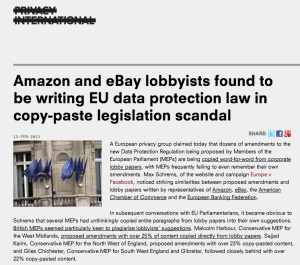
So it was a bit of a surprise when today Privacy International called it a ‘scandal’ that business lobbies have been found to have written – word for word – the amendments to a Data Protection Regulation. The companies doing this are apparently Amazon, eBay, the American Chamber of Commerce and the European Banking Federation. But this practice happens day in, day out in Brussels, and has been for years and years. A old Brussels friend has told me he knew of a MEP in the 1990s who even kept the companies’ logos on the papers he submitted with amendments.
This news today was presented on a new and very neat website – LobbyPlag – that also gives a percentage of the amendments tabled by each MEP that is purported to come from businesses.
This created a bit of a counter-reaction from FDP MEP Alvaro, who shot back with a comparison of NGO Bits of Freedom’s amendments, and those submitted by Green MEP Albrecht (top story here).
All of this raises a few questions:
1. Is it right for the likes of eBay and Amazon to lobby in Brussels? For me the clear answer is yes – they have a legitimate business concern, and are welcome to present it. Conversely other non-business interests such as Bits of Freedom must be heard too.
2. Is there any substantive difference between a business lobby’s amendment being copied word for word, and a NGO’s amendment being substantively used by a MEP, or vice versa? OK, a simple copy-paste is more blatant, but as LobbyPlag shows, it makes influence easier to track than an amendment with the same purpose but different words.
3. All this also shines the light on who MEPs meet, as well as the amendments that they submit. The UK Tories have – up until the end of June 2012 – published details of the all the meetings of their MEPs (see ‘Right to Know’ in the sidebar here), while other MEPs do not systematically do this.
Lobbying and interest representation are an inevitable part of a legislative process. Hence the best that can happen is for citizens to be able to see what their representatives have been doing, who their representatives have been meeting, and to then judge those representatives at the ballot box. Tools like LobbyPlag, the Commission’s transparency register, and the work of organisations like Corporate Europe Observatory are vital – we need more transparency, not less. But conversely we should not wish corporate lobbyists did not exist, nor view their practice as scandalous. Not knowing what they are doing is the scandalous bit, and on that front today marks a small step forward.
Not just food labelling regulations. Interesting to see which organisations are named as having agreed to the Horse Passport Regulation….. All too clearly, it’s now relevant to ask how that regulation could be made to serve other interests, as it doesn’t appear to have done much for European consumers so far.
And we’d see no trouble with having parts of it written by companies whose only interests they represent are theirs?
Except the lobbyists are writing legislative proposals, not legislation – it is still up to Parliament to decide whether or not to adopt these proposals.
Interesting, given current worries about horse-meat, to speculate on who wrote what in the EU’s regulations on food-labelling relating to origins of, eg, meat and meat products.
Good article, which I agree with….
One major factor which is often overlooked is (despite what the tabloids claim) the EP and Commission are actually very understaffed for the amount of legislation they are responsible for affecting 500m citizens.
Therefore they rely a lot of external input i.e. lobbyists.
The avg US Congressman has 15+ staff (for 350m citizens) compared to usually 4/5 for an MEP.
I agree that lobbying will happen regardless, but for me the copy-pasting is the real issue here. We’re talking about a regulation, i.e. the highest possible form of EU legislation, directly applicable in all 27(/28) Member States. And we’d see no trouble with having parts of it written by companies whose only interests they represent are theirs?
MEPs quite legitimately want to be taken seriously as policy- and lawmakers. Fair enough. But in my view the ethics of lawmaking impose not to act as a referee to decide which words get in and which words stay out of legislation—essentially what copy-pasting MEPs are doing. Lawmaking is about listening to the interests of all sides to a debate, and then *produce* wording that will serve the common good best.
Definitions of ‘common good’ will vary between GUE/NGL and ECR quite obviously, but the essential difference between lobbying and politics is the former serves particular interests, while the latter serves the general interest. Blurring the line too much between these two is never a good idea.
Lobbying cannot and must not be banned. However, as I see it at least two conditions must be fulfilled for it be legitimate and “fair”:
1) To the extent possible, the process must be transparent so public debate is appropriately informed. This can be partially formally organized by institutions (“lobby register”) but it is primarily up to transparency activists and journalists to subject policymakers to scrutiny.
2) Lobbyists must have no role whatsoever financing MEPs’ activities. This is mostly a non-issue, nothing like the horrific situation of basically legal bribery in the U.S., but can persist in the form of funding for think-tanks, events, junckets, in-kind gifts..
It would actually be nice if what LobbyPlag puts out there for the Data Protection reform would be transparent by default, i.e. through a standard legislative footprint. This would demystify influence processes (as you rightly point out) while at the same time at least discouraging attempts of trying to unduly or secretively shape EU law.
(And I’m saying this as much as an EU citizen interested in more transparent EU law-making as I do say this as a pro-transparency & anti-corruption lobbyist/advocate/activist/campaigner… 🙂 )
I very much agree, Jon. For me lobbyism is very much related to parliamentarism, even born in Westminster parliament and it never worked in dictatorships. For sure it is the task of representative democracy to implement rules on transparency and equal opportunity. MPs as well as civil servants must be aware of the diverse intentions of interest groups. But it is up to freely elected representatives how use interest groups arguments. A fair parliamentarian observation on lobbyism/civil society activism is needed of course. Media has the task to help but is sometimes even more interest group driven. We need to think complex and not ideological: wysiwyg does not work with lobbyism. Easy answers are misleading. I tried to underline this here: http://bernd.huettemann.eu/brussels-business/