How much does it cost a country to buy some influence in Brussels?
 It’s one of Tony Blair’s best known phrases, a promise to put Britain at the heart of Europe. Leaving the big issues (Euro, Iraq) to one side, any relationship with the European Union needs people to make the relationship work, and that’s the focus of this blog entry – where are those people, and how can you (should you?) support them?
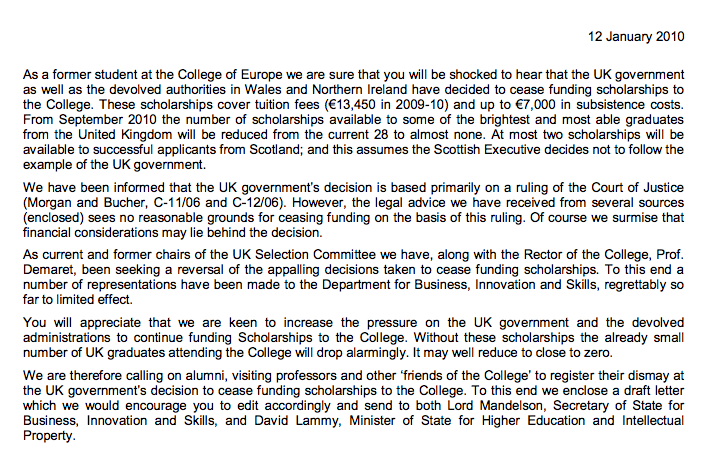
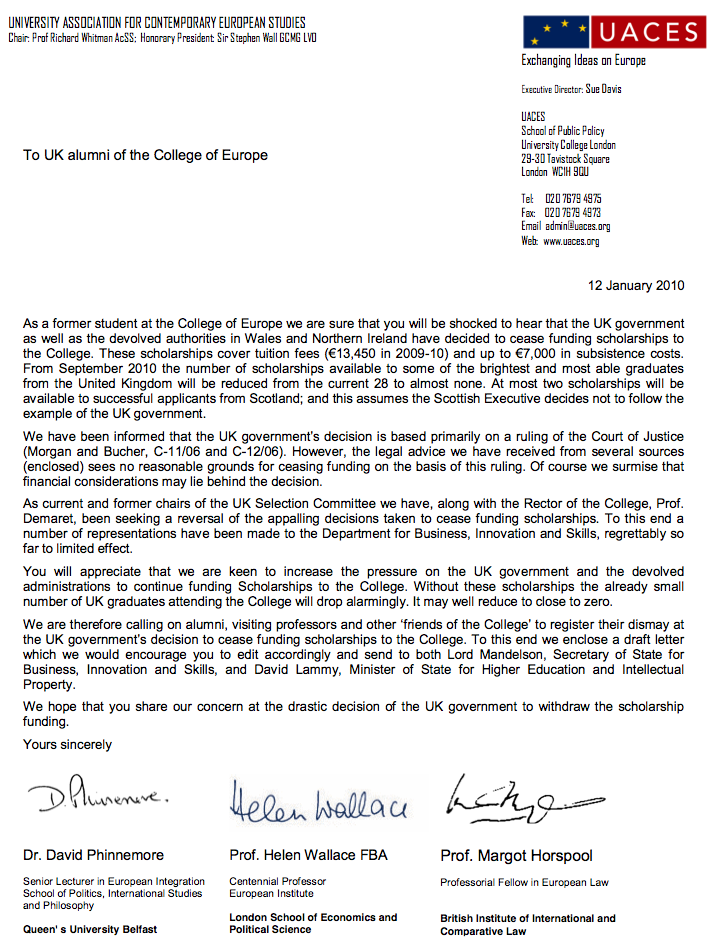
The decision to look at this was prompted by an open letter to all UK alumni of the College of Europe (I have a MA from Bruges, 2004), informing us of the decision of the UK government to stop funding the 28 annual scholarships for Brits. I’m not sure exactly how the cash allocation is worked out, but the total cost of this will be something in the region of £300000/€350000 a year.
David Lammy, the BIS minister responsible, gives some flimsy legal reason for why the funding cannot be maintained (more in the letter), but essentially it must be that they are looking for ways to cut the Higher Education budget, so why keep funding scholarships to small colleges in Belgium and Poland that train people who mostly end up working as eurocrats…
But hold on a moment. Haven’t I heard that recently? That Brits are underrepresented in the institutions? Hence the European Fast Stream scheme has been re-introduced within the UK civil service, promising a posting to Brussels and enhanced training to allow participants on the scheme… to become eurocrats.
Indeed it’s obligatory to participate in any concours for which you’re eligible when on the scheme (see the bottom of the page here). It’s hard to estimate the cost of the new EFS, but the cost of recruiting one Fast Stream civil servant is around £10000, plus there will be training costs on top – £200000 a year for the reintroduction at a rough guess? (Just to underline my EU-übergeek credentials I should say I was on the original European Fast Stream in the civil service between 2004 (after Bruges) and 2007).
So what does the EFS do, what do Bruges and Natolin do, that might be worth the UK government financing?
Essentially the answer is the creation of networks of expertise that overlap between London and Brussels, and cross between government and the private sector, and hence greatly smooth UK-EU relations. Friends of mine from Bruges work in Brussels and London, for government and the private sector, but almost all of them in EU matters. Friends from EFS work in EU jobs across UK government and the EU institutions, and a few have even made the leap to the private sector or academia, but almost all are still engaged in EU affairs. And most of us are still in contact, part professionally and part on a personal basis, with people we met through either route. Getting things done in Brussels is not as easy as learning the rules and going and getting on a Eurostar – it’s just not that simple, and EFSers or College of Europe graduates understand how to play the game.
It’s also worth underlining that neither the College of Europe nor the EFS are bastions of federalism or integrationalist thinking – in fact I had rather hoped to meet some more ideologically minded people when I studied at Bruges! Also remember it was Thatcher who established the EFS in the first place back in the 1980s.
In short, whatever you think about European integration, any EU Member State needs well trained and knowledgeable people to help oil the wheels of the machinery, and half a million pounds a year to manage to make that happen (i.e. keeping College of Europe funding going too) should not be an exorbitant price to pay for that.
(Note: there are serious shortcomings of both the EFS and the College of Europe – those will be the subject of some later posts if I find time!)
Anne,
Point taken. I shouldn’t have generalized to include our Paddies, with Irish having been adopted as an official language and all.
Still, I wonder what the numbers look like once you correct for LAD profiles.
I think Irish officials are somewhat over-represented in the Commission despite our linguistic ineptitude…
Anyhows, Jon, your country should just offer passports to EC officials (or laureates on some list) willing to swap nationalities. I wouldn’t mind joining the ranks of perfid Albion and giving it to the frogs… where can I report for duty?
Jon, I wouldn’t have expected any less of you.
It is a very appealing theory though. The very fact English has become a global lingua franca means native English speakers have no need to flex (hence train) their lingo muscles, which implies that -among others- through the 2nd language entry criterion the numbers of Brits and Irish remain low in the EC. This in turn increases the acceptability of English as a lingua franca to other EC nationals as the absence of native speakers in the institutions gives English a sort of innocuos Esperanto-like halo.
As I said… add more native English speakers to the mix and the current pax anglosaxonica might start oscillating into hitherto unfathomed bandwidths… Frogs getting real nasty, Germans retaliating…
As my favourite economist/linguist/cross-breed mongrel Van Parijs wrote “English native speakers should pay some form of tax as compensation for their language’s adoption as the EU’s lingua france”. This does strike me as an implict kind of tax.
@Elated – just for the record – je parle français, ich spreche Deutsch och jag prater en lite svenska ochså… So I don’t fall into your stereotype group.
I believe the combination of monolinguism and high salaries paid in the City will eternally keep the numbers of UK officials in the doldrums.
Imagine all of a sudden we’d have about as many Brits as frogs in the EC. This would make the current bickering about which should be the lingua france (French to buy a coffee, English for more lofty purposes) even more vitriolic as then all those native tongue speakers would be seen to enjoy definite career advantages.This is the deal: we grab your language, turn it into some apish pidgin called “Euro-English”, in exchange you stay out.
(btw: the alumni I’ve met all seem to have more of an EPA-profile. This is not the type calling the shots… trying getting some multilingual quants in (or lord forgive, some legal types), but then again any quant worth his/her salt in mainland Europe already fled to London or New York, we’re left with the dregs from the keg anyhows).
Interesting post – I guess govt prefers fast-tracking civil servants to funding scholarships because it gives them more control? Any idea if other countries are also cutting scholarships?