German election: a tough night for the left, where now?
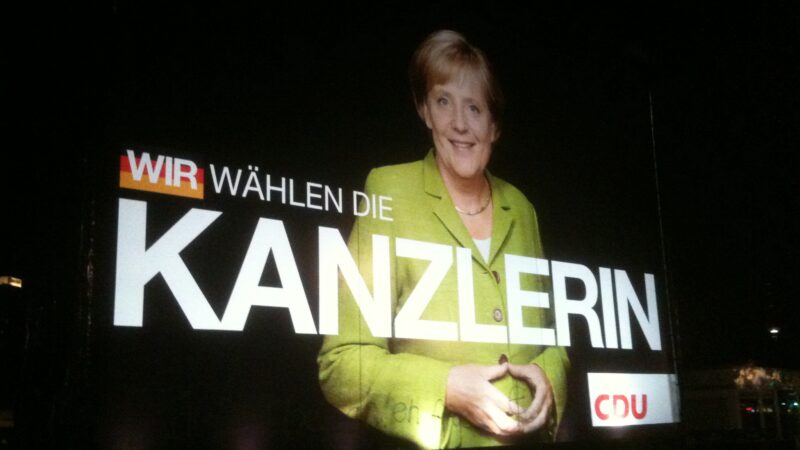

CDU at Hauptbahnhof - J. Worth, CC Sharealike
Hoping for the continuation of the grand coalition was the best the SPD could hope for before yesterday’s Bundestagswahl. In the end the result was even worse than that: 23.1% and a historic low vote for the social democrats. Guido Westerwelle’s beaming grim was everywhere, the FDP the big winners on the night.
Looking behind the simplistic headlines in today’s newspapers, what can be deduced from yesterday’s result? First of all this was no major shift to the right. FDP plus Union (CDU/CSU) were only a couple of percent ahead of the left (SPD, Die Linke, Grüne) and indeed the CDU lost a percent in comparison to the last election and scored their second worst result in history. For the CSU it was worse, at 40% a result that Seehofer found hard to take.
On the left the picture is complicated. The headline figure is the 11% loss for the SPD, balanced to a certain extent by the 3.5% gain for Die Linke and 2% gain for the Grüne. With the SPD on 23%, Die Linke on 13% and Grüne on 10% the left is split as never before.
Behind all of this lies a 5% decrease in the election turnout, down to 72% this time from 77% last time. According to ZDF last night that hit the SPD particularly hard; almost 2 million of their voters from the last election did not go to the polls this time. The SPD polled 20 million votes in 1998; yesterday it was a fraction over 10 million. That’s a lot of rebuilding to do.
The initial reaction of the SPD party leadership last night was to carry on. Defeated Chancellor candidate Frank Walter Steinmeier indicated he would be a candidate to lead the SPD Fraktion (group) in the Bundestag and party chairman Franz Müntefering indicated he would be ready to put himself forward for a further term of office at the party congress in November. Now is not the time to flee from a problem was a line from both of these rather grey old men.
So having set the scene, where now for the left?
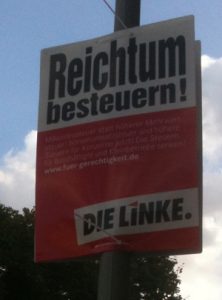
Die Linke poster in Berlin-Mitte - J. Worth, CC License
First of all the SPD and Grüne have to work out what to do with Die Linke. Die Linke are not just going to disappear or their support crumble. Strong among former SED voters in the East, their leftist rhetoric appeals to old style lefties and young radicals in the old Bundesländer too. What has to change is the simplistic and irresponsible discourse of the party leaders, Gregor Gysi and Oskar Lafontaine. “We’re the only party that speaks against the neoliberal consensus” is their line. So Oskar, what are you going to do to change things then?
There is understandable reticence in the ranks of the SPD and Grüne to cooperate in any way at national level with Die Linke. They are populist, irresponsible, not ready to govern is the typical rhetoric from the Grüne and SPD people I spoke to during my days in Germany observing how a campaign is conducted. Fair point, but what is the alternative?
The FDP, now firmly installed in government, was even more in favour of a black-yellow administration than the CDU was. A traffic-light coalition (SPD, FDP, Grüne) nationally is hence off the agenda for a long time. A SPD-Grüne coalition looks far from possible with 10+% of voters on the left backing Die Linke. The SPD has suffered in the grand coalition in the last 4 years, so no-one should aspire to enter into such an arrangement again any time soon.
So among all the various unpalatable options for the left, and the SPD in particular, a Red-Red-Green (SPD, Die Linke, Grüne) administration should be the aim for 2013. Mathias Platzeck, returned as Ministerpräsident in Brandenburg, could start the process by entering into coalition with Die Linke in Potsdam in the Brandenburg Landtag.
Don’t get me wrong: I don’t like the idea of trying to put together a Red-Red-Green alliance, but what else is there? Every other alternative is worse. Opposition for opposition’s sake is useless, black-yellow for a generation a prospect too hard to bear.
The Grüne have a role to play here too. Their leadership must sit down with the SPD leadership and hammer out some sort of arrangement about how to deal with Die Linke. For SPD cooperation with Die Linke without the same from Grüne could cause an exodus of SPD members to the Grüne. All three parties are going to have to work together, and that better start now more intensively between SPD and Grüne in the first stage.
While the leadership of Die Linke and Grüne is stable, the same cannot be said for the SPD. After a historically bad result it is simply unacceptable for the leadership status quo to be maintained. How can the SPD possibly inspire anyone in the future with the same leaders that delivered a historically bad result, both of them also implicated in the decisions of the Schröder government (Hartz IV for example)?
Steinmeier can probably hold on in the SPD Fraktion (group) in the Bundestag but the same surely cannot be said for Franz Müntefering. The buck has to stop somewhere and as party chairman his head surely has to roll. The problem is the SPD is short of alternatives, having ousted Kurt Beck and with Platzeck’s health issues. Andrea Nahles, considered to be on the left of the party, might be a possibility but now is not the time for timidity: the SPD has 4 years to rebuild, and the work has to start now.
Hammering out an acceptable message is also not going to be simple. The Greens appeal to a younger, more liberal, middle class electorate while Die Linke aspires to be the party of the old and hard left. Where is the space for the SPD within that? To be forward looking, optimistic, but holding on to the old supporter base. Pragmatic but also ideological. Social but also responsible. Those are a series of hard questions to frame in a crowded five party political system.
(Cross posted to social-europe.eu)
Well i guess there is a good answer for that question. But only few can make choices and others can assume. When we talk about German politics people most commonly think of Hitler and the Nazi regime. And many don’t see it from outside lately becouse like there is nothing to see or hard to see anything. Germans have help us here in Bosnia many times, and I think that Germany deserves to be the leader in the new upcoming era and world order.
I’ve not been following German politics closely recently – but am pleased with the results in one respect. I think grand coalition is a bloody awful way to govern in a liberal democracy – creating one big political establishment from the political mainstream, and encouraging people to vote in unusual ways if they want real change. Of course I’m not pleased that the SPD has done so badly, but grand coalition is part of the reason for this, and for the bad performance of the CDU/CSU too. One of the main reasons for the FDP’s success must be simply that it wasn’t part of the previous government.
I’m not sure what the way forward is for the left in Germany, or the SPD in particular. I do think though that its leadership looks exceptionally boring and tired, and that whatever the strategy – even if it’s to seek alliance with Die Linke and the Greens – it needs to win back voters from both those parties. If it can’t, then those parties may begin to think their best strategy is to try to take over leadership of the left, not to shore up the SPD by cooperating with it.
As long as the SPD continues making cuts in public services whilst in government, Die Linke should not even consider any sort of alliance. You can’t act as capitalism’s executioner and expect workers and the poor to see you as their representative.
Jon,
In Sweden the Social Democrats are working long term with the Green Party and the ex-Communist Left Party to forge a credible government alliance ahead of the September 2010 general election, in the same way the non-socialist parties succeeded in winning the last election.
In both cases, joint programmes and converging policies are key, such as the Greens and the Left (as proposed by its leader) dropping their demand for Sweden to leave the European Union (which it joined in 1995).
The obstacles between the parties may be higher in Germany, but as you say, there are few options …
The clear answer is, the SPD has to bite the bullet and work with Die Linke somehow, or courageously confront it head on and win back the left support. Either is massively risky. Thinking aloud, It may be worth the SPD investigating a multi party ‘red-green’ pact as has been instigated by social democrats in Sweden in Norway, admittedly in very different circumstances. Above all else, the SPD leadership, whoever that ends up as, has to remember that Die Linke are a monster they themselves created.
A bit off-topic but still interesting: there have been regional elections yesterday in Upper-Austria. The votes there for SPÖ are 11% down. It is the 5th loss in a row for the SPÖ in regional elections in Austria. Everyone in the party is alarmed.
But as there is no “Linke” in Austria, the Social Democrats get more squeezed between the Greens (which is maybe a bit more split in Austria between hard-left and liberal-left) and the FPÖ (which runs very populist anti-immigrant campaigns since years).
One starts to wonder whether there is still space for a moderate Social Democrat party.