The space between Alexander Stubb and Giorgos Papakonstantinou
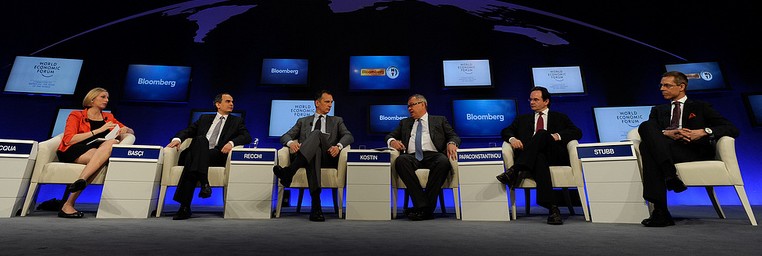
An old article in Helsingin Sanomat about Alexander Stubb was entitled “Alex Stubb is too smart to make trouble”. That was in 2008 when he was appointed as Finland’s Foreign Minister. Now in his guise as Minister for Europe and International Trade of Finland, Stubb presented today at the World Economic Forum event in Istanbul. It was the chance to hear live a politician I’ve been watching for a while. The title of the Helsingin Sanomat article remains very true.
The problem for Stubb was his job restricts what he can and cannot say. His protestations that he is “just a humble minister” and not an economist but a political scientist do not really cut it. He’s one of the sharpest politicians in the business, and of course he has answers. He just cannot say them. “Should inflation be allowed to rise in the Eurozone?” the panel was asked. “It’s a taboo subject” he said.
Earlier on Stubb had professed to being a federalist, but nuanced it by saying the EU would never be as much as a state and saying nothing of how EU level democracy could be organised. The other Eurozone countries are being generous to Greece he said, by committing 170% of the value of Greece’s GDP in loans to that country. But are these prescriptions working? Again nothing concrete. Stubb’s hands are tied as much as those of Jutta Urpilainen, Finance Minister in the Finnish Government and a former member of the Young European Federalists (not that you could determine that from her public statements on Greece!)
The antidote to Stubb was none other than Giorgos Papakonstantinou, former Finance Minister of Greece 2009-2011. Papakonstantinou was at the eye of the storm in Greece – there’s no way that anyone in his position could possibly have survived politically. But – thankfully for our sake in the audience – is that Papakonstantinou has reflected deeply about what went wrong in Greece and has joined some of the dots and is ready to point out the errors and some of the ways forward.
On inflation where Stubb said it was taboo, Papakonstantinou stated yes, inflation should rise. He was also very pointed about where EU decisions were badly wrong – for example at Deauville in 2010 when France and Germany agreed that private debt restructuring would potentially happen, but only from 2013. The decision to postpone this, according to Papakonstantinou, was the error that led to the increase in bond yields in the peripheral Eurozone countries as the threat of restructuring was present but swift action was lacking.
Here, in the space between Stubb and Papakonstantinou is the discontent with modern politics. Stubb dare not go further than what he can say, but everyone can see he is self-censoring. Papakonstantinou, free from his responsibility, can be more frank after the fact. While it’s fascinating to see this game being played out, as a citizen it leaves me cold.
Stubb was pretty outspoken when I interviewed him back in January. When I asked him whether it was time to implement eurobonds or some other mutualisation of debt in order to get ahead of the crisis, he responded:
He was even more outspoken last year, when he was quoted by Reuters as saying:
Similarly, Estonia’s Minister of Finance, Jürgen Ligi, was pretty outspoken when I spoke to him:
I think the article you opened with actually sets things out pretty well. Stubb (and other ministers) recognise that what they say can have a big impact on events (not to mention their own careers in government), and when they want to make an impact they can be ferociously outspoken. Otherwise, they try to proceed with caution.
An interesting parallel to this: Distinguished Congress scholars Thomas Mann and Norm Ornstein in their newest book suggest the establishment of a “Shadow Congress”, made up entirely of retired Congress members, who could discuss the issues of the day more honestly and openly than the current members.
The trend towards media inviting “commentators” to discuss the political news of the day annoys me greatly, but I have to acknowledge a part of the reason for it is that politicians are mostly too well-prepped for media appearances to say anything that reveals the hard choices and difficult weighing of different views going before their decisions. As the West Wing quote has it: “[I]t’s the classic Washington scandal. We screwed up by telling the truth.”
“All right. Let’s try not to do that that much.”