Post-war Tourism
Rounds are fired, politicians posture, and families flee. So is the story from Gori today and from Mostar at the start of the 1990s. As war in the Caucasus turns to nervous truce I’ve been watching the news reports and reflecting on the goings-on while spending during two weeks in the former Yugoslavia – Rijeka, Sarajevo, Mostar, Dubrovnik and the island of BraÄ.
There are tourists all over the Adriatic Coast, partiularly Italians everywhere, Germans and Austrians in Sarajevo, and plenty of Brits and Scandinavians in Mostar and especially in Dubrovnik. It is encouraging that these places are now able to generate a good tourist trade, and are ready to move on from a troubled 1990s.
But I wonder how many of the visitors that pour off the cheap flights from Köln, Milano, East Midlands and Stockholm in Rijeka, Split and Dubrovnik, take the opportunity to learn from what happened in the Balkans very much in living memory?
One Wednesday morning I was the only visitor at the excellent photo gallery War Photo Limited in a quiet side alley in Dubrovnik Old Town. It is remarkable to see the images of the fire burning in the old port of Dubrovnik in 1992, the very same place I had sat at a crowded restaurant the evening before for a meal and a pivo.
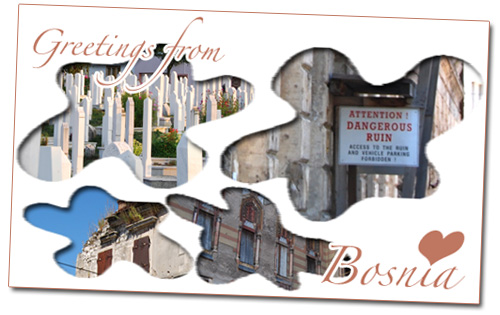
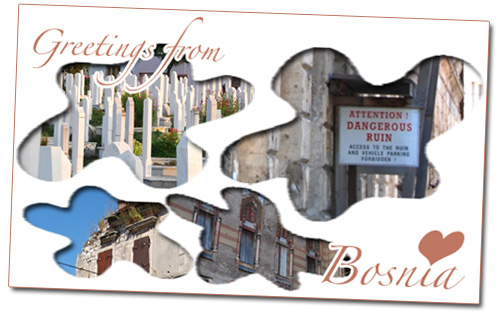
Earlier in the week I was one of the few that ventured away from the UNESCO-listed old town in Mostar, beautifully restored, and climbed the overgrown steps into Mostar for real, many buildings still burnt-out shells with bullet holes in the concrete. Sarajevo the same – not too many leave the film festival to visit the cemetery on the hill.
Don’t get me wrong – I’m content that tourists are making their way to South Eastern Europe. But we must never forget the horrors of war, and the dangers of not acting to stop a conflict, and the former Yugoslavia is a sober reminder of that. When, tanned and happy, the tourists return home to see images of tanks on the streets of Poti or rallies in Tbilisi on BBC News, RAI or Tagesschau, do they make the link?
When politicians in the EU’s major powers – France, Germany, UK, Italy – are faced with tough choices about military action, whether to send troops to our near neighbours (for the Georgia experience shows it will happen sooner or later), will those same content tourists sat at the old port in Dubrovnik be the first ones to criticise the actions of their politicians, unwilling like the rest of the population to send troops to faraway places?
I was in former Yugoslavia, near Dubrovnik guiding a group of tourists when the first problems started, fights between the national army and Croat police. Before I knew it, I was part of an evacuation effort extracting tourists from the country. I’ve followed the conflict ever since.
I think what you underestimate is that such recent wounds need healing before people are able to actively commemorate what happened. The fact that tourists do not visit exhibitions about the war, cemeteries, etc, does not at all mean that they are not aware of the horrors of recent history.
I visited Croatia and Yugoslavia two years ago. I studied in Austria for half a year and one met a very good friend there that was originally from Mostar and grew up in Makarska in Croatia.
I had the chance to visit his hometown and heard some pretty shocking stories from him, he was just 4 years old when he went through the wars but remembers many details about that time.
When most people go on vacation they prefer to concentrate on the positive things, and all those stories are very heavy but should be remembered.
Most people in Europe have no clue about war and think that the last real one was WWII but it is not true.
I think that the tourism boom in those countries should be used by the locals to build their businesses and make some money for themselves!
You write that you are a social democrat. Very well so am I. Then you´ve written a post about the necessity to use force. Well if you believe in this you´ve misunderstood social democracy. It is not an Ideoligy to die and kill for, it is (opposed to most of its historical and present competitors) one to live for. It is an ideoligy that argues the points of disscusion, negotiation and reason (and social security of course).
The lesson of the 20th century from Sarajevo to Sarajevo, shows us what happens if “we” believe we have to kill “them”: We kill them and they kill us.
This is what we learnt in the 20th centrury. Most of us at least. In the early 21th we face a new totalitarian threat, this time a totalitarianism which isn´t like religion like the old ones but which is religios expansionism with 21st century teconolgy. Violent Islam and violent christianity (euphimisticly called neoconservativism). To refuse to fall for theese new threats is necisary for us social democrats and to lead by example not to see conflict and social problems in millitary terms but to see them like they are, and to solve them socialy and politiclly.
The only socies we can in any way control are our own. We as social democrats has to: stragnthen the social spending at the price of millitary and “security” spending. Thus we will creaate a world where democacy, freedom and the rule of law prevails. This we´ll never do by force.