Non-legislative barriers to the EU Single Market in the UK
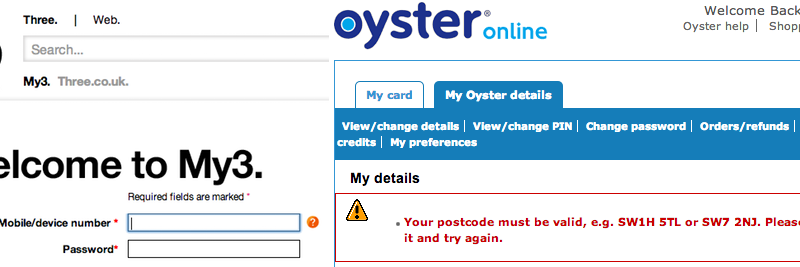
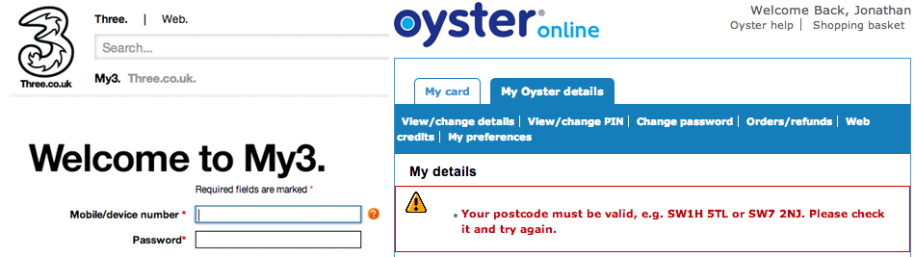
I was back in the UK for the first time in ages last week and was frustrated as a result of not being able to use two services I had grown to rely on – my Three Pay-as-you-go Data SIMcard, and Auto-TopUp for my Oyster Card.
What’s the problem? A postcode.
Yes, well, it’s a little more complicated that that, but that’s the essential issue. Both My3 and TfL’s Oyster online system oblige you, logically enough, to add an address to your profile. When you make a top-up this address is checked with the address listed for your card with the bank, and if that lookup fails, the payment fails. The problem is that while I still have a UK bank account, and hence an associated debit card and a credit card, the address associated with that account is in Germany*, and that address has a 5-figure ZIP code associated with it, rather than the UK’s 7 or 8 character postcode. Trying to enter a German address in either My3 or Oyster online fails, and if I leave my old UK address there then the payment fails instead.
Neither of the services above are contracts – if I were to disappear then the companies can just close the cards in question. Were it to be a contract for a phone then it would be different.
So the next time you hear some UK politician complaining that the European Commission is not doing enough to complete the Single Market, perhaps you can point them to this blog entry instead, and remind them that some UK services are not too hot at dealing with the EU Single Market as it is today.
* – note that some people have told me I should have kept an address in the UK precisely for this purpose, but that is actually fraudulent – I do not live in the UK any more, and I should not need to maintain a UK address to use a public transport electronic ticket or a Pay-as-you-go Data SIMcard.
Just pulling all the examples together here:
– UK case I have explained in the blog entry, regarding classic Oyster cards. The same problem also applies to payWave / contactless bank cards – those issued by non-UK banks cannot be used.
– The NL case explained by Helen above
– The massive complexities of the DK and SE cases explained here
Why, oh why, can international travellers not be thought of in the design of these systems?
I work often in the Netherlands, but my business address and bank accounts are in the UK. Whenever I buy a rail ticket or an anonymous public transport card (OV-kaart) topup, I have to pay a 50c surcharge for the privilege of either paying in cash at the ticket office or using a non-Dutch debit or credit card at a machine. To get a Dutch bank account, and hence a Dutch debit card, I would have to deposit a substantial sum (circa €30k) to open an expat account.
If I may add two things:
1. I have the same problem – have a UK debit and credit cards but the address is no longer in the UK but in Slovenia. I still however use my UK postcode in making these type of transactions as it appears my bank still uses my UK address for processing payments. In fact both post codes (UK and Slovenia) appear to work when the card is being authorised.
2. This is more a question – a few weeks ago my partner (who cannot drive in the UK due to a broken leg), a UK citizen and resident, tried to add me to the car insurance so I would be able to drive us around. However, the insurance company refused to add me to the insurance policy as I was not a UK resident. Could this manifest a discrimination against an EU citizen as I could have been added if I were a UK citizen or a UK resident? Plus I was willing to pay – they refused on this ground without looking into my particular case…
Sounds like the problems I had when I tried to obtain a personal Rejsekort (which has numerous advantages to an anonymous one). The woman at the ticket office at Copenhagen Central Station told me that she needed three pieces of information from me:
* An ID card or passport (or certain other documents)
* A statement from the Swedish authorities confirming my home address in Sweden
* A Danish address
Obviously, I do not have the last one. Very annoying.