Following just 4 people on Twitter says ‘broadcast, broadcast, broadcast’ – time for a new approach EU EEAS
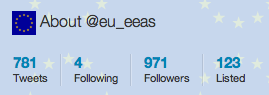
At the time of writing the EU’s European External Action Service (@EU_EEAS) was following just 4 others on Twitter – all other parts of the institutions, and not even any Commissioners or MEPs. I tweeted this, and it drew sharp reactions from @dicknieuwenhuis who works for the Commission on web comms.
Now let me be clear. I know that doing effective social media outreach in a governmental bureaucracy is not easy. I know that the EU institutions may have less staff for this than regular bureaucracies. I know this stuff takes time to learn.
But come on folks, it’s not as if Twitter is new any more! We’ve all been at it for some time now, governments included. Look at @Number10gov in the UK – 1.75 million followers, and they follow 400k people, and they even reply if you @reply them. It says very loud and clear ‘citizens, we value you, so interact with us’.
@EU_EEAS just says ‘broadcast, broadcast, broadcast’. Now we have plenty of mediums for that. They are called the mainstream media – television, radio, newspapers.
Ooh, but maybe the mainstream media doesn’t adequately cover EU matters and EU external affairs? Maybe Catherine Ashton’s statement on Tanzania is not front page news, and Twitter can fill the gap? That, I would argue, makes a decent, interactive approach to Twitter even more valuable. For there are communities of interest about all kinds of foreign policy questions on Twitter waiting to be tapped, EU nerds like me who are ready supporters of the EEAS but who are growing disillusioned by the glacial pace of progress, and MEPs and national politicians on Twitter ready to feel part of the public diplomacy efforts of the EU in some way.
So someone in the EEAS comms team needs to get Tweetdeck installed (well, if IT security allows it!) and to keep an eye on it daytimes. @EU_EEAS should be following a couple of hundred relevant people, and should be following hash tags as world issues develop, ready to step in when positions of the EU are made clear. It would not be resource intensive and it would mean – on the web at least – the EEAS could gain favour with a lot more people than it has to date.
My main point has already been taken up by Ron (that it doesn’t say anything that @number10gov follows 400k people) but I’d like to challenge even another point: Making an a corporate Twitter strategy work in my view requires more than installing Tweetdeck and “to keep an eye on it daytimes” – if you do it seriously it can very easily become a half-time or even a full-time job. Especially as replies might need to be carefully thought through and can not be as spontaneous as from a private person.
This doesn’t say that one should not at least try to monitor what is said for example about “Ashton” on Twitter and then decide whether it’s worth responding or not. This could be done on a weekly or monthly basis in the beginning.
One a sidenote: I myself would actually prefer that politicians tweet in their own name (@cathyashton and not @eu_eeas) even if that means that the account moves with the person when the job is left.
Your original points were that @eu_eeas is just broadcasting and not following anyone. It’s like complaining that our “Editors’ Choice” Twitter feed @bloggingportal2 is just broadcasting and only following one other account (@bloggingportal)
The point is that people understand that even on Twitter there are some feeds that are just broadcasting and that they don’t interact with others and we are free to follow or not. The point you didn’t make is that the EEAS could be reactive through other channels (i.e. Twitter accounts) while being able to keep @eu_eeas exactly what it describes itself: “News from the EU’s external action website”.
They are very transparent about what @eu_eeas is for them as we are very transparent about calling @bloggingportal2 “The Editors’ choice (automatic)” and using @bloggingportal to be more interactive – which actually doesn’t work because we editors follow others via @bloggingportal but because we follow them via our own accounts and use @bloggingportal to react to direct questions to this account or to send out tweets that have a broader relevance to EU blogging on issues we noticed as individuals.
In short: My point is that the form of the present @eu_eeas is not the problem but that it may need a more interactive brother and more individuals (beyond Dick) who take note of what is going on.
Two points…
1. There is plenty of ground between 0 and 5000… and both you and I are very much in the middle of that
2. The clue, I think, is to look at how often someone is on someone’s Twitter lists, and whether an account uses public lists at all. Because, in my experience, it’s interaction with smaller, defined groups on lists that really works… but that’s in no way in contradiction to the point of my original post.
My point is that I don’t see it as a numbers game. Either following is used for something (being part of a community, honestly noticing what others write) or it’s just numbers for their own sake.
What sense does it make to follow people that you actually don’t follow? To be very honest: For me, a twitter account that follows more than 5k is the same as one that follows 0, because you know that the figure doesn’t tell you anything about the actual way the account is following.
@Ron – yes, I know that stuff, and I also know people who keep an eye on Twitter without ever even writing anything at all on Twitter themselves. But what’s the point? Twitter is often a numbers game, no-one judges you if you follow a load of people, so why not actually do it?
As for how much notice is taken of social media overall… not too sure on that. I suspect a few at EEAS have an idea, but it’s not generalised.
I prefer officials like Dick tweeting – and there should be more – over an institutional account. The social in social media is about humans. And the problem with an institutional account – if you don’t have a fully fledged team behind it – is to guarantee continuity. It’s pretty difficult having people with 100 other things to do switching in from time to time or trying to understand which of the questions asked have already been answered or don’t need an answer anymore.
And by the way: You should know that you don’t need to follow any person to see when there is @-reply to your account. You should also know that you could follow people on an internal list without actually following them. So maybe the amount of people an account is following is not the best, for sure not the only measure for the amount of people read or the readiness for interactivity.
The question is: Does anyone notice when there is an @-reply to the official account? Do those behind these accounts take note of what is going on in the social media sphere? Do they have to take note via the institutional account or is it enough if they react via other channels?
I personally don’t have the feeling that those behind @eu_eeas don’t take note of what is going on – although I doubt that those behind EEAS have a clue…