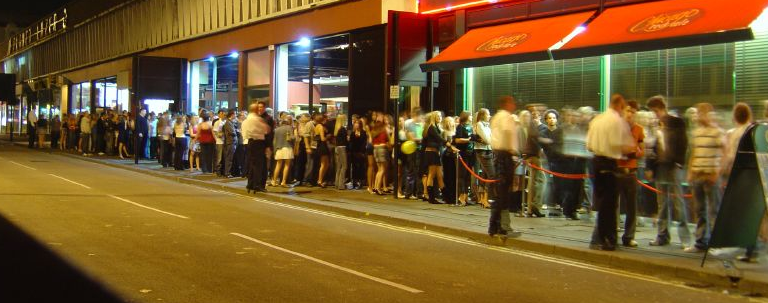
Someone jumps the queue at a crowded Eurostar terminal at Gare du Midi.
A driver does not indicate and almost knocks me off my bike when he turns unexpectedly.
Someone parks a car on a zebra crossing meaning it’s impossible for pedestrians to cross.
A passenger barges into a carriage on the London Underground without letting the passengers off first.
Cyclists that do not respect red lights and mow down pedestrians.
But what do you actually do about these sorts of things? I know for sure I am not the only one who gets annoyed, and in the Eurostar queue jumping case I could see other passengers bristling with annoyance. So I have now simply taken to talking to the people breaking the rules. If those individuals do not know what the social norm is, or they do not read the body language of the others around, then they need to be told what should happen. So a short “on respecte la file ici” to the Eurostar man sent him to the back of the queue. A short “est-ce que vous savez pourquoi les voitures ont des clignotants?” through the open window of a car that’s not respecting the rules might have a small impact. A carefully placed shoulder or bag tends to do the trick when leaving an underground carriage. Some day someone will probably turn around and hit me when I do all of this but it at least has not happened yet.
I still do not get why people behave like this though. The ball is almost always in the other court. The queue jumper is someone who is also sometimes at the front of queues. The driver who doesn’t use indicators is also surely confused by other drivers. Cyclists are sometimes pedestrians. And the underground passenger who barges on also needs to be able to get off. Surely it doesn’t take a genius to realise that to do unto others as you would want done to yourself is not a bad rule for social interaction in cities?
@Anthony – glad someone I’ve taught comes across the blog… 🙂
Apparently beards are bad for business and personally, having once vaguely tried to grow one, and having given up due to itching I don’t think it’s a viable solution for me!
Jon,
We bumped into each other when you ran a session on the EU at the NSG in Sunningdale.
I agree with the “beard” theory. It works for me on public transport like a dream. Beard + shades + headphones bigger than my head + manbag = no one crossing me.
What I hate most, is when you temporarily get off the underground/tram to let passengers on to the platform. Lo and behold, the people who had been waiting before you arrived will jump in before you can get back in. It’s just big city ways I supposes. Thank god I’m a suburbia boy.
Couldn’t agree more. We cyclists are also pedestrians and we also take cabs and should treat everyone else with respect. The things I have seen cycling through Brussels! You forgot to mention double-parking on one-way streets (turning on flashers while running in to get a sandwich at the local sandwicherie) or cars parked in the cycle lane on the corner of one-way roads… so dangerous.
I also believe we need to stand up for young women who are being harassed as they wait for their subway to arrive or as they are walking down the street. It often feels as if I am the only one who does, and to that end and despite being a young woman myself, am faced with violent threats for calling into question those breaking social norms (in this case, the right for a woman not to be verbally harassed in the metro station). If only the others would stand up!
Thanks for the great blog post.
@Jason “Beards: They give you that reckless “this guy looks like he’s given up and has nothing to lose!” look.”
Interesting theory 🙂
@Jon : i tend to ignore those “incivilités” : i am usually reading a book on my mobile phone when they happen (no, I do not drive a bike).
Jon,
Grow a beard! Since I grew a beard 3 years ago, I’ve noticed that sort of stuff happens less to me. I was standing in McDonald’s one evening ( Yes, I know. I’m a progressive liberal, etc, but I actually like Big Macs.) as a crowd of teenagers messed about in the queue beside me. When it was my turn to order, a teenager just barged in front of me from the other queue and started ordering. I stepped in front of him, pointed a finger in his face, gritted my teeth and stared him down. He actually backed out of the queue without a word, as the colour drained from his face, and I ordered, all without saying a word to him. And the very pretty Polish girl behind the counter thought this was all hilarious.
Beards: They give you that reckless “this guy looks like he’s given up and has nothing to lose!” look.
I should speak up more when this sort of thing happens. Most of the time the risk of being thumped is actually fairly low, but it’s the social awkwardness of public confrontation that stops people (at least, it is with me).
The thing is, if people are polite enough to stand in queue then they are often too polite (or too afraid of breaking the social norm of “non-confrontation”) to stop free riders.
Maybe we can start a new social norm. The norm of confronting people breaking norms.