A quick guide to UK election systems of the future
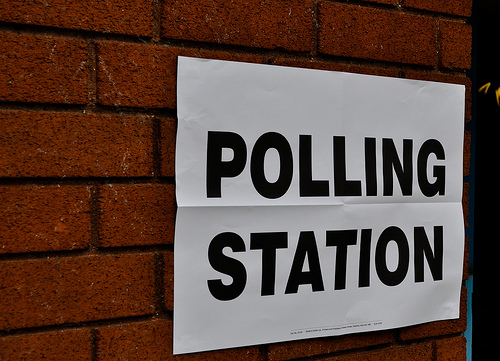
Polling Station - CC / Flickr
I’ve talked to a number of friends, in the UK and elsewhere, about the need for a new election system in the UK. Most of my friends are politics nerds, yet I have been astounded by the lack of clear thinking about the pros and cons of the alternative sorts of election systems the UK could go to replace First Past the Post. So here’s a quick guide…
- Alternative Vote (AV). This is not a proportional system. The one parliamentarian, one constituency system remains, yet instead of a cross for one candidate the voter numbers candidates in turn. A winning candidate needs to get 50% of the vote. Details on Wikipedia here.
- PROS: maintains constituency link, winning candidate needs more than 50%.
- CONS: still impossible for smaller parties, not proportional (and can be even less proportional than FPTP – see this).
- Additional Member System (AMS). This is a proportional system where each voter casts 2 votes – the first for a candidate in his or her constituency, and the second vote for a party. A proportion of the parliament is then composed of constituency MPs and a proportion of party list MPs. In the German Bundestag the proportion is 1/2 – 1/2, in the National Assembly for Wales it’s 2/3 – 1/3. A vote percentage hurdle (5% in Germany) prevents extremist parties entering parliament. Details about this system here. It’s also the same sort of idea proposed by the Jenkins Report in 1998.
- PROS: proportional system, voter marking two crosses makes it simple to understand.
- CONS: creates two sorts of parliamentarians (constituency and list members), constituencies would need to be at least twice as large as currently.
- Single Transferable Vote (STV). This is a proportional system where voters rank their preferences for candidates – 1, 2, 3, 4 etc. – until they have no further choices to make, and voters can choose between different party lists and for individual candidates on those lists. Constituencies are multi-member (normally 6 to 8 members) and each party puts forward that number of candidates. The system has been used for Irish national elections since 1919. Details on the system here.
- PROS: maximises voter choice, allows preference for individuals, maintains a broad constituency link.
- CONS: constituencies would need to be large, system can be complex to understand.
I hope that has clarified things a little… I would personally favour STV, could live with AMS, and would even back AV if that were the only offer on the table.
And if things are still not clear, then pose your questions in the comments! 🙂
[UPDATE] Political Betting has a go at explaining the different systems on offer. More long winded than my piece…
curious1 I can only guess you are from Germany, with your 5% border an all but I can’t understand your hatred towards a proportional system.
I don’t know exactly how your system works but the system we have in Denmark as good as it can get. I would suggest although I have no influence of course, that the British adopts the Danish system.
It doesn’t correspond with any of the systems described above; we have one vote and cross. You can choose to vote for a party or for an individual in the party. There can only be a certain number of representatives from one constituency, but every vote cast to any party member helps the party overall. The constituency’s only role is to decide who will represent the party, as there can only be a certain number of names on the election leaflet. A sufficiently small party can have the same person run in every constituency at once.
Does this mean that the politicians don’t represent an city like Odense or Aarlborg, or in your case, Nottingham or York? Yes it does, instead they represents the people. They represent these that have the same opinions as themselves, and in return the country.
And tell me, why should York be represented but the Liberals or the nationalist?
A winner takes it all system gives the impression that the people of York are fundamentally different from the people of Nottingham. But parliamentarism everywhere is not a collection of individuals, it is a collection of parties, and parties are differences in opinions.
In Denmark it is easy for a new party to get in, we have a low voting border at 2 % just like we have room for a myriad of small parties.
This could be seen as a treat, but also as a strength, not one party can ever dominate a nation just like not one opinion can be shared by all. To try is to create totalitarianism.
A two party system, or a winner takes it all system is of course different from a one party state but not by a long shot.
When your chooses are as limited as they must necessarily be in your present system, your opinion don’t really matter. You can be pro the present government, or against it. If you are against you vote for the different party, if you are for you vote for the governments, but you can never tell the politicians why you are against, or why you are for.
Neither can you decide to create your own party if you have the vision to create a new path, for in a winner takes it all system you are merely static for the opposition party and the government party, not a real third choose.
In Denmark this has happened. Pia Kjærsgaard the visionary founder of the Danish People Party was tired of the present parties and created an alternative. She and her party have had an important say in Danish politic for a nearly a decade now. She did it because she could, the system allowed it, and the people wanted it.
The last is the essential part, for this is what democracy is all about, what the people want. A proportional representational system is better not just different because it allows visionaries like her to actually make a difference. Will Nick Clegg be able to do the same? Only time will tell.
But in Denmark you vote for a party, for an opinion, and not merely for or against the government. We deserve this, and so do the Britons, so does everyone.
It’s not a question of one system over another, it is a question of Democracy over Oligarchy, the people vs. the elite – the choice is yours.
Jon,
For a more European take on electoral systems, see my blog:
http://grahnlaw.blogspot.com/2010/05/fair-voting-system-and-successful.html
@curious1: maybe the result of STV is that instead of having to have a strong Government and a weak Parliament, it is Parliament that is strong as you have to get legislation through by convincing the majority of MPs (MPs, I might add, that properly reflect the choice of the voters). There will be less of the party whips telling their MPs how to vote irrespective of what their constituents want.
A Government formed out of this would have to be a coalition that properly satisfied the needs of its constituent parties, which, by extension, would reflect what the voters wanted.
In essence, all the criticisms of proportional representation are based on complaining that now the people no longer simply choose one of two parties it has made democracy ‘too hard’ and it would be better to just ignore such diverse opinion and try to force such results into the two party mould.
I live in a country with a proportional system (with a 5% treshold) and a lot of people here find its outcomes disgusting. Among its flaws is:
– no direct link between an MP and a constituency; many totally unknown/unelectable in a majority system/ MPs, for a politician it is more important to please the party boss(es) than the voters as a party boss can always give you a seat, unlike the voters (applies to bigger parties)
– a ‘hung parliament’ forever, no party able to form its own government a bear responsibility for its actions ( you can always claim ‘we did not really want to do this, blame our coalition partners ‘)
– even though fewer votes are thrown out than in majority system, many a voter feel their vote cannot change anything
– in the end the winners are not those who got most votes but often the bosses of the small parties that got little over 5 % of the vote, as they are necessary in forming a majority government
So while I understand Britons may not be happy about their system, I do not see that the proportional system is better – it just produces different results – whether they are desirable or not.
curious1 – First Past the Post (the current system) is completely bonkers. Jon gives some examples but some of the outcomes based on polls during the campaign were completely insane – eg one party coming third in public support (with little more than 1 in 4 people voting for them), and on that basis being able to form a government with a robust majority.
I obviously prefer STV but AV plus might do. I really don’t think complexity is a reasonable objection to STV: it might be complex to count but for a voter all you have to do is put 1 against your first pref, 2 for second etc, which really is not complicated.
By the way I think timing of a referendum is crucial – it has to be very soon. In 18 months time when everyone has forgotten and who knows what has happened in the meantime to prevent it, it will be something completely different.
There is also a long and detailed discussion of electoral systems published by the British Academy here: http://www.britac.ac.uk/templates/asset-relay.cfm?frmAssetFileID=9194
This report identifies three questions to answer in choosing an electoral system:
• Whether the elected legislators should represent a defined area and its population – a constituency – within the national territory, plus the size and nature of that area;
• Whether a major goal of the system should be to deliver an outcome that approaches proportional representation – i.e. where a party’s share of the seats allocated should be commensurate with its share of the votes cast; and
• Whether electors should be able to indicate their preferences both for which parties should be represented in the legislature and for which individuals should be elected to represent those parties.
I think there is a fourth question: whether electors should be able to express preferences for more than one political party, or whether they should be allowed only a single choice. Allowing more than one preference actually reflects how voters really think – my first choice is A, but B is better than C – and changes the dynamics of party campaigning. Rather than saying that all the others are equally bad and that everything they say is wrong, parties have an incentive in the campaign to find areas of agreement.
A hung parliament requires them to find areas of agreement after the polls have closed: preferential voting (such as AV or STV above) has them do so while the voters still have a choice.
@Richard – thanks for the link! I very much agree with that fourth question, but I suspect that most of the heads of the political parties don’t!
Oh, and as if that were not enough, the Conservatives were only 16000 votes short of an outright majority – with 36.1% of the vote! See this.
The numbers make it clear:
Conservatives – seats won: 305 (46.92% of the seats)
Labour – seats won: 258 (39.69% of the seats)
Lib Dems – seats won: 57 (8.77% of the seats)
(total seats 650)
Conservatives – vote percentage: 36.1%
Labour – vote percentage: 29.0%
Lib Dems – vote percentage: 23.0%
@curious1 – you might call that special and nice, I call that a result that’s so damned twisted that if it happened in an African country international election observers would be called in and everyone would have concerns that democracy was not functioning properly!
Britain is a multi-party system, like the rest of Europe, at all levels *except* for elections to the House of Commons. Hence election reform is vital to make sure that such unacceptable results do not happen again.
Actually, as an outsider, I do not see why an electoral reform is needed (?) In my view, British electoral system is one of the things that make Britain special and nice …
(Apart from the fact that Liberal Democrats long for a proportional system that would give them many more seats in Westminster – exactly the reason why Conservatives and Labour will not want it …)
And if there is a true need of a reform, how about a variation of the French system – voting in two rounds, if a candidate does not win 50 % in the first round, the best candidates go on to the second round?