Why – if there is a Brexit Deal – Labour MPs should abstain
(The original version of this blog post assumed how ratification would proceed was known and clear – thanks to this excellent discussion with George Peretz QC, Nick von Westenholz and Brigid Fowler it seems that is not completely clear, and parts of this blog post have been adjusted accordingly. This confusion may also lie at the heart of why this discussion is so confused – because others may be making the same assumption I did. For the sake of accountability, the original version of the post is here.)
At the time of writing we do not know if there will be a UK-EU trade deal at the end of the transition period, and we do not know precisely what will be in such a deal if it ever emerges. We do however know that this is going to be a thin and minimal Deal, and will not – for example – prevent truck tailbacks at Dover, or solve the headaches of trade between Northern Ireland and the rest of the UK. It would be – to use the terminology used since 2016 – a Hard Brexit, rather than a No Deal Brexit.
All of that has not stopped speculation about whether the Labour Party will whip its MPs to back a Deal the Tory Government has negotiated, or not, if we ever get to that stage. This blog post examines what the Labour Party should do – and makes the case that its MPs should be whipped to abstain.
First of all, what does Labour actually want on Brexit?
We know Labour wants a Deal much more than it wants No Deal, but beyond that we know rather little – Labour has not advanced much in the way of criteria as to what sort of a Deal it sees as acceptable. The party has its own 6 tests for a Brexit Deal, but these date back to 2018, so are not much use now. We also know that – despite whatever Boris Johnson or the press might say – Britain’s exit from the EU is legally done. There is no way to Remain in the EU. The battle now is over what the future relationship should look like – and how Labour can line that up with its values.
At this stage it is worth ruling out a couple of things. Labour is not and cannot be a Rejoin the EU party – how all the political parties approach that question is one for the medium term, and is to be assessed only once the short term UK-EU relationship is clear. So this blog post is not based on Labour’s medium term approach. Second, even though Labour just wishes the Brexit question will go away, it is wrong to assume that it will. If you think the question ever dies, ask the Swiss, for whom their relationship with the EU has been one of never-ending (re-)negotiation.
So Labour wants a Deal more than it wants No Deal, and how it behaves now should be assessed according to need to shore up the short term UK-EU relationship, but conscious that the UK-EU relationship question will never be definitively answered, or go away.
Now that’s clear, what about the technicalities?
The first question is whether there will be a binding vote in the Commons on the Brexit Deal or not. This issue has caused some confusion, not least because the Commons decided to not give itself a binding vote on future trade deals back in the summer.
The important question to ask – as George Peretz points out – is whether primary legislation is needed to implement the Deal in the UK or not. Were that not to be the case, the Constitutional Reform and Governance Act applies – and as this explains, gives the Commons a delaying power, in 21 day intervals. With 32 days to go until the end of the transition period, that permits only one round, giving the Commons leverage.
Were primary legislation needed instead (and Peretz assumes it would be), the situation is different. Here Brigid Fowler explains that it is UK practice not to ratify unless and until such primary legislation is passed – and that would need the approval of both the House of Commons and the House of Lords.
So no primary legislation means delaying power, but because time is short, this is significant. If primary legislation is needed, the House of Commons would vote on it – and not voting in favour would result in No Deal.
Which then leads us to the numbers.
The current numbers of MPs per party is here.
In these tables, options with Labour abstaining are on the left, and Labour against on the right.
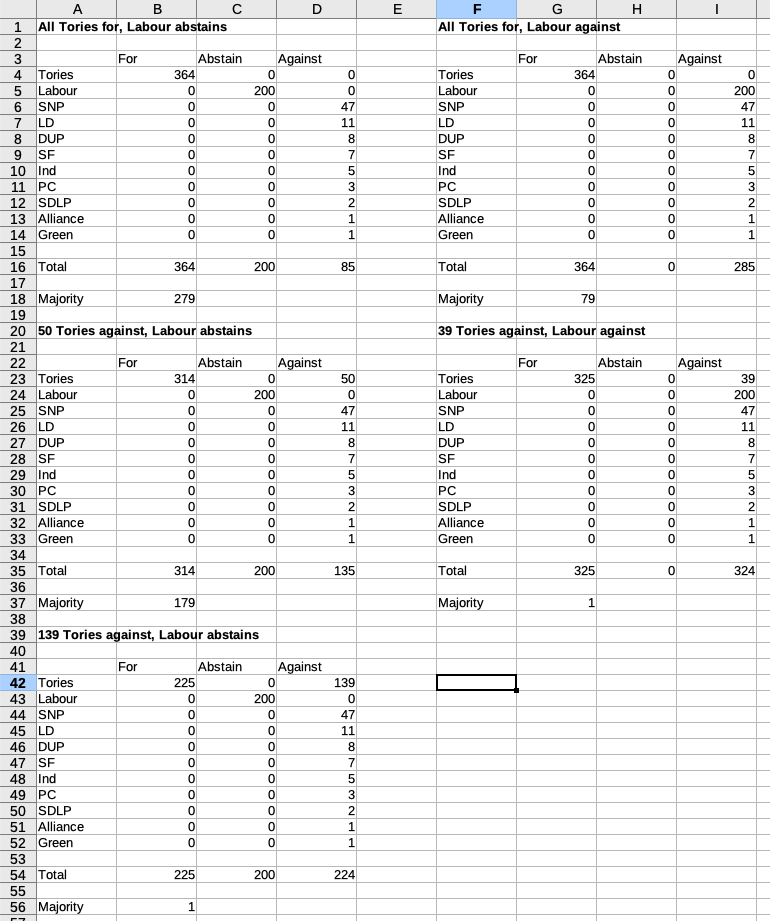
I have assumed – for the sake of safety and simplicity – that all MPs other than the Speaker (who I do not count) are against in all circumstances, and only move the Labour MPs between columns.
If Labour were to abstain, the rebellion in the Tory Party would need to be 139 MP (38% of the Parliamentary Party) to end up with a defeat. With an estimated strength of the ERG rebels of being around 50 MPs, the government is still nowhere near a defeat. Were Labour to vote against a Deal, the size of the rebellion would need to be only 40 Tory MPs.
So with all of this in mind, what are Labour’s options?
Whipping MPs to vote in favour – as Starmer seems minded to do – makes little sense. It plays into the media narrative – that Labour is not trying to reverse Brexit – but at some point this line ought to be abandoned, as it is now 10 months since the UK left the EU. Beyond that it has little to commend it. Starmer, deep down, knows that this is going to be a sub-standard Deal, and that some amount of disruption in January is inevitable. He and Labour would have negotiated a very different Deal to this. And then when Starmer wants to put Johnson on the spot about the chaos at Dover in a PMQs in January, the retort will be “well this is your Deal too!”
At some point Labour has to move on from trying to avoid the Leave-Remain fight, and start to shape a post-exit narrative – about what sort of relationship with the EU would work for the UK, and voting in favour abjectly fails to do that – it lumps Labour in with a Deal that will be sub standard, and prevents Labour being able to move on.
The notion that voting in favour at this stage is important for Labour to win back the “Red Wall” seats strikes me as wide of the mark – it assumes voters are so clever they in 2024 they will remember a vote four years previously, but that they are not clever enough to be able to distinguish between versions of Brexit. And if – as is likely – the Deal is a lousy one, having backed it is going to have thin benefits for Labour.
The idea that Labour has to vote in favour to make sure it passes is clearly wrong based on the numbers above – if Johnson has 139 MPs rebelling against him he is in Theresa May territory when it comes to rebellion in his party!
Whipping MPs to abstain is the logical continuation of Starmer’s approach to Brexit up to now – to continue the Napoleon adage “when the enemy is making a false movement we must take good care not to interrupt him“. Labour can legitimately say that the Brexit Deal was negotiated by a Tory government, that Labour would have done it differently, but is nevertheless letting the Tories own the mess. Abstaining is not dangerous (as the numbers above show) but it gives Labour a plausible way to avoid being tarred with the problems when they occur in 2021, and to pin that failure squarely on the Government. We did not stand in the way of a Deal, but we would have done it differently, can be the line to take – and it would be the right line, given where the Labour Party is just now. It is also the line that pretty much all of Labour’s parliamentary party could live with.
Whipping MPs to vote against a Deal is fraught with problems, for it would require Labour to articulate what it would do instead – and the party is ill equipped to do that. And the Tories would have a field day labelling Labour and Starmer as Remainers were he to take that route. So that is obviously too dangerous. Some pro-Europeans might advocate this one, but it makes no obvious sense as I see it. And were the Tory rebellion to be large enough and primary legislation were to be needed (see above), Labour could be left staring at No Deal – voting against is simply too dangerous.
A free vote is also not a solution for Labour, as once again it would open up all the division that the party has suffered on Brexit over the past four years, and would lead to the accusation that Starmer is even less capable than Johnson of imposing some order on an unruly party. Ethically it might make sense, but in reputation terms there is no gain whatsoever in a free vote.
So that’s how I come to the conclusion that Labour MPs should be whipped to abstain. Not because that is a perfect option, but because of the predicament Labour finds itself in (part of its own making, part made by others) it is the least worst option. It is the position that best reflects Labour’s actual stance, and the political and legal context in which the decision has to be taken. And – most importantly – there is no danger that voting this way leads to No Deal.
Abstaining will not lead to a no-deal scenario, so there is no worry there. But, I think abstention just confuses the electorate. Brexiteers expect Remainers to have what they call ‘losers consent’. So, Remainers like me, have accepted the democratic decision to leave the EU – we have to, the alternative is worse.
Now, the question is, how do we leave the EU. Simply put, it can only be with a deal or without one. If you want a deal then vote for one.
Brexiters will suspect Remainers have not truly accepted the democratic process. And so it continues, Remainers v Brexiters and it will become harder to build on a productive future relationship with the EU. After 1 January 2021 at each tentative improvement on the poor Johnson-deal, Brexiter’s will think it is a move to rejoin and will block every step towards the EU.
We need to play the long game.The mess we are in now is because Tories very successfully did just that.So Accepting No miracle occurs and Brexit happens and people will suffer.The only thing to do is plan for 2024 tho it’s a way off Assume back in power we must then make sure we change from FPTP so never again
“So Accepting No miracle occurs and Brexit happens”
Please stop this false narrative. Brexit HAS happened. The UKofGB&NI left the European Union 11 months ago at the beginning of January 2020.
On January 1st, 2021 the UKofGB&NI leaves the EEA (European Economic Area) — both the Single Market and the Customs Union and loses every economic and trade benefit that membership of those entities brings as well as no longer being a member of various other European Union based arrangements (and losing all of the benefits of those as well).
Not to worry yourself unduly though as the ruling elite including politicians (even Jeremy Corbyn) from all major parties will endure little to no hardship or deprivation, and the consequences will have to be endured by the lower orders — those on welfare, those reliant on imported medicines, as well as the working poor.
A compelling case for abstention well argued. Labour must abstain !
Labour has got to develop during December a strong ‘look at the evidence’ position and then identify what the UK is losing each week after January 1. They should then propose practical policies to rectify problems arising from Brexit. It is pro-common sense rather than Remain.
They have spent four and a half years avoiding demanding that the Government put in place measures to mitigate at least some of the downsides of Brexit.
I know it’s a tough call but by abstaining Labour is passing the buck. How can the Labour Party not have an opinion on one of the most important pieces of legislation in my lifetime? It’s a dereliction of duty on the part of the Opposition.
Hardly a new stance.
They have spent four and a half years avoiding demanding that the Government put in place measures to mitigate at least some of the downsides of Brexit.
Did they make even a token protest earlier in the year over the Government deciding not to extend the transitional period?