Time for some policy-based evidence-making – how the Jacques Delors Institut Berlin ought to work
 Back in my days as a civil servant one phrase dominated UK government-speak: evidence-based policy-making. The essential idea was to gather adequate evidence about a problem, and how various solutions could work, and determine a policy choice based on that. Now of course this was constrained by the ideology of the government of the time, but it should have meant that reports should not have been suppressed higher up the political chain, Theresa May style.
But a think tank is not a governmental institution. The nature of a think tank is to be partial, to push a particular agenda. Yet if anything is to separate a think tank from a pure lobby organisation is that it should have some sort of evidence for its assertions. In essence it needs to reverse the phrase above – to practice policy-based evidence-making.
This is what Open Europe has been doing in London for ages, and has more recently tried to start to do in Berlin. It has an essential line – that the EU should be more market-orientated, less regulated, and that EU-wide democracy cannot work, and that the EU must essentially be intergovernmental and based on the notional democratic accountability of its Member States. Open Europe then dream up things – reports, tables, quotes – that work towards this end, and because they style themselves as a think tank and are clever and consistent in their communications, the media – in the UK at least – laps it up. Their table about Merkel might have been inaccurate, or their recent piece for The Local Germany not exactly accurate, but they persist and they succeed nevertheless.
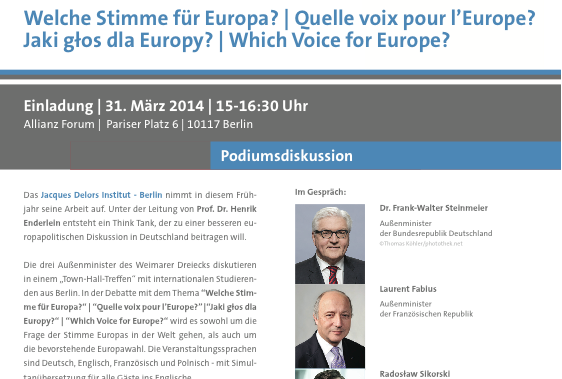
But now in Berlin, with a big launch event next week*, there’s a new think tank dealing with EU matters in Germany’s capital: the Jacques Delors Institut. It’s the German office of the Paris-based Notre Europe. My old friend Bernd Hüttemann tweeted that Open Europe “is not the only campaigning non-Germany think tank in town now”. I would quibble with the implication that there are even German campaigning think tanks in Berlin, but Bernd’s point that the Jacques Delors Institut could become a campaigning think tank would be very welcome. We have plenty of evidence about the problems the EU faces, but little in the way of pointed, media-savvy work to set the political agenda in a way that strengthens the EU, rather than seeking to limit or unravel it.
So what should the Jacques Delors Institut actually do?
Firstly, it needs an agenda that can stand alone, and that this agenda needs to be simple and positive. That economic integration in the EU works, and that it is a balance of free markets and regulation. That intergovernmentalism does not work. That EU-wide democracy is possible and desirable. Nothing that it should does should distract from these aims. Everything it does should be digestible for a half-knowledgeable policy maker or politician – it should not be excessively academic.
Second, unlike much of the traditional pro-European establishment, it should specifically not focus on populists, nationalists or extremists. We have plenty of critique of why UKIP / Jobbik / AfD / Grillo (delete as appropriate) are wrong. What we do not have are positive ideas for reform that come from the responsible centre. The Jacques Delors Institut needs to set its own course, not mirror or become embroiled in fights with the likes of Open Europe.
Third, it needs the very best multi-channel, multi-language communications strategy. It needs to understand the interplay between traditional and new media, and how the latter can shape the mainstream media narrative. In this context it needs to have strong characters who can shape a debate, and become known. Henrik Enderlein, the boss of the Institut, has a good academic record as far as I can tell, but his web comms leave a lot to be desired! Is he someone you can put up against Mats Persson in a debate?
So that’s how it could work. If it doesn’t do that then the Jacques Delors Institut will end up grouped together with a bunch of other pro-EU think tanks of questionable use.
[UPDATE 1425]
Christopher Howarth from Open Europe has rather delightfully proven my point with this tweet:
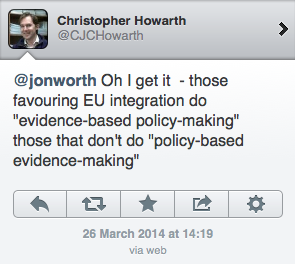
Nowhere in this blog entry do I say the pro-EU side is engaged in evidence-based policy-making, and indeed in the very first paragraph I allude to my cynicism of the whole concept anyway. So take someone’s words and twist them for your purposes – yes, that’s Open Europe.
* – I have been invited to the launch and will tweet it using the event tag #voice4eu, and know one member of staff at the Jacques Delors Institut. I have no professional affiliation with them.
re: conceptualisation of think tanks
Meaning of tt has changed significantly in the course of the last decades. First generation of tt was characterised by their distance to ongoing political affairs and used sound scientific research methods. In the 1970s, the type of advocacy tt emerged. Their purposed is to provided material—ideas, arguments, analysis—that help to implement certain political policy directions.
There are four core functions of think thanks in the political process: production of ideas; information diffusion; network; recruitment and transformation of elites.
In contrast, most academic research organisations only produce information and knowledge and hardly ever provide information for direct use in the political sphere.
Hi Jon, have to say I’m disappointed by this post.
Obviously you’re free to disagree with our policy recommendations and present your alternatives but it’s really not fair to accuse us of “dreaming stuff up” as all our research is based on verifiable evidence and clearly referenced – you’re welcome to point out concrete examples of where this is not the case.
Of course there are different ways of interpreting the same evidence and reaching wildly different conclusions off the back of it – e.g. should flaws in the EU policy making process be addressed via more powers for national parliaments or for the European parliament, but that doesn’t change the fact that the underlying evidence is objectively verifiable (turnout in elections, polling of public attitudes towards national/EU institutions etc).
With regards to the Anglo-German bargain table it was not an attempt to play ‘Merkel speech bingo’ – to apply your own standards, nowhere did we suggest that – but it was our analysis (backed up by a detailed report) of were the UK and Germany *could* agree on EU reform. I think that was obvious to most people, including yourself if you’re being honest.
More broadly you seem to be suggesting that despite us “dreaming up” stuff, we somehow continue to thrive. Which must mean that most of the people who follow this debate in the UK and indeed across the globe (as you know our media hits are spread across Europe and beyond) are somehow intellectually limited in that they are easily taken in our shallow yet snazzily communicated material – is this really your view?
Finally, regarding your conversation with Vivien above, there is no organisation that operates in a political vacuum. Every organisation, even the more academic orientated ones, pursues a certain agenda no matter how implicit – we on the other hand are quite open and transparent about our broad vision for EU reform.
@Elina – I agree re. the combination of vision and evidence. As for whether any think tank would actually *want* to employ me is a rather different question.
@Vivien – some fair points, but that would mean these sorts of organisations are more research institutes than think tanks. Chatham House helps us understand politics, but I do not know what its end game is. Of the ones you list I think Bruegel is the only one that approaches being a think tank as it does have an agenda to improve economic governance in the EU and the strong characters who established it and others now running it.
As for the blurring – yes, you are right. But what do you want to do? Fight? Or leave the field free for Open Europe?
The difference between university (say academic) research and think tank research is that think tank research is policy-oriented. The former rarely is. Moreover, in universities, you have less freedom to publish in the sense that you need to follow a fairly establish and quite rigorous framework, which you don’t have to do in think tank papers.
Would you say that Chatham House, the SWP, Ifri, Bruegel etc. are research institutes? If so, it means we, in the think tank community, really have to do a better job at clarifying what we do and who we are. My issue with your perspective is that I don’t see how a think tank could inform a public debate if you already know what its conclusions are going to be! Again, that’s an advocacy group. The lines have been so blurred in the past few years.
According to my understanding most of the think tanks have some kind of agenda or affiliation. I work at the Finnish Innovation fund and we just made a global scanning on think tanks, how they work and what are their methods. For a think tank it might be extremely tricky to try to push out solution if you don´t try to bring transparency into your background assumptions, which one almost always has. This has got to do with how they see the societies, people´s role in it or the topic they conduct research on. Another point I would like to add is that evidence based policy is a good thing but we also need to see that there are areas where you have to also have visions and courage to make these visions happen in politics, even when there is no evidence yet. If you always base your policy on evidence, it makes visioning empty. In that case man would have never been to moon, we would have not given women the right to vote in the first place or started the European Community in 1951. So think tanks should also be able to produce visions, which might not always have the full evidence behind them. Then the process how these visions could be implemented should be as transparent as possible.
But Jon, any EU think tank would benefit for having you working for their strategy!
Vivien – you nail precisely the problem with your incorrect definition. A think tank without an agenda is just research. And a better place for that is in an academic institution – like a university. If the Jacques Delors Institut is going to be like that that, then it will serve no purpose beyond what a dozen or so stodgy think tanks do on EU matters already.
Jon,
Your definition of what a think tank is puzzles me: “But a think tank is not a governmental institution. The nature of a think tank is to be partial, to push a particular agenda. Yet if anything is to separate a think tank from a pure lobby organisation is that it should have some sort of evidence for its assertions. In essence it needs to reverse the phrase above – to practice policy-based evidence-making.”
A think tank should not be partial and should not push a particular agenda. Otherwise, it’s called an advocacy group… If you’re partial and push a particular agenda, chances are you will suffer from confirmation bias (only seeking information that reinforces your point of view). It may turn out that all your evidence-based research points to a similar direction, but it shall not reflect a pre-established stance.