The chasm at the heart of European politics
At the start of last week I was a guest lecturer at Roskilde University, presenting about blogging and the EU. You can find the slides I used on Slideshare here.
In the discussion following the presentation I was posed a question by Angela Bourne, one of the academics that had invited me. Her assertion was that I presented a very EU-Institutional concept of blogging, and asked what connection – if any – did my blog, or the blogs in BloggingPortal.eu, have with alternative social movements such as Occupy, 15-M etc.? The answer, in short, is none, at least from the blogs I follow closely.
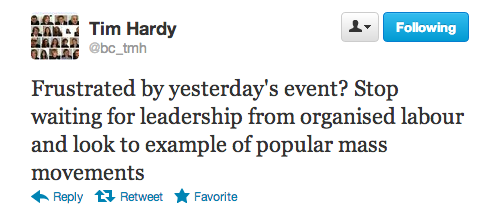
But that set me thinking, inspired further by this tweet from Tim Hardy attending the 20th October march in London:
What if, essentially, we are just looking in the wrong places for the solutions to the problems of legitimacy at EU and national level? Are we facing the situation where political parties, traditional NGOs and trade unions are beyond repair?
In this regard the recent work by Mary Kaldor on what she calls ‘subterranean politics’ is interesting. A summary of her work is here (inc. a disturbing table on trust in political systems), and the full paper is here. I am especially struck by the words Kaldor draws in from Pleyers: the idea of prefigurative action, described as the attempt to practice the kind of democracy that the participants imagine. For this is surely the heart of the problem in party politics at all levels – party politics is not conducted in the way we conduct the rest of our lives. Most of us engage with party politics and with elections because we feel we ought to, not because the processes are ones that we can relate to any more. This becomes even more problematic in the networked world – where connections between people are easy and swift, yet connection to the political system feels more distant than ever. It’s clear that even the German SPD’s candidate for Chancellor still has a lot to learn.
This further passage from Kaldor et al’s full paper is also interesting, setting this problem in the wider context:
What we discovered was a fundamental mismatch or chasm between what we describe as mainstream politics, elite trans-European policy making circles, including what are sometimes depicted as ‘expert’ activists, and what we are calling subterranean politics – various forms of grassroots activism and protest.
At the level of mainstream politics, the crisis is portrayed primarily in financial terms and there has been a proliferation of conferences, reports, appeals and manifestoes that put forward proposals about how to reform the European Union and save the Euro.
At the level of subterranean politics, our research revealed a shared trans-European concern among very disparate groups across Europe about the failure and indeed corruption of political elites, especially but not only at the national level, and about the lack of meaningful participation. Moreover, among the groups and individuals engaged in subterranean politics, what was remarkable was the invisibility of Europe; the absence, by and large, of any mention of Europe, let alone debates, initiatives and campaigns.
There are related works by Counterpoint and Demos that look at why disaffection from the mainstream can also lead to a rise in support for populist and xenophobic parties, rather than the subterranean politics that is the focus of Kaldor’s work.
So here is the chasm: between the way the party political mainstream conducts its business, and the way people go about their everyday lives. The disaffection from the mainstream is not an anti-politics sentiment, but more a feeling of powerlessness and distance. Many politicians at national and EU level pay lip service to dealing with this disconnection, but have any of them really understood the problem in an adequate way?
@Jon. Conference details here; http://www.lesrencontres.eu/index.php?option=com_content&task=view&id=112&Itemid=89
Aimed at those working at city level rather than national, but as more commentators point out “action” is mostly taking place at city/regional level compared to the slower moving national level. The UK’s hollowed out local government system puts it near the bottom of this pile regardless of the current cuts round. As a member of the selection panel for European Capitals of Culture I see just how many cities are both seeking to generate prosperity but increasingly turning inwards even from capitals let alone Europe. Very different approaches from EU-15 from the newer members. MK makes the strong point early on: the dissonance between being European and the relationship with the institutional concept of the EU itself. It’s a normal finding from most nation branding surveys: people can very easily separate views about a country and its people, culture, sport, jobs, opportunities etc from their views about its government.
@Steve – what’s that event? Because there are a few people from the political / blogging scene in Paris I know who could be interested.
@Eurocentric – I’ve tried having a foot in both camps, and it’s hard, if not impossible. It is only possible to put your ideals to one side to succeed in a party if you have your eye on a prize of some sort that will make the whole engagement feel worthwhile, and to do that you have to sacrifice a lot of your capacity to be human. I am hence not sure we should encourage more people into parties – the parties have been trying that themselves for decades and it has not worked, and I cannot see how non-party people could advocate for parties. There are some sorts of activist movements for European democracy (JEF is one, and I spent 6 years as a volunteer, heavily involved there), but they are small and nerdy – can this ever become a mainstream pursuit?
In short: I see the downsides of all possible ways forward, and the upsides of none of them. Hard.
Some very interesting points, but how could political parties and government structures be brought closer to the public? I’m not sure how far they can reform themselves to bring themselves closer to ordinary people – I think that that position casts the public in too much of a passive (perhaps consumerist) light. Maybe the chasm just needs to be spanned by people with a foot in either camp, and we should encourage more party membership and see it as a form of critical engagement.
Also, I wonder what this says about the Euroblogosphere & European politics that there isn’t much of a civil society campaign for democratic reform of the EU institutions or for a particular Eurozone structure. Maybe the Euroblogosphere needs to have a bit more of an activist dimension? I’d be happy to join a pro-active campaign on making the EU more democratic or for a more just Eurozone. (I know that there are several groups out there, but few seem to be actively campaigning or trying to enlist greater public support…).
Jon, interesting topic. I’m speaking at a conference in Paris in November on similar lines, coming at it from culture rather than blogging but essentially the same issue: the great EU(ro)-disconnect. Matthew Taylor at the RSA is another good source as well as MK with his four cultural theory categories.