Politics for people, or let’s bash the bankers?
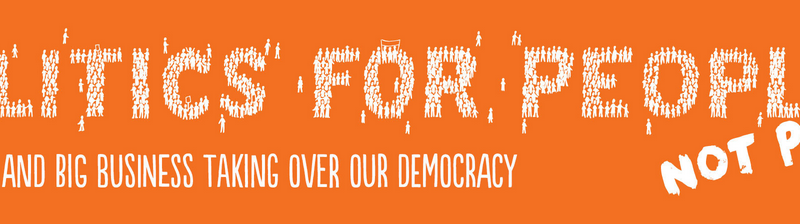

With the European elections now just over a month away, every campaign organisation in Brussels is coming up with its demands for wannabe MEPs before the election. ALTER-EU, the campaign for lobby transparency, has released its campaign site entitled “Politics for People“, with the subtitle “Stop banks and big business taking over our democracy”.
For me the subtitle muddles the issue spectacularly. Perhaps, like the Right 2 Water petition, the emotive language draws people in. But for me it is overdoing it.
If you click though on the website to the actual demand from a citizen to a wannabe MEP the text reads as follows:
Please pledge that, if you are elected as an MEP, you will stand-up for citizens and democracy against the excessive lobbying influence of banks and big business.
Sorry, but this makes little sense. What is “excessive lobbying”? And surely no-one could be against excessive lobbying by just one group. It would be impossible to measure whether a MEP had indeed complied with this after 5 years in the European Parliament.
For me there are two issues at stake here.
The first is: do we know who is lobbying whom, and who is meeting whom? That is the basis of lobby transparency. Citizens can then judge whether the behaviour of MEPs was ethical or not. To achieve this the lobby register should be made compulsory (current, weaker, rules are here), and every meeting between a MEP or Commissioner and a lobbyist be documented, and records of all meetings made available in an open data format.
The second issue is whether money buys undue influence in EU policymaking, and what to do about this. The situation is not as grave in EU politics as it is in the USA (more on that here), and successful citizen engagement like Right 2 Water, Hugh’s Fish Fight and the Neonicotinoid pesticide ban show what can be done when citizens are organised. Further, I do fear that the EU institutions are too administratively weak to answer many of the questions the institutions themselves pose, and a revolving door between institutions and the private sector is too pervasive. But dealing with these issues is not the same as bemoaning the amount of money poured into lobbying by banks – if they feel they have an interest to defend they cannot easily be stopped. It is the institutions, MEPs, and indeed then by definition, the electorate, that needs workable and implementable solutions, and the Politics for People pledge does not concretely propose any.
(Note: I know a number of the people who work for the ALTER-EU coalition)
I am part of the Politics for People team (I work for Corporate Europe Observatory) and I wanted to point out that, contrary to Jon’s assertion, we have a lot to say about solutions to the problem of excessive lobbying influence of banks and big business in Brussels.
If you check out this link http://politicsforpeople.eu/en/solution/#02 you will see we make various points, including, top of the list, calling for a mandatory lobby register, as you mention in your blog post. When MEP candidates are invited to sign our pledge, they are sent this list of 6 proposals for reform. We also set out our overall vision here: http://politicsforpeople.eu/en/solution/#01 and put forward some examples of where progressive forces have beaten the corporate lobbyists! http://politicsforpeople.eu/en/solution/#03
And the organisers of Politics for People, ALTER-EU has a 10 point plan for resolving the issues around lobbying and ethics at the EU level: http://www.alter-eu.org/about/demands