Politicians blocking users on Twitter
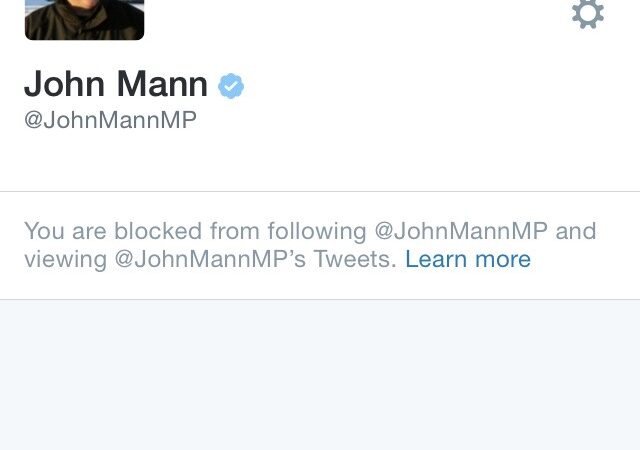
 Yesterday evening I was browsing Twitter, and saw this tweet about serious allegations of election fraud by UKIP from Labour politician John Mann (Bassetlaw) retweeted into my timeline. Oh, I’ll retweet that I thought (I’m on John’s side here, not UKIP’s), but Twitter prevented it – it turns out my main Twitter account (@jonworth) is blocked by @JohnMannMP – see screenshot.
This perplexed me, as I have only ever twice tweeted John Mann – both of these tweets from 27 November 2013 (it required searching to locate as I couldn’t even remember them – thanks Andrés):
https://twitter.com/jonworth/status/405751505627926528
https://twitter.com/jonworth/status/405761689632927744
In these tweets my critique is at least as much levelled at Crick as it is at Mann, although confusing a social democrat with the populist right wing is a bit of an error in my view. But as those are the only tweets I have ever written to John Mann, I can only presume those are the reason I am blocked. I of course cannot tweet John Mann to ask because, well, I am blocked, and hence have no way to reach him on Twitter any more. I am also not the only one to be blocked by Mann, and be perplexed as to why. Are those tweets really reason enough to block someone?
The thing of course is that getting stats on who blocks whom on Twitter, and why, is a bit of a mystery, as – understandably – Twitter does not want to make a list of “accounts that blocked me” easily available. I tweeted to ask my followers for experiences, and replies piled in – Paul Bigland about Michael Dugher, Gary Pepworth about Diane Abbott, Nissemus about Tom Watson, Andy Hicks about Natalie Bennett, and a whole bunch of stories in Brighton (thanks to Jason Kitcat, Richard Dingle and Emma Daniel). Erik Griswold weighed in with a US example, Mathieu with a French example, and Davide Denti with an Italian example from within his own party. Mark Thompson also has an old piece about the issue on his blog here.
I think the heart of the problem here is the misunderstanding of the Block function by some of these politicians. Block is the last step, the most ballistic option, the one that says most bluntly “I am deliberately refusing to listen to anything you say, ever”. It is the ultimate red rag to the Twitter troll, or at least that is the way I see it. I checked (using this tool) who I have blocked on Twitter (and I’ve been on Twitter since 2008, and have written more than 60k tweets!) and I’ve only blocked 16 people, ever, and 14 of those are spammers.
I of course understand why the Block function has to exist, and MPs are subjected to some pretty gruesome stuff on Twitter – abuse, threats, racism etc., and in those circumstances I can completely understand why Block is an appropriate response. But where is the line between abuse, and fair yet pointed critique? Block – to deal with the latter – strikes me as excessive.
This is especially the case as there are other options.
Firstly, I am not expecting John Mann to follow me or really pay any attention to me. I would – through an @-reply – like to be able to raise an issue with him from time to time, and to be able to retweet something he writes if I see fit. Blocking me prevents me doing either of these things, and I am not abusive, threatening or racist in the way I tweet. He could, in other words, simply choose to ignore some of the things that come his way, and leave it at that. If he had, he wouldn’t be the subject of this blog entry about him!
Secondly, if critique from a particular user, or traffic on a particular hashtag, becomes too dominant in a user’s home feed or in their @-replies, then using the mute function is a means to filter out this content. I have dozens of filters set up to prevent tweets about – for example – the British royal family or Margaret Thatcher polluting my timeline, and I can also filter people out of my timeline as well (I do not want to see RTs of Nadine Dorries tweets for example). Some filters are time-limited, others permanent. Yet if someone wants to – once in a while – reach me about one of these topics, then @-replying to me is still open as an option. This explains how to use the mute filters in Tweetbot, my favoured Twitter client.
So, politicians (and indeed anyone else for that matter), before your finger hovers over the Block button the next time, ask yourself this: do you really need to block that person? Or might simply ignoring an issue, or applying some filters, be a less confrontational way to handle the issue?
[UPDATE 18.5.2015, 2200]
So it turns out that mocking a MP about Luis Suarez is enough for a block as well (also see the replies to the tweet).
This blog post may be of interest to you and your readers: http://www.fighting4fair.com/uncategorized/since-when-did-it-become-acceptable-for-public-servants-to-block-ppl-on-social-media-in-the-absence-of-threats-or-abuse-since-now-it-would-seem/
Well done that man.
Twitter works like the MAFIA these days and runs a protection scam and if you say anything negative about any of the big USA corporations who run adverts on Twitter like Microsoft then you will be tweeting to yourself.
They don’t ban you, ho no because you would go away and post whaat you have to say some where where people might read it.
Google does the same and unless your site is a controlled source then you will always remain on page ten unless you pay them some money and talk some SEO bull with them.
UKIP votes have been fixed and allowing the government to get away with it will be a death nail for democracy, regardless of who you vote for.
First past the post voting is not good for slow runnings like UKIP or the Libdems but we need to reinvent the laws of averages if a runner is even slower then you wins eight seats and you only with one out of the 650 seats.
The maths is not easy but the results says that democracy is broken in the UK and if we let them get away with it then it might be the greens or SNP or your party that gets fixed next time.
Hi John,
I had a very similar experience with Maurizio Gasparri who is not a new name in the Italian political scene when it comes to insulting citizens publicly and displaying detrimental social media management skills
http://marcorecorder.com/2013/12/19/when-italian-politicians-block-you-on-twitter-the-story-of-maurizio-gasparri/
@Gary – a fair theory, but I can’t begin to prove that.
@Andy – if you, or someone else, could actually ask Mann on Twitter that might be a start? Because of course I can’t ask it as I am blocked… And I agree – dealing with persistent critique is hard, and when I have been subject to that I have had to resort of personal contacts to allievate it. But yes, I agree more research would be handy.
@Warren – out of interest, did Mute not do the trick? And of course, yes, abusive and threatening behaviour justifies a block, but it seems (admittedly anecdotally) that block is being used by politcians a lot more than that.
I was a “politician” once. I was a local councillor. I did block people. I have a particularly thick skin but the line I had was abusive and threatening comments tweeted at my twitter account.
It’s one thing to disagree with policy, but it’s quite another to be personally abusive and threatening.
interesting issue, and one that would be worth broadening out into piece of research on how politicians (or perhaps more accurately, how their offices). Was Mann’s office trigger happy, not really clued up on how to use Twitter or did they genuinely take offence? We’ll never know. My anecdotal experience of politicians and blocking is that they would generally avoid until it becomes clear that person is not going to stop and is becoming offensive or obsessive.
I wonder if this is mainly an issue with those politicians who enjoy the privilege of a fairly regular broadcast media platform? Such are used to broadcasting their message to millions safe from any feedback via that medium from us mere ordinary types.
If you are asked to appear on say, This Week, you are subjected to a certain amount of pampering and cosseting from the show’s producers. On Twitter there is no such deference, so they block out the critics and avoid any danger of their pomposity being pricked.