“Over 50 political accounts deleted in Facebook purge” – it’s much more complicated
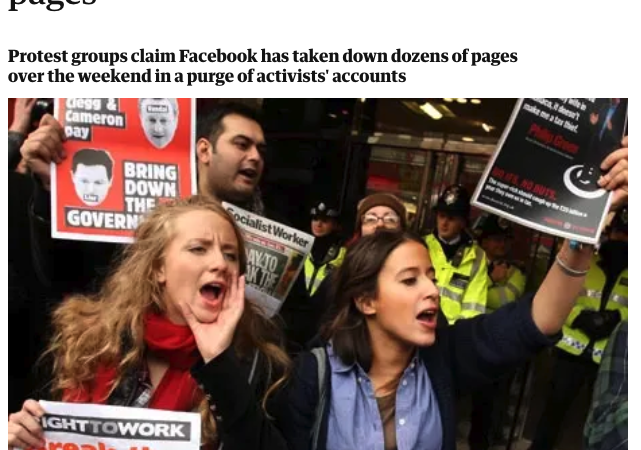
Hell, crackdown by the evil Facebook! Shutting down student protest! In cahoots with the authorities! Even Evgeny Morozov is onto it:
"Over 50 political accounts deleted in Facebook purge" http://goo.gl/YmBWD
— Evgeny Morozov (evgenymorozov.bsky.social) (@evgenymorozov) April 29, 2011
Look folks, this was a problem waiting to happen. Here’s why.
Take the story on the UCL Occupation blog:
There appears to be a purge of political Facebook groups taking place. Profiles are being deleted without warning or explanation.
Am I supposed to trust a rant that mixes up the Facebook terminology in the very first sentence? Therein – I think – is the root of the problem.
The accounts that have been purged are Profiles – i.e. organisations that behave as people on Facebook. The UCL Occupation one – still in existence for now – is still up, but a bunch of other have been deleted. Some more are listed here at Open Democracy.
In short there are three main ways to be on Facebook:
- With a profile – intended for real people, with a name
- With a group – a small to medium size group of people discussing something
- With a page – ‘Like’ something to get news updates from it
As far as I can determine no groups or pages have been deleted, only profiles, and all the profiles were not individual people, they were being used by organisations. Not only is this stupid (as I’ve previously explained here) but it violates the Facebook terms of service. So no leg to stand on if one is deleted.
Now was the reaction of Facebook right? Probably not – the owners of the profiles could have been contacted, suggestions made to convert the accounts into Pages etc. Just deleting profiles generates a strong counter reaction. Someone undoubtedly informed Facebook of the breach, and got the accounts shut down. Facebook, as a company, has form for these sorts of things – it’s to hegemonic to care about individual users.
But – frankly – I have often done the same, and I’m sure many people have. When political opponents of mine have bee using profiles rather than pages I report them to Facebook. I of course don’t report accounts of organisations I agree with, and just send them a friendly message to warn them.
In conclusion, there are errors on both sides here. The accounts in question broke the terms, and Facebook behaved insensitively, but we should not have expected anything else. The lesson: if you do want to use this unpleasant, money making, American walled garden for your political protests, at least learn to use it properly before you start out!
[UPDATE – 1.5.2011] By the look of it my take on events was more or less correct.
[UPDATE – 2.5.2011] I’ve now found The Guardian’s take on the story, and it’s even more inaccurate than the initial UCL blog post. It’s not that complicated folks!
[UPDATE – 5.5.2011] I had not seen it before, but Facebook now even has a tool to make the conversion for you. So no excuse!
Individuals who choose to not to give Facebook their mobile numbers, or who choose not to provide Facebook with face recognition information on their friends also had their facebook pages shut down.
This is a gross Breach of Privacy. A company such as Facebook should NOT be above the law. In most civilised countries people are not compelled to provide personal information to companies unless they choose to.
Facebook is NOT a government, Facebook is NOT elected democratically, and therfore should NOT be permitted to operate above the law with regardds to Privacy issues,and censorship issues, with regards to arbitrarily dictating to users what personal information about themselves, or their friends, they are forced to provide to Facebook, especially when that information was not required when they initially, and perhaps naively, set up their accounts with Facebook in the first place.
Facebook compells them to give information without warning, when they have bee using the system, without such compulsions, for a number of years.
The US Government should crack down on the abuses of power which Facebook is exerting over people without their consent. Facebook should not be censoring accounts, and should not be compelling users to provide further information, years after setting up their accounts, which they were not required to provide when they initially signed up.
In a world which values freedom of speech and freedom of association, and a world which is currently removing dictatorships around the world through protest and democratic processes, Facebook’s censorship compelling people to provide personal information and removal of individuals accounts who do not comply is unjustifiable and unacceptable.
Well I’ve got an example of Facebook closing down a Group, not a Profile. “Keep Sheffield Station open to the public!!!” was a group with more than 2200 members. When I returned from holiday I found a message at the top of the group saying that it would soon be “archived”. Nowhere could I find what this meant. I desperately tried to contact Facebook but none of my mail was replied to. On Sunday 31st July the group disappeared. How do I get it reinstated? It was not inactive, there had been at least 3 posts in the week it was axed.
We have now created a new “page” but have lost contact with many supporters.
@Jeremy – not sure. I am aware of a few politicians who have tried to approach Facebook to request a change, afraid I don’t know what happened though. It’s high time for Facebook to provide some sensible solutions for this though!
Surely the point is that not everybody reads the terms and conditions in full, so doesn’t realise this is the case, and that at the very least Facebook should offer page conversion as standard in all such cases, with a reasonable period of time prior to deletion/suspension?
As it currently stands what is someone who realises they’ve set up an ‘illegal’ profile meant to do – if they ask to be converted to a page they might get refused and deleted.
In these circumstances defending Facebook while telling activists they’re stupid for not reading the small print may be technically correct, but it also fails to take Facebook to task for giving a shoddy service to users who have made honest mistakes. It’s also slightly lacking in solidarity, an oldfashioned but useful concept 🙂
Fix your site, it serves bollocks to TOR users. Or at least, that is what I just got…. a message telling me to turn on javascript and some bitching like Google does when you try and anonymise yourself from their data-rape. No fucking way am I executing code from an unknown source! Though a page reload, and I got the content. So whatever you are trying does not work, and just costs you more in bandwidth.
I also do not want to be tracked by Facebook, Topsy, Klout, Twitter, or Flattr, and so will not turn on JS on the request of some blog. Get over yourself!
Indeed, one should be wary of using Facebook – but that’s all the more reason for publicising stories like these, so people are aware of the dangers.
Facebook could have a T&C that says “We reserve the right to be complete arseholes”. But just because they have a right to do so, doesn’t mean we shouldn’t criticise such actions.
Facebook is a confusing mess – a situation where groups commonly set up profiles, but then randomly a load of such profiles are deleted apparently without warning, is not a good way to run things (especially if they are only groups of a particular political orientation). Just because some of us already know that Facebook are poor on this, doesn’t mean everyone does – all the more reason to publicise.
As an individual, I dislike the “pages” for groups which have to be “Liked” – because then, even though I set my profile to be private, Facebook ignores my preferences and still puts the pages I’ve “liked” on a public webpage.
Why then did Facebook close the event pages (well, I know of one for sure so suspect more) of planned demonstrations?
Thought you were just trying to sweep it under the carpet 😛
We always try and use our blog, but naturally facebook is fantastic for mobilisation and we would be stupid to ignore its possibilities. Naturally we accept the risk and act cautiously backing up files etc.
It just is an opportunity – this – to point out to the public how these guys act and how facebook is not necessarily your friend!
@Alex – I don’t deny the timing is odd and have said so. But as I have remarked if I were Guido Fawkes, or someone like him, I would have reported all these organisations, just in the same way as I report my political opponents who use profiles for the wrong purpose.
Also don’t get me wrong – I am on the left, have also done my fair share of occupations, marches etc. It’s just on all of this the wrong choice – using a Profile – made it easy for whoever the opponents were.
@Fleabite – I’ve replied to Luke on this. If events were organised by profiles that were suspended the events will be suspended too. If Groups or Pages were deleted then please provide evidence. I have not found any.
@Alex – it is censorship. But what the hell do you expect from Facebook? The rules are not geared up to use it as a civic or political space. It’s a private walled garden, and you enter it on their terms. Anyone using a profile for an organisation is asking for trouble. A breach of the terms of service just makes it easy for them to delete you. Be more savvy for goodness sake, don’t make easy for them!
If you, and any of the other protest organisations impacted by this, care about this issue you should also be making the case for an open and fair Internet.
And as UCL say themselves
“It may well be that these groups are technically in violation of Facebook’s terms of agreement, but the timing – on the royal wedding and May day weekend – is deeply suspicious” UCL Occupation
This is a story that would struggle to get into the mainstream media on a quiet day, whereas anti-cuts protestors are a lot less likely than the public as a whole to be distracted by a royal wedding.
So if the day has been chosen carefully, I suspect the intention was to ensure that the news spread through the anti-cuts movement as quckly as possible.
Bull. Facebook only moderate when they are required to or when it suits them. They may be cases of breach of terms and conditions but I don’t see them taking down cat profiles or all sorts.
Who is it hurting to have a group as a profile? The government and those who the anti cuts groups are angering.
And no @Jon, the owners were not contacted until afterwards… In light of all the noise being kicked up. Maybe they thought Anti-Cuts individuals were especially pro monarch and would be distracted by the wedding.
This can not be passed away as procedure. Its censorship
@Luke – if these events were organised by the profiles that were suspended then the events would have been suspended too…
Not all the groups deleted had profiles. Definitely some of what was deleted was events. I’m told that others were groups and pages. So far they all are activist related and in uk, so until we hear of a diff group being deleted in this same round today it seems clear that this was politically motivated, and not just facebook/police picking the wedding day to bury a story of activist groups getting deleted. No, we shouldn’t be suprised by them doing this, but we should still be angry.
Seems the owners of the profiles were notified, or at least some of them. Makes the complaints even more groundless.
See the comments here http://www.openrightsgroup.org/blog/2011/facebook-takedowns:-burying-bad-news
@Jim – also see this, confirms it http://twitter.com/#!/randomvariable/status/64030489765347328
@Gordon – you might be right. Would be good to read if any of the account owners had any luck finding out what happened
@Jim – no guarantee as to effectiveness of the complaints, but Facebook is not totally immune to pressure
Good post, John. I wasn’t aware the takedowns could be triggered by user complaints. That’s useful to know.
Probably because someone – not necessarily the police – reported all of these pages, knowing doing it now would cause major disruption. If you were someone like Guido Fawkes wouldn’t you want to do something like this?
Well that certainly illuminates the why but doesn’t it strike you odd as to the when? The timing of this is a little odd, why so many in one go in the same period of time as raids on squats and pre-emptive arrests of anti Monarchy activists?