How to make a conference presentation
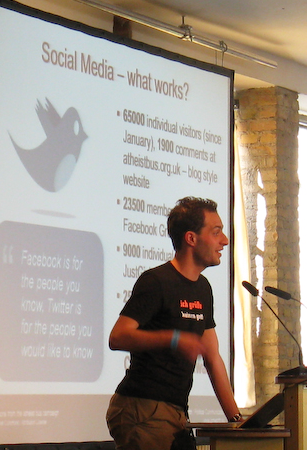
Jon at re:publica 09 - CC / Flickr
I’ve been making presentations to all kinds of events over the last few months, and I’ve been reflecting on my performance and the performance of others. All of this was brought into especially sharp focus by the Quadriga Online Communications conference in Amsterdam on Friday where I gave a 30 minute presentation on the latest trends in online communities. The slides I used for the session can be found here.
So what makes a good presentation? Here are my very personal thoughts on the matter…
1. It’s about the audience, it’s not about the speaker
This may sound completely obvious, but it’s so often forgotten. An audience only needs to know enough about you so as to be able to trust that you know what you’re on about. A conference presentation is not the place to tell your life story. What is the audience going to want from a presentation? What are their interests? What will make them remember what you have to say? Ask yourself those questions all the time before you start. In short, be selfless and not selfish.
2. Prepare well
It’s possible to use the same core presentation for all kinds of audiences, but it’s terrible if it looks that way. So adjust the examples, make sure everything mentioned is current, and also make sure that the presentation at hand is the right length to fit the time you have available. Don’t start a presentation going “Well, I have enough here for 3 hours, but for you guys I’m going to cram it into 30 minutes”. Equally don’t turn up and make it look like you have no plan at all. Either way it looks terribly amateur. Furthermore, if you’ve clearly prepared well then it’s much easier to get away with saying “I don’t know” in response to questions.
3. Work out what your key points are, and try to have no more than 3
What do you want the audience to remember from your presentation? They are for sure not going to recall everything. So try to nail it down to a few key points, 3 if possible. On Friday my points were: Where’s your audience? Non-engagement is not an option and don’t worry about critique, worry about human resources – enough for most people to be able to remember at the end of the presentation.
That’s about as succinct as I can make it…
[UPDATE 25.10.09]
Jean-Paul Chapon, one of the Amsterdam participants, has a good picture of flipchart from my workshop session. He’s a charming guy, and fascinated by Paris and its suburbs (as well as being a comms pro for a large corporate), I’ll be following his blog now for sure.
I use Powerpoint, not because I like it, but because if I cannot connect my laptop somewhere then any computer is sure to have Powerpoint… Keynote looks ace but I have never had time to fully investigate it.
Good advice, Jon, thanks. What software do you use? PowerPoint? Keynote? And do you have thoughts about how to use it?
Good stuff- PST in practice, in fact!
There was someone filming on the balcony, but I haven’t seen it online yet.
Thank you for those, I will definitely add at least point 1 to our guidelines!
I haven’t received them yet as the cameraman is still on his way to Berlin, but there should be a video record, which I’ll be glad to send you as soon as I have it, if the quality is ok (hopefully tomorrow!).
No, I don’t think so… It wasn’t obvious that anyone was filming.
Is there a video anywhere ?
The ever present rule of three…