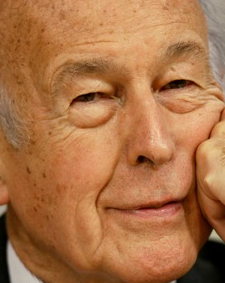
 Former French President Valéry Giscard d’Estaing has spoken out about the UK’s relationship with the EU, and has said that Britain should simply not participate in some policy areas if doing so would be to the detriment of further EU integration. Should be music to David Cameron’s ears because I presume his wish to withdraw from the EU’s Social Chapter would not entail demanding the rest of the EU tears it up too.
But where Giscard really touches a nerve for me is when he speaks about the tactics used by British diplomats (and by extension civil servants) when it comes to the EU, essentially efforts to find administrative reasons to oppose advances in policy. Examples that spring to mind are the UK’s opposition to an EU energy market regulator, the determination that the European Institute of Technology should be limited in scope, and that any EU diplomatic corps should be firmly controlled by Member States and not the Commission.
Yet while it might be possible to argue that the UK is the most administratively conservative of the EU’s Member States (i.e. it always thinks Westminster mandarins know better than Brussels fonctionnaires), where Giscard’s line falls down is when it comes to the behaviour of the other Member States. What Member States are there today that want to move forward in any major policy area and are blocked by the UK? While I can point to some policy areas where the outcome was more minimalist due to the UK I can’t think of one issue recently where a whole policy failed to develop as a result of the UK.
Essentially Britain’s administrative and political approach to the EU aims for the most minimal outcome every time – why can Britain never determine what it wants the EU to actually do, rather that trying to water down what the EU could do? But the idea that Britain is keeping the lid on a great outpouring of integration is ridiculous.
Igor,
sometimes the two things are the same.
There seem a bunch of commenters here who want the European Project to thrive and see the British as a hindrance. What you need to do is kick us out… Please!
Trooper Thompson
“Not at all. It will be (most of) our pleasure to oblige.”
Actually, I trust you to put duty before pleasure.
Igor,
“Asking Britain to step down, accepting an EEA-like membership and let us continentals to look after ourselves, it’s like asking a cat not to hunt rats.”
Not at all. It will be (most of) our pleasure to oblige.
At the end of the day, two-tier Europe, core Europe and the like have been defeated by the Six Founders (one in particular), not by the Uk.
The British position on the Eu, at least as it may be seen from the outside, seem extraordinarily straight-forward and consistent. They are here to stop the engine. Seven prime ministers, three conservative, four labour, who all keep mocking, opposing, sabotaging, watering down, delaying and finally opting out whatever is on the table. It’s not even a plot, you hear it straight from the horse’s mouth: we support enlargment as it will make further integration impossible. As simple as that.
Asking Britain to step down, accepting an EEA-like membership and let us continentals to look after ourselves, it’s like asking a cat not to hunt rats.
The defence community demise, the empty chair crisis, the Constitutional Treaty rejection…hardly “perfidious Albion” is to blame.
What could the Uk actually do, if the continent was really committed to a political union?
Just putting up? Joining, maybe?
Until the Founders heal from schyzophrenia and stop being both the main supporters and the main opponents of integration at the same time, things are not going to change whatever the Uk does, in my opinion.
Igor Guerra
Italy
One difference between the UK and other MS is that we usually have a pre-existing policy on e.g. widgets that needs to be reconciled with whatever the EU proposal is. That’s not always the case for smaller or newer administrations.
It might not necessarily be a perfect policy that pre-exists, but it will have been devised in the UK for UK specificities. So you can understand that to need to change that for a policy that’s EU-wide will not necessarily be popular with Ministers (of whatever flavour) that have other priorities they want to pursue, or maybe don’t see the competitive benefits for UK companies etc. that flow from an EU-wide level playing field.
Sadly there’s no requirement to understand the UK consitutional set-up (which includes EU membership) before becoming an MP, or indeed a senior civil servant or journalist.
Also, it’s always struck me as odd that other MS can take the view that whatever is in their interest is basically the European interest and project that successfully at all stages of European policy development. If we were a bit less antagonistic in our language on the EU, we might be able to be that effective in a positive way.
Ralph and others (Giscard included) might be surprised to know that there are actually areas in which the UK drives EU actions and policies. Might be fun to see if anyone can name any of them…
“why can Britain never determine what it wants the EU to actually do”
What the vast majority of Britons would like the EU to do is bugger off.
Which is why the vast majority of Britons are never asked their opinion and wouldn’t be listened to even if they were.
Jon,
If you cannot think of even one policy area where the UK has blocked progress, why don’t you take a look at every intergovernmental conference (including the European Convention), where Britain’s politicians and civil servants have spared no effort to limit advances by the whole and to opt out of crucial common policies?
By the way, Valéry Giscard d’Estaing’s blog bears the motto ‘for European democracy’, but it and his various appearances are inordinately silent on the subject. In my opinion, we EU citizens need a European Union with real powers on the international scene, but real powers require democratic legitimacy. Time for VGE to achieve some renewal himself.
It’s not the mandarins and politicos who are against the ‘project’, it’s the ordinary people.
If the bureaucrats of this country didn’t enforce their ‘gold-plated’ version of EU regulations with such satanic joy, the EU would be more popular here.
Giscard’s just playing politics. Bashing the UK’s attitude is standard fare from the French. Needless to say, they are quite prepared to hold progress hostage when it’s in their perceived national interest.