British press in petulant Frenchman controls the city shocker
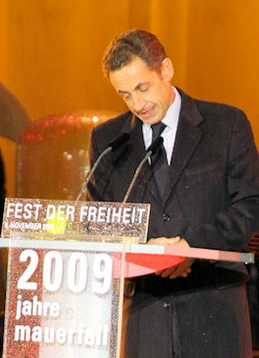
Nicolas Sarkozy - CC / Flickr
The French President can behave like a petulant teenager, yet the British press (and the British Bankers’ Association) seem to not understand that the best thing to do with a petulant teenager is to ignore it.
The Times led today with the headline “Banks blast ‘hostile’ Sarkozy over City rule gibe” and followed it up with “We are in charge now, Sarkozy tells the City” and “It’s déjà vu all over again as Sarkozy takes aim at City of London“. The Evening Standard went with “Darling in rearguard action to stop French pulling City strings”. The BBA’s press release on the matter is equally inflammatory, starting with these words:
The hostile comments of French President Sarkozy have damaged public confidence in the EUs new institutions and raise serious questions about the impartiality of the French nominee to the European Commission, the British Bankers Association said today
Just calm down folks, seriously calm down. And what are those new institutions exactly? OK, the Treaty of Lisbon makes the European Council an institution formally, but they can’t mean that can they?
But I digress… why is all of this a storm in a glass of Bourgogne?
Firstly, Sarko is a loose cannon. What he says does not even represent France, let alone come close to being adopted by the European Union.
Secondly, Michel Barnier, the nominee in question, has been a Member of the European Commission before (Regional Affairs – 1999-2004). I don’t think he was stellar, but he was one of the better members of the Prodi Commission. Why should he be any more partial this time around?
Thirdly the notion that the Commissioners are impartial is rubbish, and the BBA knows that very well. Was Peter Mandelson, Trade Commissioner until 2008, impartial in the way the BBA claims Barnier should be? Of course not. In fact I would bet that they organised meetings with Mandelson during his term to get fellow Commissioners to back policies favourable to UK banks.
Fourth, the Times and Evening Standard articles completely ignore the other appointment in Directorate General Internal Market (DGs are like ministries), that of Brit Jonathan Faull to be Director General – the highest ranking civil servant in the DG. Reuters confirms that news here. So the top politician is French and the top civil servant English. Perhaps not equal, but a fact to consider before having a mis-guided rant.
Fifth, the notion implied by the Evening Standard that Alistair Darling is mounting a rearguard action is untrue. If anything it’s an initiative on the front foot. No legislation has been drafted yet, that is going to take months, and then it will go through the codecision process and be subject to amendment by the European Parliament. Yes, agreed, the UK does not have a veto as QMV will apply, but there are 27 Member States and 736 MEPs in this game, a fact that the UK newspapers have conveniently neglected.
Sixth, why do all the newspapers buy all this pro-City of London crap anyway? Has no-one actually realised that it was the British banking sector that landed us in large part in this mess (or at least exacerbated the mess) and actually legislation to make banks serve the people, rather than the other way around, might not be a bad idea? Or is that about as naive as to hope that the British press might have a go at accurately reporting the EU?
So – in conclusion if you’ve got this far – what now? For sure there will be regulation of some sort. For sure it will have an impact on the City of London. But the UK government, UK banks and anyone else implication should be working diligently, preparing a lobby strategy, and getting ready to make their case in Brussels, just like any sensible people do about any legislation that could be brought up (handy therefore that the Mayor is not closing the London Office in Brussels).
I don’t mind that the UK negotiated to have a Brit as DG, but they got the wrong individual. They have replaced to well proven economist, one of whom is a Brit (David Wright) and one who has fairly pro-city views (Jorgen Holmquist) with someone with no background in finance and economics. If anything this might result in Barnier being even more unchecked during his time as commissioner. Big, big mistake.
i like your comment that those who seek benefit for uk … ‘should be working diligently, preparing a lobby strategy, and getting ready to make their case in Brussels, just like any sensible people do about any legislation that could be brought up.’
It is right that the British people should lobby the European Union for our interests, in fact the people who we are lobbying should be fully in charge of Britain. The time has come where we can no longer control our own affairs and instead we should pass the book on to the bureaucrats within the EU to control our country.
Jon, first of all, have a good time in Africa. Second, I agree with everything you write but I am slightly uneasy about the sudden apparent politicisation of the nationality of top civil servants in Brussels and I think it would be better not to use their nationality as an argument. Jonathan Faull is an excellent and impartial top civil servant, full stop. His nationality doesn’t and certainly shouldn’t enter into consideration. Martin
Jon, you might have noted that Sarkozy is noted for this sort of jibe. He just can’t resist poking people in their sensitive spots. OK, if it gives him a kick: it doesn’t count for much on his home territory (unless it’s the socialists in his line of fire ….!)
There will be 751 MEPs, but not just yet. The extra ones have not taken their seats yet, and the timetable is not yet fixed for that. It’s not automatic after Lisbon. So it’s 736 MEPs for a while longer yet.
Jon, I thought there will be 751 MEPs…;)
This is getting confusing – it’s the Lord Mayor that represents the City of London, whereas Boris represents the city of London… so I wonder how much lobbying his offices are able to do?
I’d also suggest that the penultimate paragraph of this http://euobserver.com/19/29063 EU Obs article is interesting reading.
As a country the UK was well served by getting the High Representative and Commissioner with responsibility for external relations. I still believe that this “double-hatted” post is potentially more important for the EU as a whole than any one of the economic Commission portfolios.
The internal market is based on the rule of law and, as we know, detailed regulation. Still, it is important to follow how Barnier and all the other Commissioners use their margin of appreciation.
Naturally, British businesses, including the financial sector, can see the issues from their own angle of self-interest. Barnier has not been on the internal market job for a day yet, so it is early to judge him on his record. Being French is not a ground for disqualification.
President Nicolas Sarkozy must have felt an irresistible urge to turn into Santa Claus for the British anti-Europeans, handing them a Christmas present to keep them happy for a long time. He must have felt empathy with their worn out arguments and downtrodden airs, when Europe finally has started life under the Lisbon Treaty and is busy putting its modest house in order.
If I understand correctly, the finance ministers were about 26 to 1 before knitting together the (watered-down) deal on financial supervision. Can we be absolutely sure that all the other member states are wrong with regard to the common European interest and that they are only out to destroy the City of London?
The UK Labour government will be at the receiving end of much criticism, until someone starts thinking about the prospects for coalition-building in Europe for a Conservative government, which has burnt many bridges long before taking office.