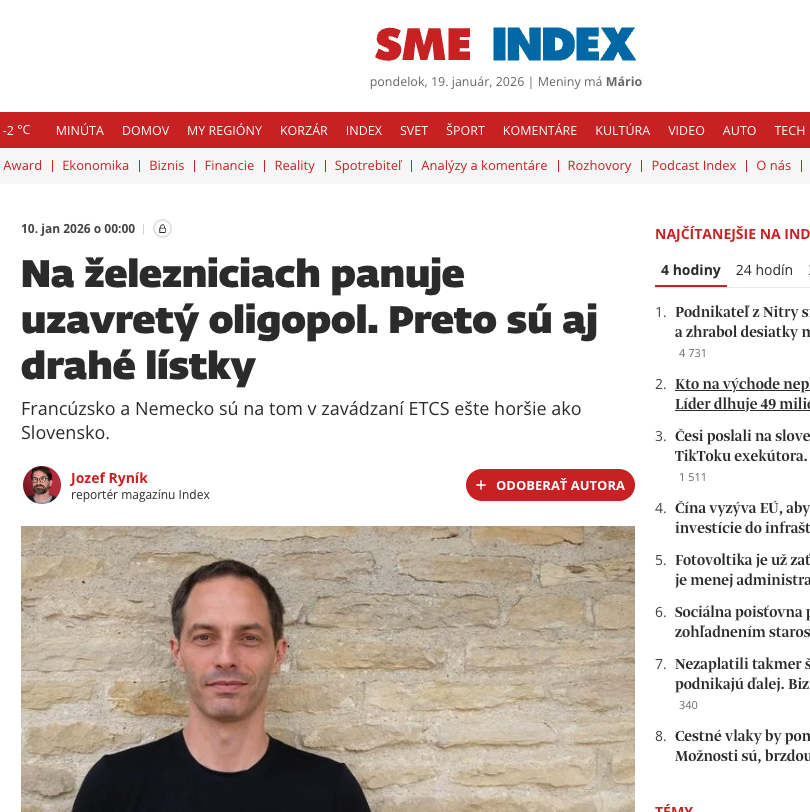
On 20th November – two months ago – I received a media request from the Slovak newspaper SME, asking whether I could help them put the quality of Slovak railways in a European context. Given I spent a lot of time researching Slovakia’s international railways in the summer of 2025 that was a fair request and I accepted. I spent an hour in a video call with their journalist a few days later, and for free of course – a newspaper is not going to pay me for my time for something like that (this is expert commentary, not consultancy).
And then today – much to my surprise – a Slovakia-based friend of mine told me he had found the article which is paywalled and had come out 9 days ago.
This was the first I had heard of it.
OK, I admit this is a slightly extreme case, given I neither speak Slovak nor know that many people there. But this sort of situation occurs over and over when I do media work – when the story eventually appears the journalist does not inform me the piece is even online, and then when it is, it is paywalled and then I cannot access it. At least in the SME case my Bratislava based friend told me and was able to get the text of the piece to me, but quite often I only find an article has even appeared because it pops up in my Google Alerts (having a rare name helps – there are few false positives).
Of course I understand why a journalist themselves might not be able to email all the people whose information they used – perhaps this should somehow be the responsibility of the publication instead? But conversely having given my time for free, the very least I am entitled to expect is to be able to see the text of the piece.
There also ought to be a self interested reason for contacting the expert in these situations – they are likely to post a link to the piece on their own social media channels, and that can then drive more readers to the initial story. In this SME case, as with so many others, the journalist had even found me via social media in the first place – strengthen the feedback loop!
So here is a guide for journalists about how to do it, and not surprise (at best) or annoy (at worst) your expert:
- Do not assume the reputation of who you work for will be a decisive factor in whether an expert says yes or no to your request (I have personally had more bad experiences with the BBC than all other media put together, and often smaller publications are the easiest to deal with) – I am more likely to respond positively to what looks like a relevant request than what is notionally a prestigious one
- When first making contact, explain how what the expert is to explain is to be used, and when whatever article or piece is likely to be published
- If the journalist expects a response from the expert on some channel other than the one used to make contact initially, please explain what that is (if I am sent a request by email, I am going to reply by email unless told otherwise)
- When replying to an expert’s initial positive response, propose detailed time(s) when a call will happen. If I read “tomorrow” then I interpret that as a “that will probably will not happen“. If I read “can we speak on Zoom tomorrow between 09:00 and 11:00 CET” then it’s more reassuring
- If a call subsequently cannot happen, tell the expert – do not leave them hanging around for a call that never comes. Just tell the person straight up it will not happen
- When the piece has been published, email a link to it to the expert, regardless of the language it is in (we all have machine translation)
- If the article is paywalled, make sure the expert can get around the paywall – send them a gift link or a PDF. Do not take offence that the expert is not a subscriber to your publication – you might well be in some market or use a language that is most of the time incomprehensible to the expert
And that is about it.
None of this is complicated. But that I have even thought it necessary to write up this list is rooted in the frustration of many of those points normally not being respected!