How we tweet about Brexit

For years now Twitter has been my main professional social network. It is (or has been?) the way to keep in touch with what is going on in politics, and to seek to influence it in some way. I have also written a lot about it – all gathered here.
But over the last few months it has been getting me down.
Here I am going to try to explain why.
These are the “Top Tweets” of mine according to Twitter Analytics over the past few months:
May
https://twitter.com/jonworth/status/1130793832818323457
Impressions 366,775 | Likes 2,349 | Profile clicks 789 | Retweets 688 | Replies 117
April
https://twitter.com/jonworth/status/1117548935248338949
Impressions 223,381 | Likes 1,683 | Retweets 454 | Profile clicks 307 | Replies 42
March
https://twitter.com/jonworth/status/1110190491386159105
Impressions 547,250 | Likes 4,669 | Retweets 864 | Profile clicks 2,663 | Replies 117
What do all of those tweets have in common? They motivate the pro-EU side of the debate in the UK by showing how idiotic the anti-EU side is. Push the emotional buttons of Remainers, get retweets, these get retweeted further. Rinse. Repeat.
By contrast things like this thread get nowhere at all. A few people asked me for some conclusions from the EP elections in Germany. I obliged, and the research took a fair amount of time to complete… and then no reaction. Is it even worth my while assembling something like that?
Twitter has always been a place for quick responses and frivolous quips, but I think the problem has been exacerbated by Twitter’s more persistent use of algorithms to filter the feed.
Now whenever I login to twitter.com I have to click the stars at the top in order to switch back to “latest Tweets”, but by default – every time – it puts the algorithmically filtered feed back.
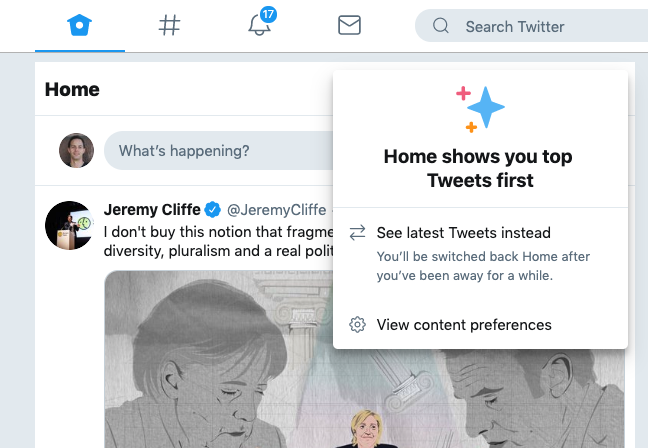
The Twitter App is a little better – sometimes it keeps latest Tweets, but then periodically switches back. Only on Tweetdeck in my browser is it strictly chronological. Twitter’s API changes last year removed key features from 3rd party clients like Tweetbot, making it impractical for everyday use.
These two factors – the push-the-buttons-of-Remainers and the more persistent use of algorithms – seem to mutually reinforce each other. Cheap shot rants like this hang around for days while anything that did not generate a positive initial reaction sinks without trace. And then in terms of information consumption, seeing endless retweets of AC Grayling over-interpreting the European Parliament election results is not really what I want in my home feed.
So what can we do about this?
Use Tweetdeck. Keep switching Twitter.com and the Twitter Apps back to “latest Tweets”. Make judicious use of Twitter lists. Retweet sensible stuff instead of confirmation bias sustaining content. Retweet people who themselves have a small audience, and could do with more exposure. Be aware of the problems I outline in this post and, conscious of that, behave yourself on Twitter in the way you would like others to behave.
(Oh, and to prove the point, I bet that when I tweet out the link to this post, it is not going to become my “Top Tweet” of the month!)
Have you ever heard of Mastodon? Twitter users are probably as much a problem as the Twitter cooperation.
Yes, I have an account on one of the Mastodon instances.
“So what can we do about this?”
Well, what I do – but I’m not trying to influence anyone on twitter – is just manually “follow” the people on twitter that I want to follow. *Without* having a twitter ID. It’s easy. Just type their name or twitter id in the browser address bar. Once you’ve seen them once, the browser can use autosuggest to show it to you again.
I always see their posts with latest first. I don’t see the replies to their posts, which I generally don’t find worth my while – except on threads, strangely enough, when the twitter browser-page will show them.
It’s been a generally positive experience, I have to say. I see what a lot of well-informed people are thinking about what I’m interested in, see links that they in turn find interesting. All with no ads, no pile-ins, no echo chambers, no bots, no trolls.
It won’t be for you I expect, since you do a lot of web analytics on the data. But it’s curious – I appear to have a far more enjoyable twitter experience than most heavy twitter users.