How to make sure the People’s Vote ends up with the UK staying in the EU
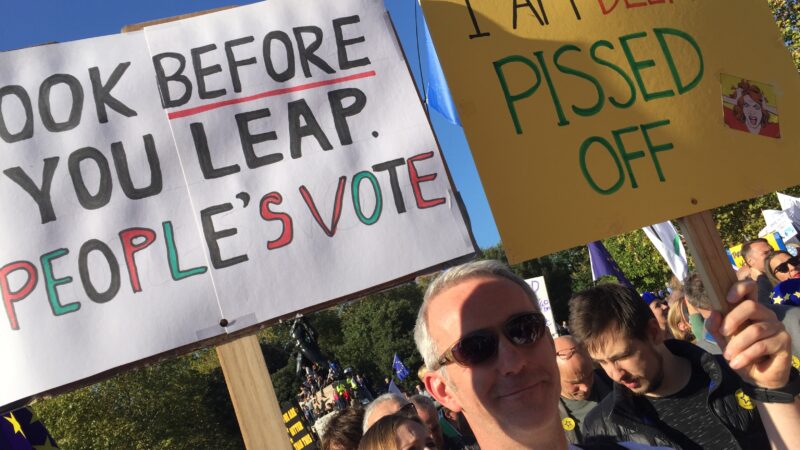
In a fortnight the House of Commons will almost certainly reject Theresa May’s Brexit deal when the so-called “Meaningful Vote” happens. After that the path ahead is unclear, but one of the ways forward would be for a second Brexit referendum – a People’s Vote – to take place. If the Commons cannot decide, put the issue back to the people. It is of course far from clear that the Commons would take that route, but for the sake of the rest of this blog entry let’s assume it eventually will.
I am not much of a fan of referendums, but I see no way of stopping Brexit without another one. The fear of course would be that all of the lies and deceit of the 2016 vote would come back with a vengeance this second time. British politics is even more tense and divided now than it was then. Questions about campaign finance in the first vote are still unanswered. We do not know what the referendum question would even be. We have not debated whether the same rules would apply to who can vote this time around as did last time (16 year olds? Brits overseas? EU citizens in the UK?) And as a referendum would take upwards of 20 weeks to organise (explained by UCL here), and today we are 17 weeks before 29.3.2019, an extension of the Article 50 negotiation period would have to be requested to even allow a referendum to happen.
But those are not actually the most major issues.
The only questions that matter are: can Remain even win such a referendum? And how can it do that?
Here are some ideas about how to do that.
1. Build the most pluralist campaign ever seen
The Britain Stronger In Europe campaign in 2016 felt like New Labour message control dusted down two decades on from Blair. Its rhetoric (with flags and patriotism and aimed at middle England) and message discipline was a turn off for many. Campaigning to Remain in the future needs to be a coalition of all sorts of organisations, each with their own reasons for Remain, each with their own audiences, and each using their own channels to reach people. The rhetoric of these groups, how they choose to campaign, who their target audiences are, is going to vary. That’s fine. Vote Leave and Leave.eu were not on precisely the same line last time either.
Making a campaign like that work – somewhat along the lines of Yes Scotland – requires tolerance of difference, and trust between different organisations. And it would be a major break from the top down campaigning so typical of the British political establishment. But in a social media driven era, and with trust and reach of the traditional media weakened, there is no other way to do it.
So bite your tongue. Trust that pro-EU person who you have been arguing with on Twitter. You and her are on the same side here.
2. Build the biggest grassroots campaign ever seen
On 20th October 700000 people marched through London to oppose Brexit. Get even half of these people campaigning in a further referendum and you would have the biggest grassroots campaign ever assembled in the UK. Don’t get me wrong – there was grassroots organisation in 2016, but this time it needs to be bigger and more intense than it was then. Plus this grassroots activity has to be assembled separate from political parties that are themselves so divided on Brexit. Street stalls, canvassing, phone banks are all going to have to be staffed pretty much only by volunteers. Anyone with time and energy and willing to work for the cause must be welcomed with open arms.
If you are reading this blog post, ask yourself: what are you going to do?
3. Argue for the EU as a good in itself
If a second referendum can even be held in 2019, after the UK has wasted 3 years of other EU countries’ time trying to leave, the UK is going to have to swallow the EU as it is just now. So none of the exceptionalism, none of the demands for special deals please. Brexit is a failure of the UK political class, not a failure of the EU. The EU is a good thing, a democratic alliance that defends the rule of law and upholds the multilateral world order. The west is faced with multiple threats – we only overcome those by standing together. Also note that the EU has been united in the Brexit negotiations – it cannot simultaneously be that, and be about to disintegrate as the Brexiters claim.
4. Do not just deploy economic arguments
Economic arguments did not work last time. And – judging by polling about the the economic effects of different Brexit deals – still have no traction. A full quarter of the British population thinks a No Deal Brexit (the most damaging Brexit of all, economically) would be the best economically. The UK has had negative wage growth (the worst in the G7 and third worst in the OECD) since the financial crisis (FT (€) here), and the areas of the country where this has been felt hardest are not in London and the South East. The UK is an economically divided country, and Brexit is going to make it even harder to solve that. That sort of case has to be made together with other arguments.
5. Downplay the role of politicians in the campaign
The likes of Chuka Umunna and Vince Cable would like to see themselves as princes in shining armour, riding to save the country. But as they are the traditional elites (as opposed to the likes of Farage and Banks that are still seen as insurgents), they have an even deeper trust problem (as William Davies explains in the Guardian Long Read here). The faces leading the Remain campaign then need to be diverse and interesting, and politicians should not dominate – Brian Cox, Gary Lineker, J K Rowling and Deborah Meaden are going to have to be the main faces of the campaign. If you do want politicians then deploy ones like Sadiq Khan and Nicola Sturgeon who have a different resonance to Westminster MPs. And yes, sometimes the arguments these people will deploy are going to make the MPs wince, but so be it – this is about getting Brexit stopped as the main imperative. Everything else can wait.
6. Don’t fight using the frames of your opponents
Does £350 million a week really go to the EU? No. About £170 million does. But it is a big number anyway, and the big red bus with the number on it was an effective campaign tool for Leave last time around. Remain needs to set out its own case – why staying in the EU, even now, is the best option. For every person. For Britain’s and Europe’s peace and stability in the future. For every person’s job. For every young person’s future. And make that case on its own, not spend the whole time rebutting arguments made by Leave. George Lakoff famously wrote a book called “Don’t think of an Elephant” – read quickly before the referendum campaign kicks off.
None of this is simple. But all of these points are eminently achievable. And trying to do all of them could well start in just a few weeks from now.
[UPDATES]
Lots of ideas and critique of this blog post keeps coming in. I will add these points here.
From a friend on Facebook:
I’d also add that the PV campaign should be fronted by those that have changed their mind, rather than be characterised as a “Loser’s Vote” and people will need to… ya know… actually talk to people that are not avid Remainers and treat them like human beings 👍
Maybe bussing people from very solid Remain areas like Bristol West to knife edge places or places with a sizeable shift in opinion since the referendum based on polling.
Both v relevant points!
Other ideas:
I agree – but we should try to get Jeremy Clarkson on board, to counter the likes of Boris Johnson, and to reach a different demongraphic. Clarkson would rip Johnson to shreds in a debate (and I don't even like Clarkson much!).
— Richard Milne (@milneorchid) November 30, 2018
.. or @CarolineLucas surely?
— memneon 💙 (@memneon) November 30, 2018
https://twitter.com/LivinLamelaCoco/status/1068464690857213952
https://twitter.com/PhillWatson1970/status/1068479079857434624
https://twitter.com/anesch/status/1068521171094691840
https://twitter.com/MikeH_PR/status/1066253636492251136
Did you see this from @rolandmcs ? https://t.co/wbGCiSHV2Q
and this from @MikeH_PR?https://t.co/qW1uB8jJBM— Ruth Fletcher 🔶 (@mihe2000) November 30, 2018
Couldn’t agree more with this, although to note that #people’s vote is building/has built a good grassroots network (although of course it can be better), plus I can’t seem to stop thinking of John Major as one of the figureheads of a campaign.
No I don’t know either. https://t.co/76r8HVRyRj— David Sargen (@sargey75) November 30, 2018
we had peoples vote in 2016 you lost get over it and it is the working class who voted leave not the right people like me who have seen there hourly rate drop to minimum wage as mine has from 12+ an hour thanks to east Europeans flooding construction which has made an employers market a small work pool = higher wages an employees market
I very much fear the the title of this article seems like the plan of some of ?our negotiators. Where the 2 options given to us in a referendum are either to remain under current terms or remain within the EU with Theresa May’s deal – ie with limited and diminished sovereignty, no vote, no veto, no get out… We talk of a hard Brexit or a soft brexit, we could talk about a hard remain or a soft remain. I voted to leave, I do not think we will be.
I voted remain out of pragmatism, I never bought into the ‘great civilising project’ schtick, there was clearly far too much open corruption, venality and sclerosis to make that credible. The EU is the devil we know. Two years of negotiations have only exposed that the glue holding the EU together as a seething mass of greedy clients. How do you propose to force that horrible reality back in the wardrobe? There’s absolutely no chance that anyone will ever take EU reform seriously again, now its clear how much power venal clients have to extract economic rents for UK taxpayers.
Agree with above but: https://green10.org/wp-content/uploads/2017/06/Green10_Manifesto.pdf this has looked to same since the 90s. If you look at all civil society manifestos No 8 is repeated repeated repeated. For example I asked if Save the Children would do some work pre ref: Possibly they should be asked again.
Agree very much with your positive suggestions. However, I am not sure we can allow the right to get away their scheming and this means introducing a negative element which we might call Trump.
I have very little doubt that the hard core Brexiteers see leaving the EU as one step towards a political and economic revolution in Britain to import and entrench US style conservatism. The trade treaty they so long for would be vital in this respect and would bind all future governments. Although people like Daniel Hannan cannot disguise their disdain for the NHS and Johnston clearly sees himself as an up market Trump, on the whole the right keep quiet about the way they want to use Brexit. Gove in particular is very good at presenting himself as a progressive while pursuing reactionary policies.
I think that if you are going to an attack an opponent you have to inflict a serious political wound. An assault that does not come off makes you look petty and narky. Exposing the real motives of the right would therefore need to be carefully considered but is not an issue I feel should be avoided.