From Assange to Tehran, and from Tottenham to Cairo – British politicians not understanding the interconnected world
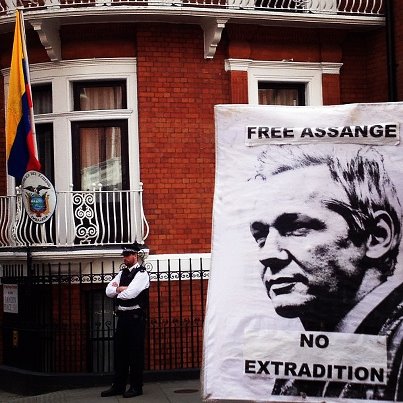
 Steve Bell’s Guardian cartoon has William Hague in the barrel of a tank’s cannon approaching the Embassy of Ecuador in London – reference to the robust wording of the British Embassy in Quito’s letter to the Ecuador government (excerpt here). The threat is that unless Ecuador hands over Julian Assange, then ministers have the power to withdraw recognition from diplomatic premises and enter the building and arrest him.
Others are much better placed than I am to examine the pros and cons of the Assange case itself [for the record: I think he should go to Sweden and face trial], but instead I want to look at the international political implications of the British Embassy’s letter, and the FCO’s hard line on this.
Turn the clock back to 29 November 2011. The UK decided to close its embassy in Tehran because the building had been stormed, and Hague alleged the attack had the backing of the Iranian regime. Protection of Embassies by the host country is a central component of the 1961 Vienna Convention, and Iran was clearly in breach. This is the same reason why UK police protect the embassies of Syria (still) and Libya (previously, when Gaddafi was still in power) against protestors.
The UK then cannot threaten to withdraw recognition of the premises of Ecuador in London and simultaneously complain when its own premises are attacked in Tehran.
The UK government faces the same quandary when it comes to freedom of expression. David Cameron might want to restrict London rioters’ access to social networks (a point developed further by Andrea Leadsom earlier this month) while William Hague urged the former Egyptian regime to protect freedom of expression. Likewise any UK calls for Russia to respect the rights of Pussy Riot and other protestors are rendered less forceful as UK ministers criticise the Human Rights Act that ensures the European Convention on Human Rights has force in UK law.
Do unto others as you would have them do to you is always a decent principle. William Hague, and the rest of the UK government, would do well to bear it in mind more often.
At the risk of appearing pedantic, it’s a boat, not a tank (I think!). It’s a reference to “gun boat diplomacy” and Lord Palmerston.
@Ella – first of all I have no idea whether he’s guilty of these rape charges or not. But the allegations are serious, and have to be dealt with, and the way the European Arrest Warrant works requires that the investigation, questioning and – eventually if it gets that far – a court case has to take place where the alleged crime took place, so Sweden in this case. It works this way as getting an agreement between EU countries on simplified extradition procedures was a *lot* easier than agreement on common criminal law. So – in short – serious allegation in Sweden needs to be investigated and tried in Sweden.
Second, the whole seeking asylum thing is absurd – it’s not as if Sweden is some odd and corrupt power in the pocket of the USA. Indeed I would trust Sweden more than I would the UK in this regard, and Sweden never extradites to countries where there is the death penalty. So why Assange needs to keep fighting this in the UK is beyond me. He should go to Sweden, face trial, be imprisoned there if he’s guilty of rape, and if he’s not then walk free and the battle for Wikileaks and what it does should go on. More people would defend Assange if he cleared his name on the rape allegation first.
I’m undecided, but out of curiosity, why do you think he should go to Sweden?